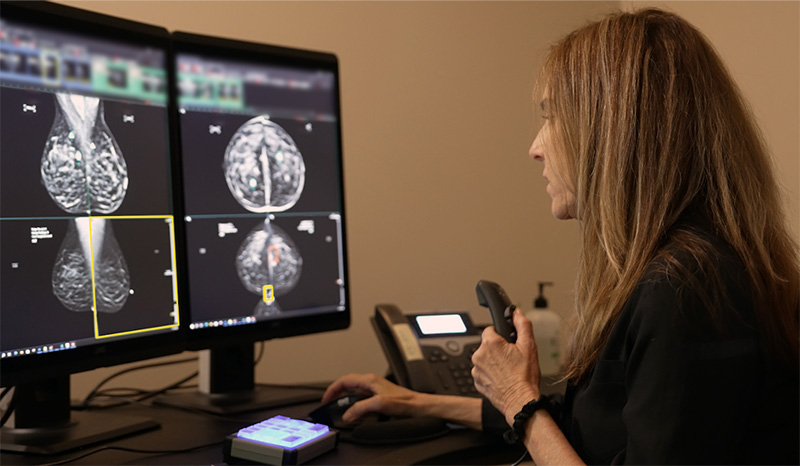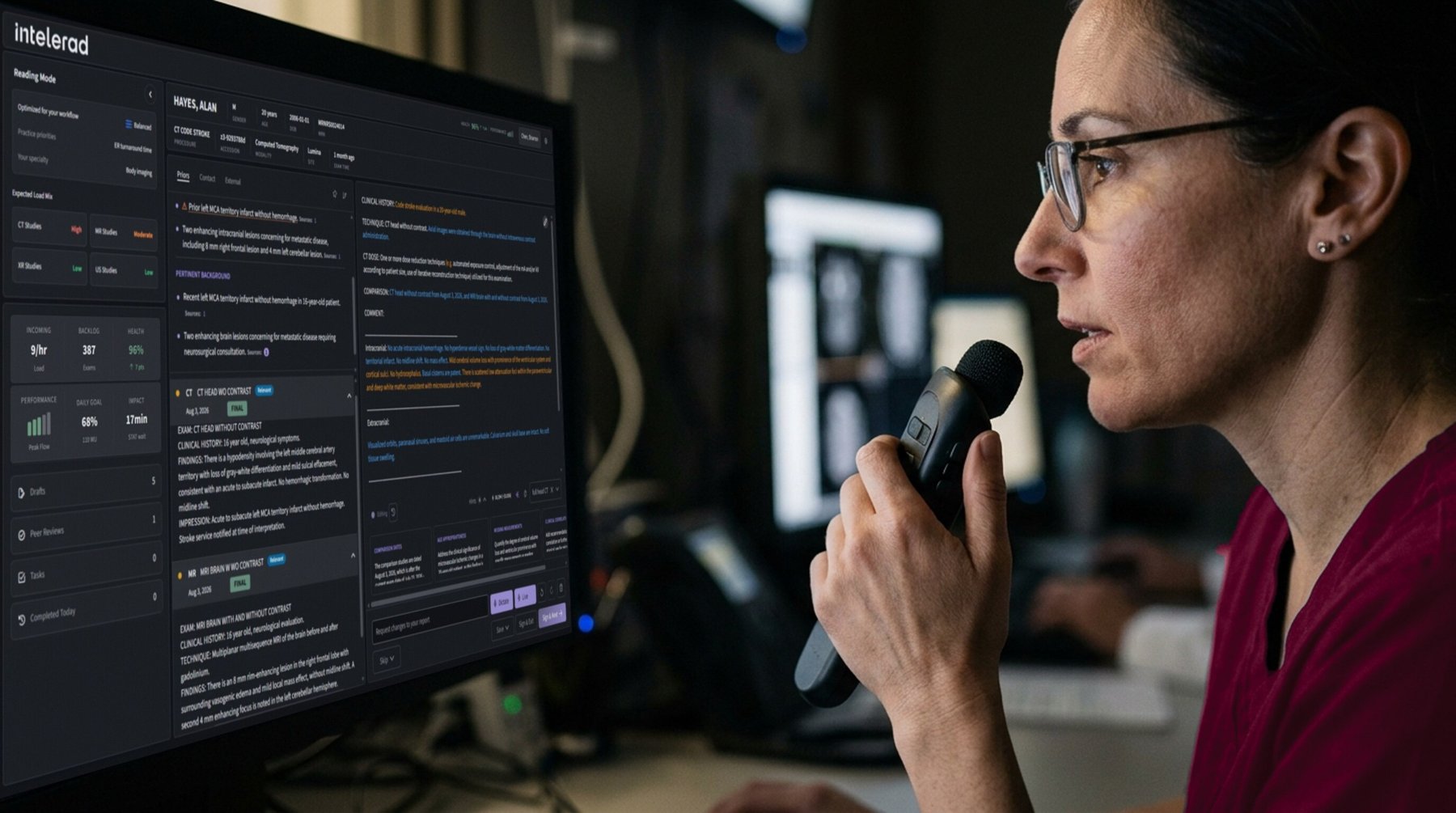
A neuroradiologist opens the next head CT on a busy evening list. Before she looks at a single image, she needs context: the reason for the scan, the last three reports, the surgery two years ago, the oncology note from last month. Finding that across separate systems can take longer than the read itself. Then she dictates findings, edits the transcript, fixes the template and signs. Much of the reading day is assembly work around the diagnosis.
On November 24, GE HealthCare launched InteleOrchestrator Clarity, an AI layer that targets exactly that assembly work. It summarises prior reports and history with links back to the sources, and it turns the radiologist's dictation into a structured report draft. The launch, days before RSNA 2026, marks a shift in radiology AI from finding things in images to helping radiologists write about them.
Detection AI competes with the radiologist's eyes. Drafting AI competes with the radiologist's keyboard, and that is a much easier sell.
In This Deep Dive
- Why this matters now
- What actually happened
- The obvious read versus the deeper signal
- Historical playbook
- The world forming around reporting AI
- Category map and taxonomy
- Evidence Ladder
- Regulation of drafting and summarisation tools
- Capital flows and bottom-up economics
- The HealthTech Investor's Signal
- Counter-thesis
- Forward Intelligence
- The Bottom Line for Radiology Leaders and Investors
Why this matters now
Radiology already has more AI than any other specialty. On the FDA's list of AI-enabled devices, 1,228 of 1,610 entries sit in radiology. Most of those tools detect, triage or quantify findings. Fewer address the reporting and context work that fills the rest of the day.
Workload is the pressure. GE HealthCare's release cites the AMA's 2025 National Physician Comparison Report, in which 45.2% of radiologists reported at least one symptom of burnout. Tools that save minutes per study across a full worklist can matter more to a practice than a detection model used on a fraction of cases.
Language models made it feasible. Summarising unstructured prior reports and turning free dictation into structured text are tasks large language models handle well, provided the output is checked. The design question is how to keep the radiologist in control and the sources visible.
What actually happened
- The product: InteleOrchestrator Clarity, an AI-enabled layer inside InteleOrchestrator, GE HealthCare's enterprise reading workflow, developed by Intelerad, a GE HealthCare company.
- Summaries: Source-linked summaries of available prior reports and patient history within the reading workflow, with links to the underlying information so radiologists can verify the content.
- Drafts: As the radiologist dictates, Clarity consolidates the dictation and available information into a structured report draft. The radiologist reviews it, corrects it, finalises and signs.
- Deployment: Delivered through InteleOrchestrator Cloud and available now to InteleOrchestrator customers, so practices can adopt AI at their own pace on the workflow they already run.
- At RSNA: Demonstrations at GE HealthCare's booth 7330 and Intelerad's booth 6113.

The obvious read versus the deeper signal
The obvious read: GE HealthCare adds generative AI features to a workflow product ahead of RSNA, like many vendors.
The deeper signal: The workflow layer is where the radiologist spends the whole day, so whoever owns the worklist can add summarisation and drafting without a new purchase decision for each tool. Owning Intelerad, which develops InteleOrchestrator, gives GE HealthCare that position in a large base of practices. Drafting becomes a feature of the reading platform, which pressures standalone reporting AI vendors.
Historical playbook
Radiology reporting has gone through several automation waves. Speech recognition replaced transcriptionists for most practices, shifting editing work onto radiologists. Structured templates came next, improving consistency but often adding clicks. Worklist orchestration then routed studies to the right reader at the right time.
Detection AI arrived in parallel. Tools that flag suspected hemorrhage, pulmonary embolism or fractures went through FDA clearance in large numbers, and on November 24 CGI said its AI Head Analysis tool, built with Helsinki University Hospital and Planmeca to detect intracranial hemorrhage on head CT, won EU MDR class IIb certification. These tools change the order of the worklist or add a flag. They rarely change how the report gets written.
Generative drafting closes that gap. Clarity drafts from the radiologist's own dictation. Other companies go further: Korea's Soombit AI drafts chest X-ray reports directly from images with its AIRead-CXR, which received Class 3 digital medical device approval from Korea's Ministry of Food and Drug Safety in April 2026, and plans to show AIRead-CT at RSNA 2026.
The world forming around reporting AI
Reporting AI is splitting into two models. In the assistive model, as with Clarity, the radiologist still interprets the images and dictates; AI handles context and formatting. In the image-to-draft model, as with Soombit's AIRead-CXR, AI proposes findings and a draft from the image itself, and the radiologist confirms or edits.
The two carry different risks and regulatory treatment. Assistive drafting that only reorganises what the radiologist said keeps interpretation with the human. Image-to-draft systems make the first interpretation, so they are regulated as medical devices and face higher evidence expectations. Platform vendors such as GE HealthCare and DeepHealth, which bundles clinical AI, workflow tools and analytics in its Radiology AI Suite, are positioned to offer both over time.
Category map and taxonomy
Radiology AI approaches by what they automate. Entries use verified public information.
| Player or approach | Modality | Physical / commercial target | Clinical maturity | Regulatory pathway | Strategic moat | Key limitation |
|---|---|---|---|---|---|---|
| GE HealthCare InteleOrchestrator Clarity | LLM summarisation and dictation-to-draft | Reading context and report formatting | Available now; one customer quote published | Not stated in release | Embedded in InteleOrchestrator worklist | No time-saving data published |
| Soombit AI AIRead-CXR | Generative image-to-report | Chest X-ray report drafts | Korean MFDS Class 3 approval Apr 2026 | Medical device (Korea); FDA and CE work planned | Direct image interpretation | Not yet cleared in U.S. or EU |
| CGI AI Head Analysis | Detection model | Intracranial hemorrhage on head CT | EU MDR class IIb certified Nov 2026 | EU MDR | Developed with HUS; peer-reviewed work | Flags findings; does not write reports |
| FDA-listed radiology detection and triage tools | Classification and quantification | Specific findings across modalities | 1,228 radiology devices on FDA AI list | 510(k), De Novo, PMA | Regulatory clearance | Point solutions; integration burden |
| Speech recognition with templates | Dictation software | Report text | Mature, widely used | Not a device | Ubiquitous | Editing burden stays with radiologist |
Evidence Ladder
- Physics and signal: Strong for summarisation and formatting; language models handle unstructured text well when outputs are checked.
- Lab proof: Claimed. GE HealthCare describes the capabilities; no benchmark of summary accuracy or omissions was published.
- Real-world performance: Early. One named radiologist describes a more focused reading experience; no time-per-study or error-rate data released.
- Clinical validation: Not shown. No data on whether drafting changes report accuracy, turnaround or follow-up recommendation quality.
- Reimbursement: Not applicable. Value must come from radiologist productivity and retention, not new billing.
Regulation of drafting and summarisation tools
In the U.S., software that analyses medical images is a device. Software that supports clinicians may fall outside the device definition if it meets the non-device clinical decision support criteria in section 520(o) of the Federal Food, Drug, and Cosmetic Act, as explained in the FDA's September 2022 Clinical Decision Support Software guidance. A key criterion is that the clinician can independently review the basis for the output.
Clarity's design, with summaries linked back to source documents and drafts built from the radiologist's own dictation, aligns with that principle of reviewability, though GE HealthCare's release does not state Clarity's regulatory status. Image-to-report systems, which interpret images, are devices and need clearance.
Liability stays with the signing radiologist either way. That makes omission risk, a summary that leaves out a relevant prior finding, the main safety question for drafting tools, and the main thing practices should test.
Capital flows and bottom-up economics
The economics run through productivity. A radiology practice is paid per study read, so any tool that safely increases studies per hour or reduces after-hours editing improves margins or relieves staffing pressure. No pricing was disclosed for Clarity.
Platform position lowers adoption cost. Because Clarity is a layer within InteleOrchestrator Cloud, existing customers avoid a separate integration project. That is the core advantage of workflow owners over standalone reporting AI start-ups, which must integrate with each PACS, dictation system and worklist they sell into.
For standalone vendors, the response is likely to be deeper image-to-report capability, where workflow platforms do not yet compete directly, and regulatory clearances that platforms will need to license or match.
Institutional hubs and buyer dynamics
Buyers are radiology group leadership and hospital imaging IT. Teleradiology groups and large outpatient networks, which read high volumes across many sites, have the most to gain from saved minutes per study and the most leverage in vendor negotiations.
Radiologists themselves are the real gatekeepers. If drafts need heavy editing or summaries miss relevant priors, readers will turn the feature off. Early pilots should measure actual use per radiologist, not licence counts.
📈 The HealthTech Investor's Signal
For investors, the signal is that large imaging companies are making generative reporting a platform feature. That raises the bar for standalone reporting AI companies, which now need clear evidence of time savings or image-level capability that platforms lack.
No stock picks. Watch for published time-per-study and omission-rate data from Clarity customers, U.S. clearance of image-to-report systems, and RSNA 2026 announcements from other workflow vendors.
Counter-thesis
The counter-thesis is that drafting saves less time than it promises. If radiologists must verify every summarised fact against the source and correct every draft, the net gain may be small, and automation bias could let errors through when readers trust the draft too much.
A second risk is homogenisation. Structured drafts built from models may push reports toward generic language, which can weaken the nuance referring clinicians rely on. Practices should check whether reports become more useful to referrers or merely more uniform.
Forward Intelligence
- Whether GE HealthCare or customers publish time-per-study, editing time or omission rates for Clarity.
- Which other workflow and reporting vendors announce drafting features at RSNA 2026, November 29 to December 3.
- Whether Soombit or other image-to-report systems file for FDA clearance.
- Whether FDA updates its approach to generative AI in clinical software.
- Whether radiology burnout measures change in practices that adopt drafting tools.
The Bottom Line for Radiology Leaders and Investors
What changed this week is that a major imaging platform put AI summarisation and report drafting directly into the reading workflow, available now to existing customers. For radiology leaders, that removes the integration barrier that slowed earlier reporting tools.
What remains unknown is the size of the benefit and the omission risk. Leaders should pilot with clear measures: minutes saved per study, edits per draft and missed priors. Investors should expect reporting AI to consolidate around workflow owners, with standalone vendors forced to prove image-level value.
Sources
- GE HealthCare: GE HealthCare introduces a new capability for seamless reading and reporting workflows (Nov 24, 2026) (Tier 1, primary)
- FDA: Artificial Intelligence-Enabled Medical Devices list (Tier 1, regulator)
- FDA guidance: Clinical Decision Support Software (Sep 2022) (Tier 1, regulator)
- Soombit AI newsroom: Series A and MFDS approval of AIRead-CXR (Tier 1, company)
- CGI: CGI and HUS AI solution certified as EU MDR medical device (Nov 24, 2026) (Tier 1, company)
- DeepHealth: Mammo Risk FDA clearance release (Nov 24, 2026) (Tier 1, company)