Somewhere today a coder at a medical group is reading a chart to make sure every diagnosis the documentation supports is on the claim. A few weeks later, a reviewer at the health plan will read the same chart to find diagnoses the documentation does not support. Both now use software, increasingly AI, and each side's tools are tuned to its own incentives. The result is a loop: more codes, more denials, more appeals, more audits. Nobody in the loop is treating a patient.
Charta Health's pitch, backed by a $55 million Series B announced November 10, is to break the loop by selling the same AI chart review to both sides. It has grown on the provider side and is now launching Charta for Payers on the same engine. Below we look at what was announced, why Medicare Advantage audits make payers more receptive, how the competitive field splits by mechanism, and the evidence that would show a shared standard is really possible.
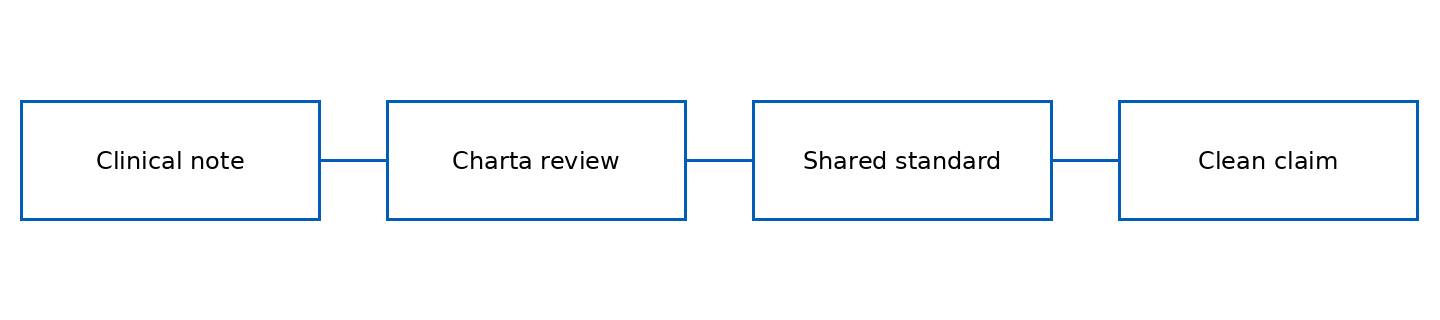
The pitch is not better coding. It is one reading of the chart that payer and provider agree on before the claim goes out.
In This Deep Dive
- Why this matters now
- What actually happened
- The obvious read versus the deeper signal
- Category map and taxonomy
- Evidence Ladder
- Regulation and international divergence: audits, APIs and the neutrality question
- Capital flows and bottom-up economics
- The HealthTech Investor's Signal
- Evidence boundaries
- Forward Intelligence
- The Bottom Line for Revenue Cycle Leaders, Health Plan Executives and Healthcare Software Investors
Why this matters now
The cost of the current loop is large. Charta cites a 2025 study estimating that claims adjudication cost U.S. hospitals and health systems more than $25 billion in 2023, with nearly $18 billion of that potentially wasted on denials and appeals. Its investor Madrona adds a detail that explains why: when it first invested, most provider groups reviewed only 1% to 2% of their charts, often weeks after the visit. Language models make it feasible to review every chart before billing, which changes what is possible on both sides.
The regulatory pressure is rising on payers. In May 2025, CMS announced it would audit all eligible Medicare Advantage contracts for each payment year in newly initiated risk adjustment data validation (RADV) audits, rising from about 60 plans a year to about 550, expand its medical coder workforce from 40 to about 2,000 by September 2025, and move from 35 records per plan to between 35 and 200 depending on plan size. For a Medicare Advantage plan, unsupported diagnoses are now a much larger financial risk. That makes a payer more interested in accuracy than in volume, which is exactly the opening Charta needs.
Certainty: (A) adjudication cost study figures as cited by Charta (we have not reviewed the underlying study); (A) RADV changes from the CMS May 2025 release; (A) the 1% to 2% review rate as stated by Madrona.
What actually happened
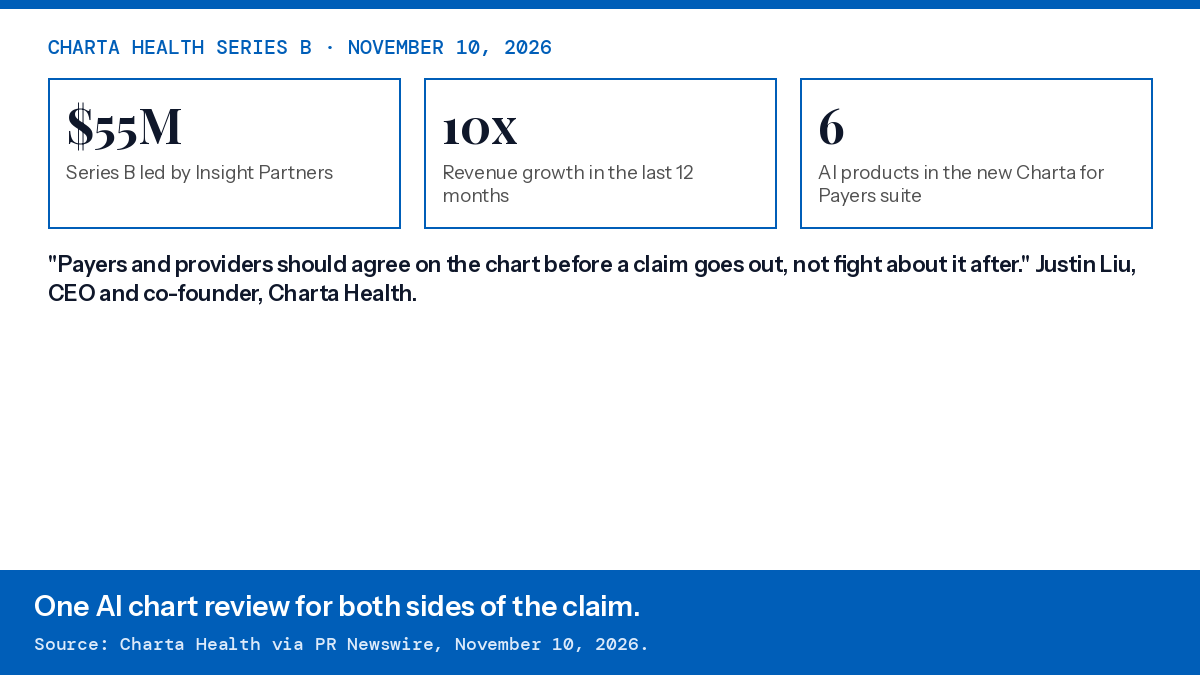
- Round: $55 million Series B led by Insight Partners; existing investors Madrona, Bain Capital Ventures and South Park Commons participated, alongside QuantumLight. Total funding is $85 million, Charta's third round in less than two years.
- Growth: Charta says revenue grew 10x in the last 12 months with both health plans and provider organizations.
- Charta for Providers: reviews every chart before claim submission against coding guidelines, payer rules and each organization's own clinical protocols, with findings surfacing for human approval inside the EHR. Customers include American Family Care, Grow Therapy and Pediatric Associates Family of Companies. The round funds expansion into new specialties.
- Charta for Payers: six products designed with one of the largest U.S. health insurers: retrospective HCC coding, AI-automated second-pass coding, a smart coding platform, prospective risk adjustment intelligence, HCC validation and audit workflow, and HEDIS and quality care gap detection, aimed at Medicare Advantage and ACA Marketplace plans.
- Founders: CEO Justin Liu and CTO Scott Morris came from Rockset, which became OpenAI's first product acquisition, and spent a year earning Certified Professional Coder credentials and interviewing more than 100 healthcare leaders before building. Charta requires its engineering and growth teams to get coding certified.
- Investor view: Jeff Horing, co-founder and managing director at Insight Partners, said the opportunity lies in getting the underlying record right before a claim is submitted.
- Distribution: Charta has also joined athenahealth's Marketplace to offer chart review to athenahealth customers, per its earlier release.
Certainty: (A) all items from Charta's release and site, cross-checked with Madrona's post and Behavioral Health Business; (A) athenahealth Marketplace listing from Charta's prior release as shown on PR Newswire.
The obvious read versus the deeper signal
The obvious read: Another revenue cycle AI company raises money. Coding automation is a crowded category, and Charta adds a payer product to grow its market.
The deeper signal: The interesting part is the claim of neutrality. Most billing AI is partisan by design: provider tools aim to capture every supportable code; payer tools aim to find what is unsupported. Charta is betting that one engine, applying one standard of accuracy, can be trusted by both. If that works, the unit of value shifts from winning a dispute to preventing it, and the market for denial management and appeals shrinks. It also creates an unusual network effect. Each payer that adopts the standard makes it more valuable to providers that bill that payer, and vice versa.
Certainty: (A) the shared-standard positioning as stated by Charta and its investors; (B) our analysis of network effects and market impact.
Historical playbook
Healthcare billing has seen escalation cycles before. Each wave of provider coding technology, from computer-assisted coding to clinical documentation improvement programs, was followed by payer-side analytics and audit tools tuned to catch overcoding. Medicare Advantage risk adjustment made the stakes explicit, because diagnoses directly drive payments, which is why CMS has invested in RADV and why risk adjustment accuracy is a recurring enforcement theme.
Outside healthcare, shared standards have resolved similar standoffs. Credit bureaus and card networks gave lenders and merchants a common reference so each transaction did not need to be argued from scratch. The lesson is that neutrality has to be structural, through governance, transparency and auditability, not just claimed. A vendor serving both sides needs to show each side that the other cannot tune the engine in its favor.