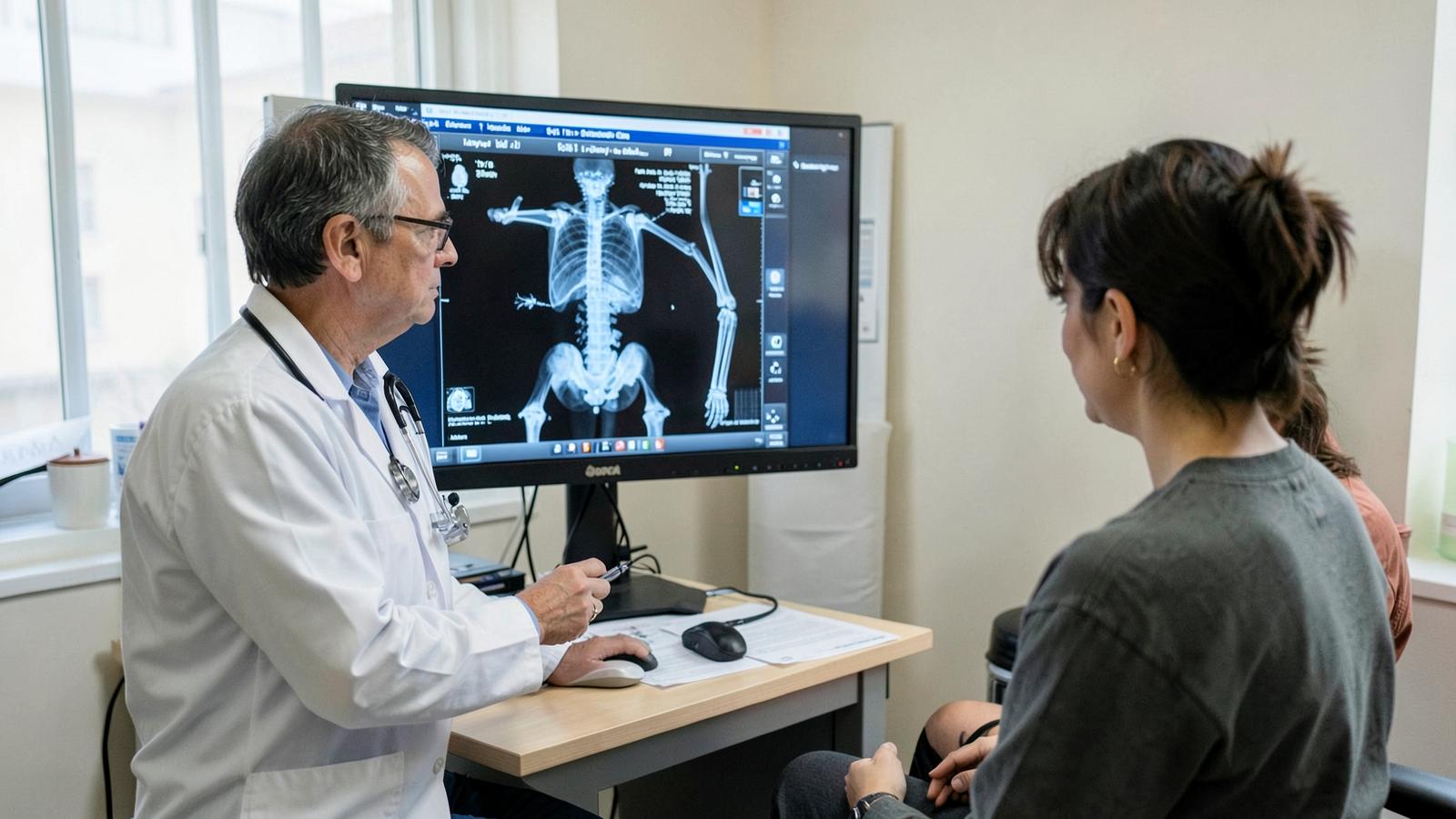
A man in his fifties has a chest X-ray in an emergency department after a minor car accident. The report focuses on his ribs. A small shadow in the upper lobe is noted by nobody, and the image goes into the archive. Three years later he is diagnosed with lung cancer that has already spread. Somewhere in that archive was an early chance.
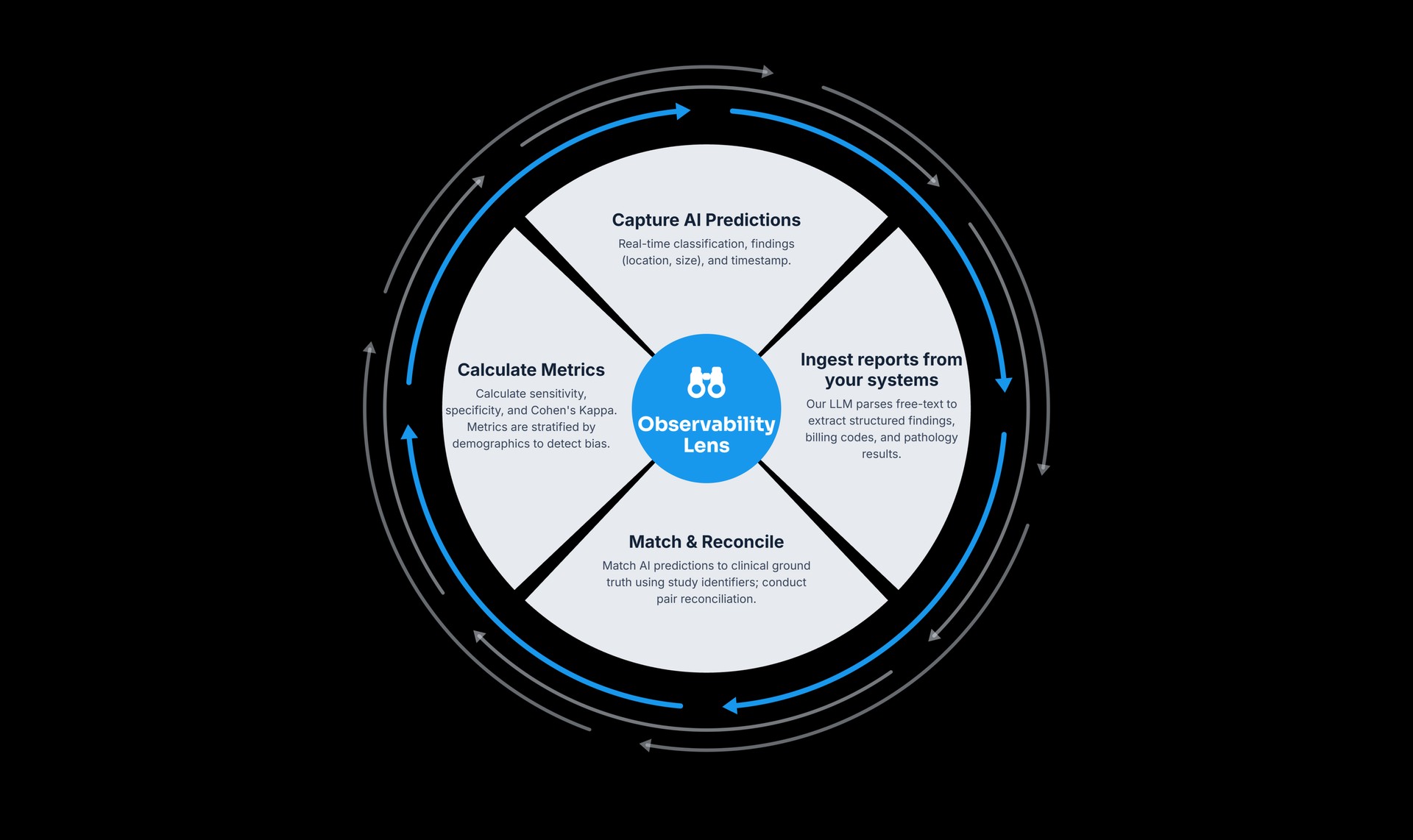
On November 23, Lunit and M42 agreed to propose a program to look for those chances at the scale of a whole emirate. The idea is to run Lunit's chest X-ray AI over images already held in Abu Dhabi's health information exchange, flag suspicious findings and route those people to further evaluation. It is a simple concept with hard practical questions.
The cheapest screening image is the one that has already been taken. The expensive part is everything that happens after the AI raises a flag.
In This Deep Dive
- Why this matters now
- What actually happened
- The obvious read versus the deeper signal
- Historical playbook
- The world forming around lung imaging AI
- Category map and taxonomy
- Evidence Ladder
- Regulation: approval of the program, device status and data use
- Capital flows and bottom-up economics
- The HealthTech Investor's Signal
- Counter-thesis
- Forward Intelligence
- The Bottom Line for Health System Leaders and Investors
Why this matters now
Most lung cancer is found late, and formal screening reaches only part of the at-risk population. In the United States, the U.S. Preventive Services Task Force recommends annual low-dose CT screening for adults aged 50 to 80 with a 20 pack-year smoking history who currently smoke or quit within the past 15 years. People outside those criteria, or who never enter a screening program, are not covered.
Chest X-rays, by contrast, are among the most common imaging tests, taken for many reasons unrelated to cancer. That creates a large archive of images in which an early nodule may be visible but unreported. AI that reads every chest X-ray for suspicious findings could, in theory, turn that archive into a second screening net.
Abu Dhabi has the data infrastructure to try. The Lunit release says Malaffi connects more than 3,100 healthcare facilities and brings together 14 million unique patient profiles and 4.2 billion clinical records.
What actually happened
- The partners: Lunit, a Seoul-listed medical AI company (KRX: 328130) founded in 2013, and M42, a healthcare and health technology group established by Mubadala and G42 that operates more than 480 healthcare facilities across 28 countries.
- The tool: Lunit INSIGHT CXR, Lunit's AI-powered chest X-ray analysis solution, applied to existing images through Malaffi.
- The roles: M42 will prepare and submit the proposed program to the Department of Health, Abu Dhabi and the Abu Dhabi Public Health Center. Lunit will provide technical expertise and support the proposed deployment and integration.
- The terms: Financial terms were not disclosed.

The obvious read versus the deeper signal
The obvious read: AI will scan millions of old X-rays and catch lung cancers that radiologists missed.
The deeper signal: The AI read is the easy step. A retrospective program has to decide which images are recent enough to act on, how to reach people whose scans may be years old, who reviews each flag, how quickly follow-up CT happens and who pays for it. The proposal goes to the health department and the public health centre for exactly that reason: this is a population health program with an AI component, not a software rollout.
Historical playbook
Computer-aided detection for chest imaging has existed for decades, but the current generation of deep learning tools is far more capable and far more widely deployed. Lunit says its products are used at more than 10,000 sites in more than 65 countries.
Most deployments so far are prospective: the AI reads new images as they are taken and helps the radiologist on the current case. Retrospective use, going back over images already reported, is less common because it raises questions about liability for past reads, consent and the logistics of contacting patients.
Health information exchanges change that equation. When images from many providers sit in one connected system, a single program can reach a population rather than one hospital's patients. That is the distinctive feature of the Abu Dhabi proposal.
The world forming around lung imaging AI
Lung AI is one of the busiest corners of imaging. On November 20, RevealDx launched ReViewer, a diagnostic-quality viewer for lung nodule identification and quantification that lets its RevealAI-Lung product run inside any PACS, and ReViz, a dashboard for monitoring AI performance. RevealDx also says its lung cancer screening CADx product, RevealAI-Screen, will be offered at no charge to U.S. patients pending FDA clearance.
In Korea, Soombit AI announced a 12 billion won Series A on November 17. Its AIRead-CXR drafts chest X-ray reports and was approved by Korea's Ministry of Food and Drug Safety in April 2026. It plans to show AIRead-CT at RSNA 2026.
Health systems are also building ways to manage many imaging models at once. On November 23, Allegheny Health Network chose Ferrum Health as its enterprise imaging AI partner, with every model monitored for drift and bias. A retrospective lung program would need the same kind of monitoring, because performance on old images from many scanners can differ from performance in a trial.
Category map and taxonomy
The table compares the approaches named in the sources with standard screening. Status is as reported on the dates cited.
| Player or approach | Modality | Physical / commercial target | Clinical maturity | Regulatory pathway | Strategic moat | Key limitation |
|---|---|---|---|---|---|---|
| Lunit INSIGHT CXR in the M42 proposal | AI over archived chest X-rays via an exchange | Abu Dhabi population | Proposed program; tool in wide use | Needs Abu Dhabi health authority approval | Exchange-level reach, installed base | Follow-up pathway not yet defined |
| RevealDx RevealAI-Lung and RevealAI-Screen | Nodule malignancy characterization (CADx) | Incidental nodules; screening pending | Lung cleared by FDA; Screen pending | FDA clearance; EU MDR certified Nov 2025 | Works with any nodule detector | Screen product not yet cleared |
| Soombit AIRead-CXR | Generative draft reports for chest X-rays | Radiology departments | Approved by Korea MFDS, Apr 2026 | Seeking FDA and CE marking | Report drafting, not only flags | Approval so far in Korea only |
| Low-dose CT screening (baseline) | Prospective CT in eligible adults | USPSTF-eligible population | Standard of care | Guideline-based | Strong evidence base | Reaches only those enrolled |
Evidence Ladder
- Technical: The AI detects suspicious lung findings on chest X-rays with known sensitivity and specificity. Lunit's tool is in wide use, so this rung is the most mature.
- Data fitness: Archived images from many facilities and scanners are retrievable, linked to the right patient and of usable quality.
- Workflow: Every flag is reviewed by a qualified reader, prior reports are checked, and the patient is contacted and offered follow-up CT within a defined time.
- Clinical outcome: The program finds cancers at earlier stages than they would otherwise be found, without an unacceptable number of false alarms and unnecessary procedures.
- Policy and payment: The health authority approves the program and funds follow-up imaging and care.
Regulation: approval of the program, device status and data use
The key approval here is not a device clearance but a program approval. M42 will submit the proposed program to the Department of Health, Abu Dhabi and the Abu Dhabi Public Health Center. Those bodies will decide whether retrospective analysis of exchange images is permitted, how patients are contacted and who is responsible for follow-up.
Device status still matters. Each AI tool used must be authorized for its intended use in the jurisdiction where it runs. The release does not state the regulatory status of Lunit INSIGHT CXR in the UAE, and a retrospective population use may differ from the uses a tool was originally authorized for.
Data governance is the third layer. Running AI over 4.2 billion clinical records, or the imaging subset of them, requires clear rules on access, processing location and retention. M42's ownership of the exchange operator, Abu Dhabi Health Data Services, simplifies the technical side but not the policy side.
Capital flows and bottom-up economics
The economics of retrospective screening depend on how many people are flagged, how many flags are true, and what follow-up costs. The AI read itself is cheap per image. The CT scans, specialist visits, biopsies and treatment that follow are not.
An illustrative model shows the trade-off: if a program reads a large archive and flags even a small percentage for follow-up, the number of CT scans required can be substantial, and each false positive carries cost and anxiety. The value comes from earlier-stage diagnoses, which are cheaper to treat and have better survival. The model is illustrative; the real inputs depend on the archive, the flag rate and local costs.
For Lunit, a sovereign-scale program would be a reference case for other health systems with connected exchanges. For M42, it would show what the Malaffi data can do for population health. Neither company disclosed financial terms.
Institutional hubs and buyer dynamics
In Abu Dhabi the decision sits with the health department and the public health centre, with M42 as the operator. In other markets, the equivalent buyers would be national health services, integrated payer-providers and large health systems with consolidated imaging archives.
Integrated payer-providers have a particular interest. Allegheny Health Network, part of Highmark Health, described itself on November 23 as accountable for both the care and the cost of care. That is the kind of organization that benefits most if earlier detection lowers treatment costs.
📈 The HealthTech Investor's Signal
For investors, the Lunit and M42 deal points to a new demand source for imaging AI: population programs run on existing data rather than per-scan sales to radiology departments. If approved, it would expand the addressable market from new images to archived ones.
No stock picks. Watch for the health authority's decision, the defined follow-up pathway, and the first reported cancers found and false positive rates as the signals that retrospective screening can scale.
Counter-thesis
The counter-thesis is that retrospective screening creates more problems than it solves. Old images may show findings that have already been followed up, resolved or treated elsewhere. Contacting people about scans taken years ago can cause alarm and may generate many follow-up CTs with low yield. Health systems also worry about liability when an AI flags something on an image that was reported as normal.
There is also selection bias. People who had chest X-rays for other reasons may differ from the population most at risk, and screening them does not replace well-run low-dose CT programs for eligible adults.
Forward Intelligence
- Whether the Department of Health, Abu Dhabi and the Abu Dhabi Public Health Center approve the proposed program, and on what terms.
- How the program defines which archived images are eligible, who reviews flags and how fast follow-up CT happens.
- Whether Lunit or M42 report the number of flags, confirmed cancers and stage at diagnosis after a first phase.
- Whether RevealDx's RevealAI-Screen receives FDA clearance, and whether Soombit AI secures FDA or CE marking for AIRead-CXR.
- Whether other health information exchanges propose similar retrospective programs.
The Bottom Line for Health System Leaders and Investors
What changed this week is that a major imaging AI company and the operator of a regional health information exchange agreed to propose AI screening of existing chest X-rays across an emirate. The market signal is that imaging AI demand may come from population health programs that reuse archives, not only from reading new scans.
What remains uncertain is everything after the AI flag: approval, follow-up capacity, false positive burden and payment. Health system leaders should plan the clinical pathway before the algorithm. Investors should wait for the health authority's decision and first-phase results before pricing this as a new market.
Sources
- Lunit: Lunit and M42 Partner to Advance AI-Powered Lung Cancer Early Detection in the United Arab Emirates (Nov 23, 2026) (Tier 1, primary)
- RevealDx: RevealDx Announces New Products Ahead of 2026 RSNA (Nov 20, 2026) (Tier 1, company)
- Soombit.ai newsroom: Series A funding (Nov 17, 2026) and MFDS approval of AIRead-CXR (Apr 2, 2026) (Tier 1, company)
- U.S. Preventive Services Task Force: Lung Cancer Screening recommendation (2021) (Tier 1, guideline)
- FDA: Artificial Intelligence-Enabled Medical Devices list (content current as of Sep 4, 2026) (Tier 1, regulator)
- Ferrum Health: Ferrum Health Selected as Enterprise Imaging AI Partner for Allegheny Health Network (Nov 23, 2026) (Tier 1, company)