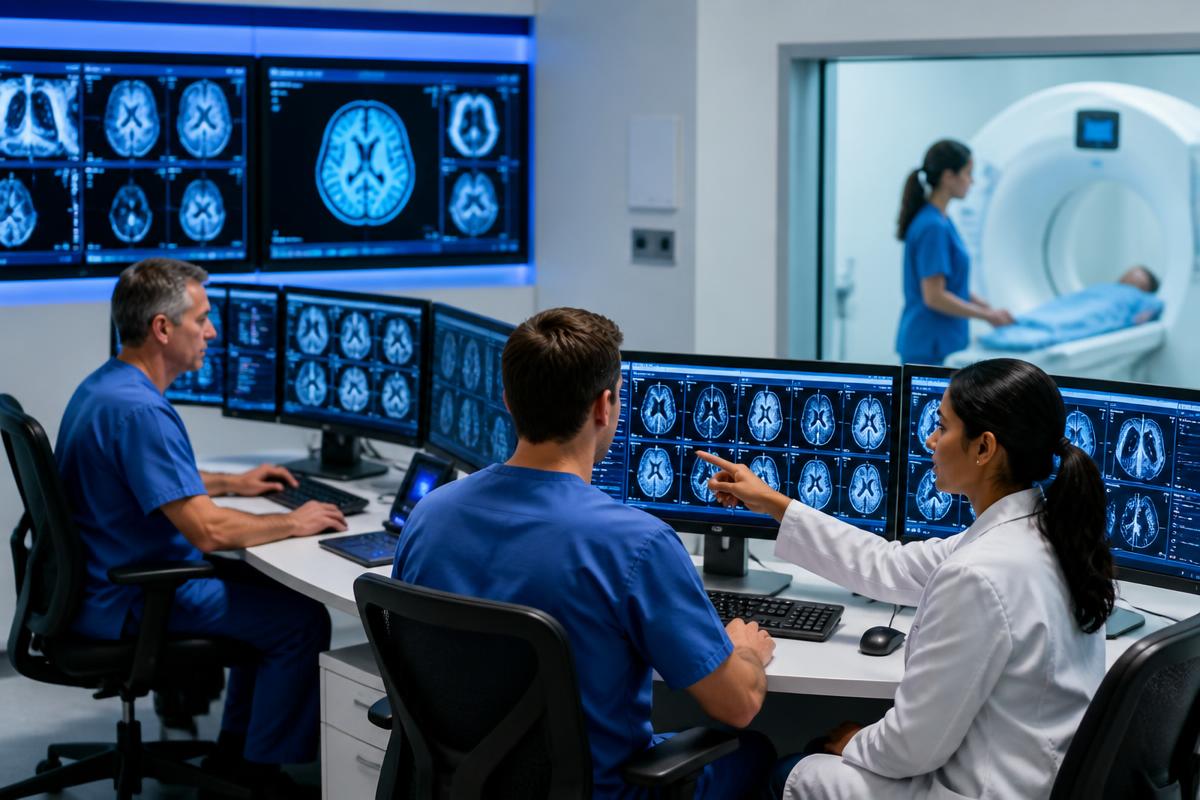
Picture the worklist at 2 a.m. in a community hospital that sends its imaging to a remote radiology group. A trauma pan-scan, three chest X-rays from the emergency department, a follow-up abdomen and pelvis CT, a knee series. Until now the AI in that workflow, if there was any, did one job per product: one tool flagged a possible bleed, another a pulmonary embolism, a third sorted the queue. The radiologist still looked at everything else and dictated every word of the report.
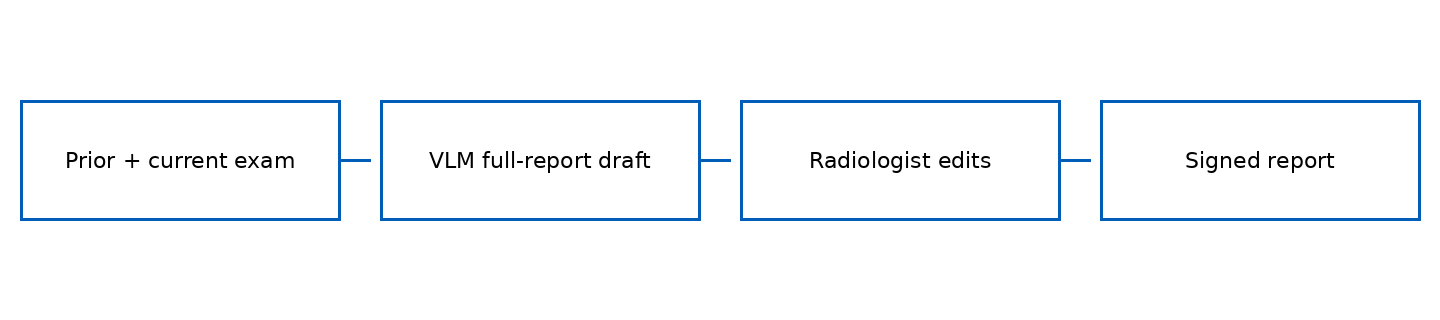
Radiology Partners is betting that this division of labor is about to flip. Its subsidiary Mosaic Clinical Technologies runs vision-language models that read the whole study, compare it with the prior exam and draft a complete report for the radiologist to confirm, edit or reject. On November 11 it published the first large internal look at what that does to detection, errors and speed. The answers are striking, and the caveats matter just as much. Below we walk through why this matters now, what actually happened, the obvious read versus the deeper signal, and then, for Signal Plus subscribers, the category map, the Evidence Ladder, the regulatory path, the economics and the evidence boundaries.
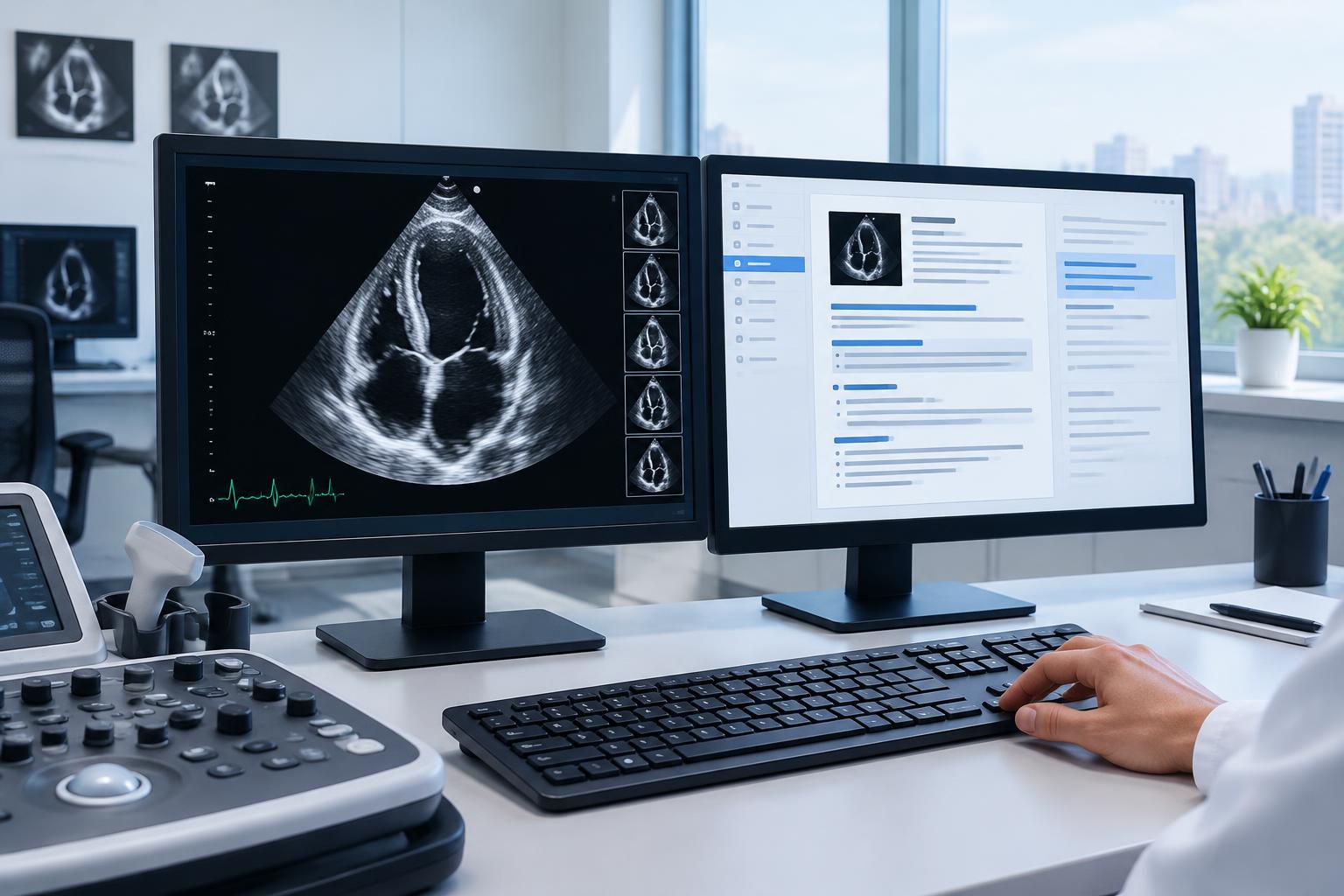
The model does not flag a finding. It writes the first draft of the report, and the radiologist becomes the editor. That is a different product, a different regulatory question and a different business.
In This Deep Dive
- Why this matters now
- What actually happened
- The obvious read versus the deeper signal
- Category map and taxonomy
- Evidence Ladder
- Regulation and international divergence: when the device writes the report
- Capital flows and bottom-up economics
- The HealthTech Investor's Signal
- Evidence boundaries
- Forward Intelligence
- The Bottom Line for Health System Leaders, Radiology Groups and Imaging AI Investors
Why this matters now
Three pressures meet here. The first is capacity. Mosaic's announcement frames the problem as imaging demand growing much faster than the radiologist workforce, and RP's own scale makes the point concrete: more than 4,000 radiologists in its network reading more than 55 million studies a year for more than 3,400 hospitals and other facilities. A practice of that size feels every percentage point of reading time as a staffing decision.
The second is the limit of narrow AI. Most imaging AI on the market is built for a single task, such as flagging intracranial hemorrhage or a fracture, which the release itself notes leaves radiologists to find and describe everything else unaided. Hospitals have bought many of these tools, and many have struggled to show a return when each one covers a sliver of the worklist.
The third is that the technology finally fits the job. Vision-language models can take an image and produce structured natural language, which is what a radiology report is. That makes a whole-report draft technically plausible in a way it was not with classifiers. The question has moved from whether a model can write a report to whether the report it writes is good enough, often enough, for a physician to sign it after review.
Certainty: (A) RP scale, study design and the single-task framing are from the November 11 release; (B) the point about hospitals struggling to show return on narrow tools is our interpretation of a widely discussed market pattern, not a figure from this study.
What actually happened
- The announcement: on November 11, 2026, Mosaic Clinical Technologies (Nashville), a wholly owned subsidiary of Radiology Partners, announced results from an ongoing, internal research study of investigational VLMs developed by Cognita Imaging, its advanced AI lab. The models contribute to a draft report inside MosaicOS, Mosaic's cloud-native radiology operating system, for radiologists to review, edit and sign.
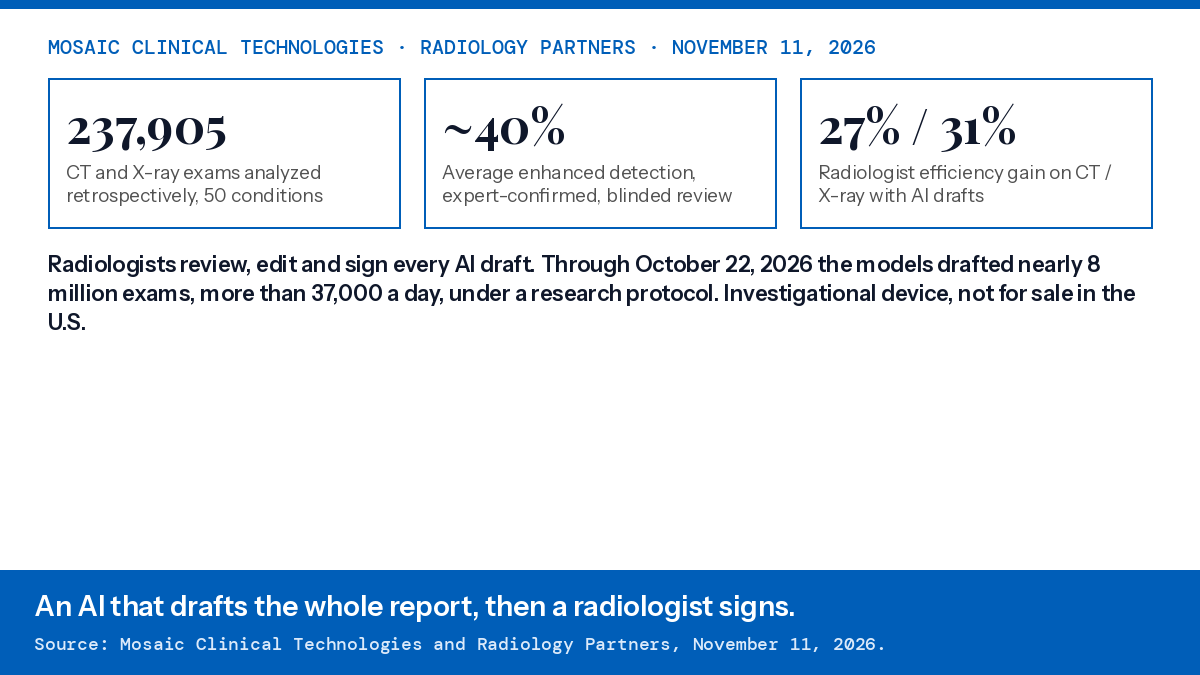
- The method: a retrospective analysis of 237,905 exams that radiologists had previously interpreted without AI, measuring radiologist-model concordance and discordance across 50 significant conditions. Panels of U.S. board-certified radiologists, blinded to the source of each finding, reviewed a large random subset of cases where the AI draft, the original report or both flagged a finding. The outcome is the enhanced detection rate (EDR): additional expert-confirmed findings the models identified.
- CT (71,707 exams, 35 broadly defined conditions): EDR averaged 40.9% (range 5.2% to 109.6%), including 73.4% for fractures on head CT, 68.1% for fractures on abdomen and pelvis CT, 50.4% for pancreatic masses and 40.6% for free air in the abdomen.
- Chest X-ray (100,000 exams, 10 conditions): EDR averaged 43.4% (range 12.7% to 57.5%), including 57.5% for lung nodules or masses, 51.6% for malpositioned devices and 46.5% for pneumothorax.
- Musculoskeletal and abdominal X-ray (66,198 exams, 5 conditions): EDR averaged 23.9% (range 6.8% to 45.8%), including 27.1% for bone infections and 45.8% for suspicious bone lesions.
- Errors: on chest X-ray, 91.2% of VLM drafts were rated error-free against 83.0% of original radiologist-only reports; on musculoskeletal and abdominal X-ray, 3.7% of drafts had a clinically significant error against 6.5%; on CT, clinically significant error rates were comparable to or lower than the originals.
- Speed and scale: among radiologists who had read at least 50 AI-drafted exams, average efficiency rose more than 27% on CT and 31% on X-ray against their own pre-AI performance. Through October 22, 2026, the models had drafted nearly 8 million exams (about 6.3 million X-rays and 1.7 million CTs), averaging more than 37,000 a day, used by radiologists in the RP Clinical Services practice under a research protocol supporting FDA authorization.
- Regulatory status: the models are investigational and not for sale in the U.S. Cognita's chest X-ray model received FDA Breakthrough Device designation, announced March 5, 2026. Mosaic describes it as the first radiology generative AI model to receive the designation; that is the company's claim.
- People: Rich Whitney, who co-founded RP in 2012 and is its chairman and CEO, called it radiology's "ChatGPT moment." Jon Foster of HCA Healthcare was quoted endorsing the focus on measuring quality alongside efficiency. Louis Blankemeier, PhD, co-founder and CEO of Cognita, and Nina Kottler, MD, Mosaic's Chief Medical AI Officer, are presenting at RSNA 2026.
Certainty: (A) every number above is from the November 11 release and Mosaic's March 5 Breakthrough announcement. The study is internal and ongoing; the papers are posted on Mosaic's RSNA event hub rather than in a peer-reviewed journal at the time of writing.
The obvious read versus the deeper signal
The obvious read: An AI vendor publishes impressive numbers ahead of RSNA, and radiologists get a faster dictation assistant.
The deeper signal: This is a vertically integrated practice redesigning its own production line. RP owns the radiologists, the client contracts, the workflow platform and now the model lab, and it has been running drafts on tens of thousands of exams a day before authorization under a research protocol. That gives it something no standalone AI vendor has: millions of human edits on its own model's output, the feedback loop Cognita's leadership has described as reinforcement learning through continuous radiologist feedback. The deeper signal is that the unit of competition in imaging AI may shift from the algorithm to the practice that can generate, measure and monetize radiologist-in-the-loop data at scale.
Certainty: (A) ownership structure and deployment volume from the releases; (B) the shift in competitive unit is our interpretation.
Historical playbook
Radiology has been here before, twice. The first time was speech recognition. When front-end voice recognition replaced transcriptionists in the 2000s, the radiologist became responsible for editing machine-produced text in real time. Productivity rose, but so did a new class of error: wrong-word and wrong-side mistakes that the human editor did not catch. The lesson for AI drafting is direct. When the machine writes and the human edits, the error profile changes, and monitoring has to be designed for the new failure modes, not the old ones. Mosaic says it tracks how often radiologists keep or change AI-drafted findings and how long reports take to sign, precisely to spot over-reliance.
The second was computer-aided detection in mammography. CAD was adopted widely in the U.S. after Medicare began paying for it, and later large observational studies questioned whether it improved accuracy in routine practice. The lesson there is about evidence: retrospective reader studies and enthusiastic early users do not guarantee real-world benefit, and payment can run ahead of proof. Both precedents argue for the same thing here: outside validation, prospective measurement and outcome data before the industry concludes that more findings equal better care.