
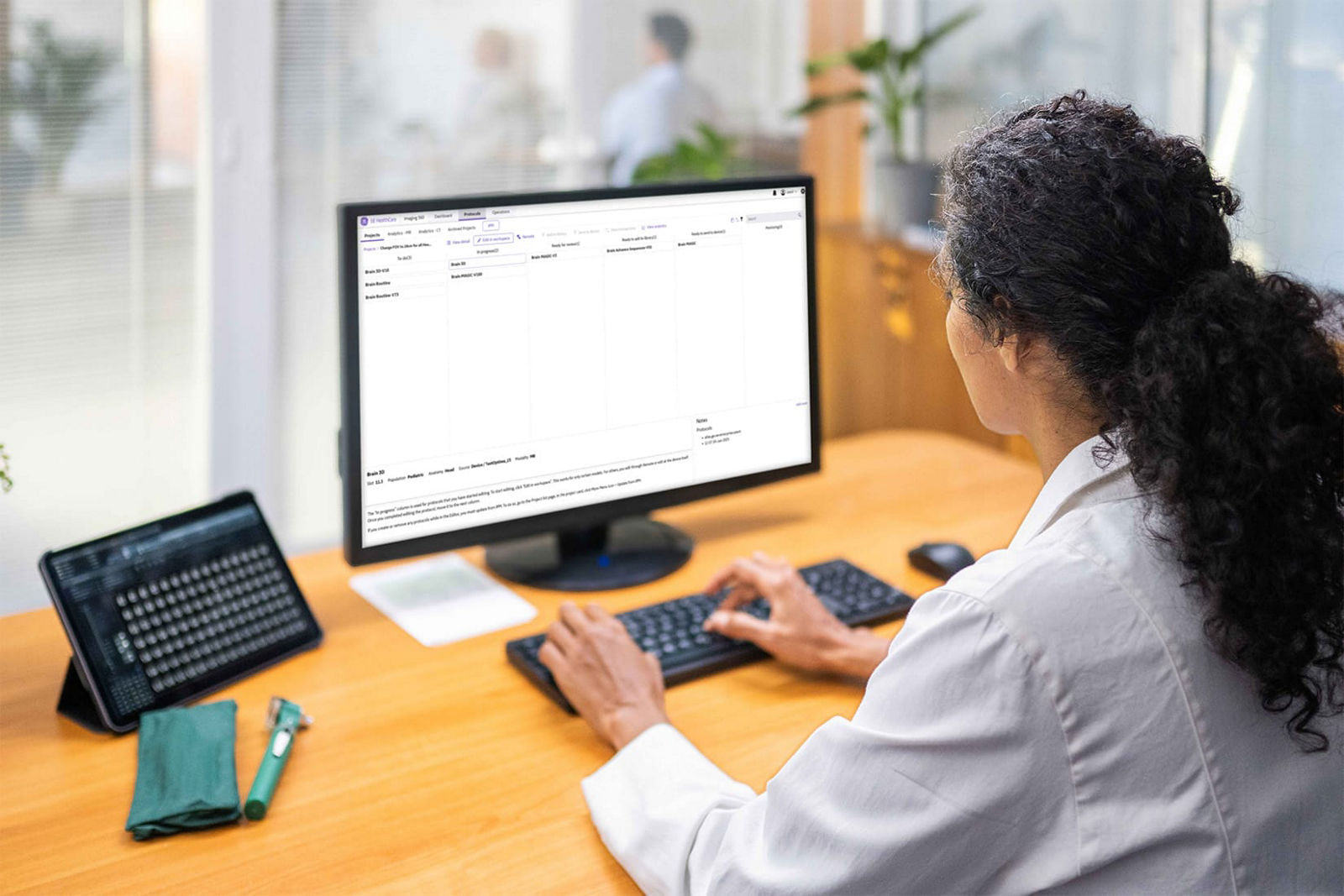
Before a CT or MR scan happens, someone has to decide exactly how it will be done: which sequences, which contrast, which slice thickness, which dose settings. That decision, called protocoling, usually falls to a radiologist or technologist working through a queue of orders between other tasks. It is repetitive, it varies from one reader and one site to the next, and when it goes wrong the patient may need a repeat scan or receive a study that does not answer the clinical question.
On November 20, GE HealthCare announced two Imaging 360 features aimed squarely at that step, nine days before RSNA 2026 opens in Chicago.
Siemens Healthineers and
Philips announced their own imaging software in the same week. Below we set out what each company launched, why protocoling is attracting AI, what the evidence does and does not show, which rules apply and the questions buyers should take to the booth.
The free story is a feature launch. The world around it is a race to own the software layer that sits between the imaging order and the scanner.
In This Deep Dive
- Why this matters now
- What actually happened
- The obvious read versus the deeper signal
- Historical playbook
- The world forming around radiology operations software
- Category map and taxonomy
- Evidence Ladder
- Regulation: where operational AI ends and clinical software begins
- Capital flows and bottom-up economics
- The HealthTech Investor's Signal
- Counter-thesis
- Forward Intelligence
- The Bottom Line for Radiology Leaders and Imaging Technology Investors
Why this matters now
Radiology departments are under sustained volume pressure, and much of the strain sits in work that is not image interpretation: protocoling, scheduling, quality review and fleet management. Vendors have concluded that these operational steps are a lower-risk place to introduce AI than diagnosis, because a human confirms the output and the tools can often be positioned outside clinical decision-making.
Protocoling also has a consistency problem that matters for quality and safety. Different radiologists choose different protocols for similar orders, and multi-site systems often run different protocol libraries on different scanners. Tools that make protocol use visible across an enterprise, and that suggest consistent choices, speak directly to that problem.
RSNA concentrates buying attention. Announcing just before the meeting lets vendors fill booth conversations, and it means buyers will see several overlapping AI claims in one week. Knowing what each product actually is, and what evidence sits behind it, is the main defense against confusion.
Certainty: (A) launch details and dates are from the GE, Siemens Healthineers and
Philips releases; (B) the description of operational AI as lower-risk is our interpretation.
What actually happened
GE HealthCare, November 20: Two new Imaging 360 capabilities. The Imaging 360 AI assistant helps imaging leaders, administrators and protocol managers explore protocol-related analytics by asking questions in natural English, without navigating multiple dashboards. GE says it is for operational use, does not provide clinical interpretation or patient-specific recommendations, and is read-only, so it does not modify protocols or source data.
- AI-assisted protocoling: Described by GE as a vendor-agnostic, multi-modality application designed to provide consistency in protocoling for CT and MR exams. Radiologists and technologists review the recommendations before they select the protocol in the RIS.
- The people: Ryan Dobbe, general manager of Advanced Imaging Solutions Digital Ecosystem at
- The evidence cited: GE says that in an analysis of two observational studies, researchers estimated radiologists spend an average of 1.3 hours per day on protocoling. The release footnote gives the source of the protocoling statistics as a GE-sponsored survey of 150 CT radiologists and technologists from January 2019. GE describes itself as a $20.6 billion business with approximately 54,000 colleagues.
- The same week:
Siemens Healthineers announced FDA clearance of syngo.CT Coronary Cockpit on November 19, an application within syngo.via that uses AI-based segmentation, labeling and visualization of coronary plaque from CCTA data from any CT scanner and supports PCI planning.
Philips introduced Skylight Device Manager on November 18, a cloud application that consolidates data from connected ultrasound systems for utilization and service planning.

Certainty: (A) every item above is from the GE HealthCare release of November 20, 2026, the
Siemens Healthineers release of November 19 and the
Philips release of November 18. GE gave no pricing, availability date or performance results for the new features.
The obvious read versus the deeper signal
The obvious read: Every large imaging vendor is adding AI assistants before RSNA. On this reading GE's launch is one more chatbot on a dashboard, and buyers can ignore it until it is bundled into a scanner purchase.
The deeper signal: The more important change is where the AI sits. GE's assistant and protocoling tool live in Imaging 360, a software layer that spans sites and, GE says for protocoling, scanners from other vendors. Siemens put its coronary tool inside syngo.via, and Philips built a cloud layer over its ultrasound fleet. Each is extending software that sits above individual scanners, where the vendor can sell to the enterprise rather than the modality. Whoever owns that layer gains visibility into protocol use, utilization and service needs across a whole department, which is valuable for quality, for operations and for the vendor's next sale.
Certainty: (B) evidence-based interpretation of three releases; none of the vendors has published adoption figures for these features.
Historical playbook
The imaging AI market has already gone through one cycle that teaches a concrete lesson. Over the past decade, regulators cleared a large number of image-analysis algorithms, many from startups, but adoption lagged because each tool needed separate integration, separate contracts and a separate business case. The response was platform distribution: marketplaces and enterprise imaging layers that bundle many tools under one contract. Operational AI like protocoling is now following the platform route from the start.
Protocol management itself has a longer history. Scanner vendors have long offered tools to manage protocol libraries on their own machines, and accreditation and dose-optimization efforts pushed departments to standardize and review CT protocols. What is new is the attempt to manage protocols across sites and vendors in one place, and to put AI suggestions into the individual protocoling decision.
The world forming around radiology operations software
Several credible actors moved in the same direction in a single week. GE extended Imaging 360 with an assistant and protocoling. Siemens Healthineers added an FDA-cleared AI application to syngo.via that works with CCTA data from any CT scanner.
Philips built a cloud application that turns ultrasound fleet data into utilization and service planning. The products differ, a protocol workflow tool, a cleared clinical analysis product and an operations dashboard, but each extends a platform the vendor already sells.
The convergence matters for buyers because it changes procurement. Instead of evaluating standalone AI tools, departments are increasingly asked to extend an existing vendor relationship. That can reduce integration work, but it also deepens dependence on one vendor's platform. The vendor-agnostic language in GE's protocoling description and the any-scanner language in Siemens's release suggest vendors know buyers are wary of lock-in.