Key Signals
- November 23, 2026: Ferrum Health announced that Allegheny Health Network (AHN), part of Highmark Health, named it AHN's enterprise partner for imaging AI across its 16 hospitals (Ferrum release).
- AHN will deploy an initial set of models across four modalities: X-ray, CT, mammography and ultrasound. The program covers FDA-cleared applications and in-house models built on foundation model technology.
- Every model in use at AHN will be continuously monitored for performance drift and bias, and AHN is connecting its systems to Ferrum's Observability Lens to quantify clinical, operational and financial return.
- Highmark Health also includes a Blue Cross Blue Shield health plan, so AHN operates as an integrated payer-provider accountable for both outcomes and cost.
- Ferrum says its platform covers more than 45 million lives across more than 400 care sites, with customers including Sutter Health, AHN and Carle Health. Financial terms were not disclosed.
- Context: the FDA's AI-enabled device list (content current as of September 4, 2026) holds 1,610 devices, and 1,228 of them, 76%, sit in the radiology panel.
PITTSBURGH. On November 23, Ferrum Health said Allegheny Health Network had named it the enterprise partner for imaging AI across all 16 AHN hospitals. AHN, part of Highmark Health, is building what the companies describe as one program to bring proven AI to clinicians, monitor every model for safety and measure its impact on patients and cost.
The announcement is short on numbers and long on structure. That is the point. AHN is not buying a single algorithm for a single finding. It is buying the layer that decides which algorithms go live, watches how they perform once they are live, and retires the ones that do not earn their place.
For a radiology market crowded with cleared models, that layer may matter more than any one model.
Health systems have spent five years buying imaging AI one tool at a time. AHN is buying the system that manages the tools. The test is whether it publishes what that system finds.
In This Story
- What AHN and Ferrum announced
- Why imaging AI needs a management layer
- How Ferrum's platform works
- Who AHN is, and why the payer side matters
- The market forming around AI governance
- What it means for health systems, payers and investors
- Regulation and accreditation
- Evidence Ladder
- Counter-thesis
- Risks and open questions
- What to watch next
What AHN and Ferrum announced
The release sets out four commitments. AHN will get faster access to AI that helps clinicians, starting with an initial set of models across X-ray, CT, mammography and ultrasound. It will monitor every model for performance drift and bias. It will measure the value of each investment by connecting its systems to Ferrum's Observability Lens. And it will adopt the next generation of AI, including foundation models and agents, under the same safety oversight.
Ferrum's AI Governance Suite is the platform behind the program. The company describes it as giving AHN one partner for clinical AI, from selection and deployment through monitoring and measurement.
| Announcement detail | What was said | Source |
|---|---|---|
| Partner role | Enterprise partner for imaging AI | Ferrum release, Nov 23, 2026 |
| Scope | All 16 AHN hospitals | Ferrum release |
| Initial modalities | X-ray, CT, mammography, ultrasound | Ferrum release |
| Model sources | FDA-cleared applications and in-house models on foundation model technology | Ferrum release |
| Safety commitment | Every model continuously monitored for drift and bias | Ferrum release |
| Value measurement | Clinical, operational and financial return per application via Observability Lens | Ferrum release |
| Speed claim | Selection to live clinical use in a matter of weeks via Model Hub | Ferrum release (company claim) |
| Financial terms | Not disclosed | Ferrum release |
Two people are quoted. Dr. Charles Li, a neuroradiologist, physician informaticist and associate professor at AHN, said the network wants full visibility into what AI delivers, and that the partnership lets it bring promising AI to clinicians, see how it supports their decisions and be ready for the models that come next. Peter Eason, chief executive officer of Ferrum Health, said Highmark Health sees the impact of AI from both sides, the quality of care patients receive and the cost of delivering it, and that a single governed program can deliver for both.
Why imaging AI needs a management layer
The FDA publishes a list of AI-enabled medical devices that have received marketing authorization. The version with content current as of September 4, 2026 holds 1,610 devices. Radiology dominates.
| FDA AI-enabled device list, by lead review panel | Devices | Share |
|---|---|---|
| Radiology | 1,228 | 76% |
| Cardiovascular | 152 | 9% |
| Neurology | 73 | 5% |
| Anesthesiology | 30 | 2% |
| Gastroenterology and urology | 27 | 2% |
| All other panels | 100 | 6% |
| Total | 1,610 | 100% |
The pace is rising. Counting devices on the list by year of final FDA decision shows the volume of new authorizations climbing for most of the decade, with radiology taking the bulk each year.
| Year of FDA final decision | All AI-enabled devices on the list | Radiology panel |
|---|---|---|
| 2021 | 129 | 110 |
| 2022 | 162 | 138 |
| 2023 | 226 | 178 |
| 2024 | 234 | 182 |
| 2025 | 332 | 253 |
| 2026 (decisions through June 29) | 181 | 135 |
Source: FDA AI-enabled medical devices list, our count by date of final decision and lead panel. The FDA notes the list is not comprehensive and is updated periodically.
For a radiology department, this abundance creates a practical problem. Each cleared model covers a narrow task: a finding, a modality, a body part. A health system that wants broad coverage ends up evaluating, contracting, integrating and monitoring dozens of separate products, each with its own interface and its own claims. Without a common layer, nobody can say with confidence which tools are working on that system's own patients and scanners, which are drifting, and which are worth renewing.
That is the gap AHN is trying to close. Ferrum's pitch, in Peter Eason's words, is that clinicians get proven tools faster, every model stays safe and accountable, and executive leadership can measure the return.
How Ferrum's platform works
Ferrum describes itself as the clinical AI governance platform for health systems. Its website lists three products under the AI Governance Suite: Model Hub, Deployment Fabric and Observability Lens. The company says its vendor-neutral suite validates and monitors clinical AI models within a health system's own secure environment, so protected health information does not leave and the evidence stays with the health system.
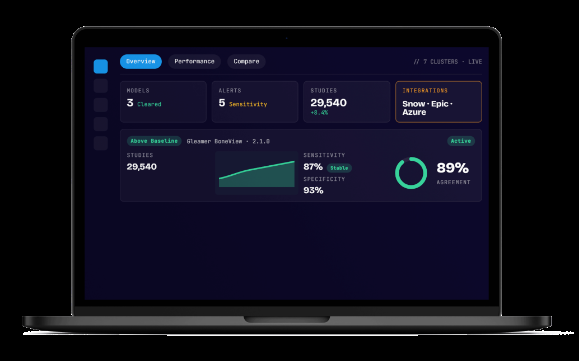
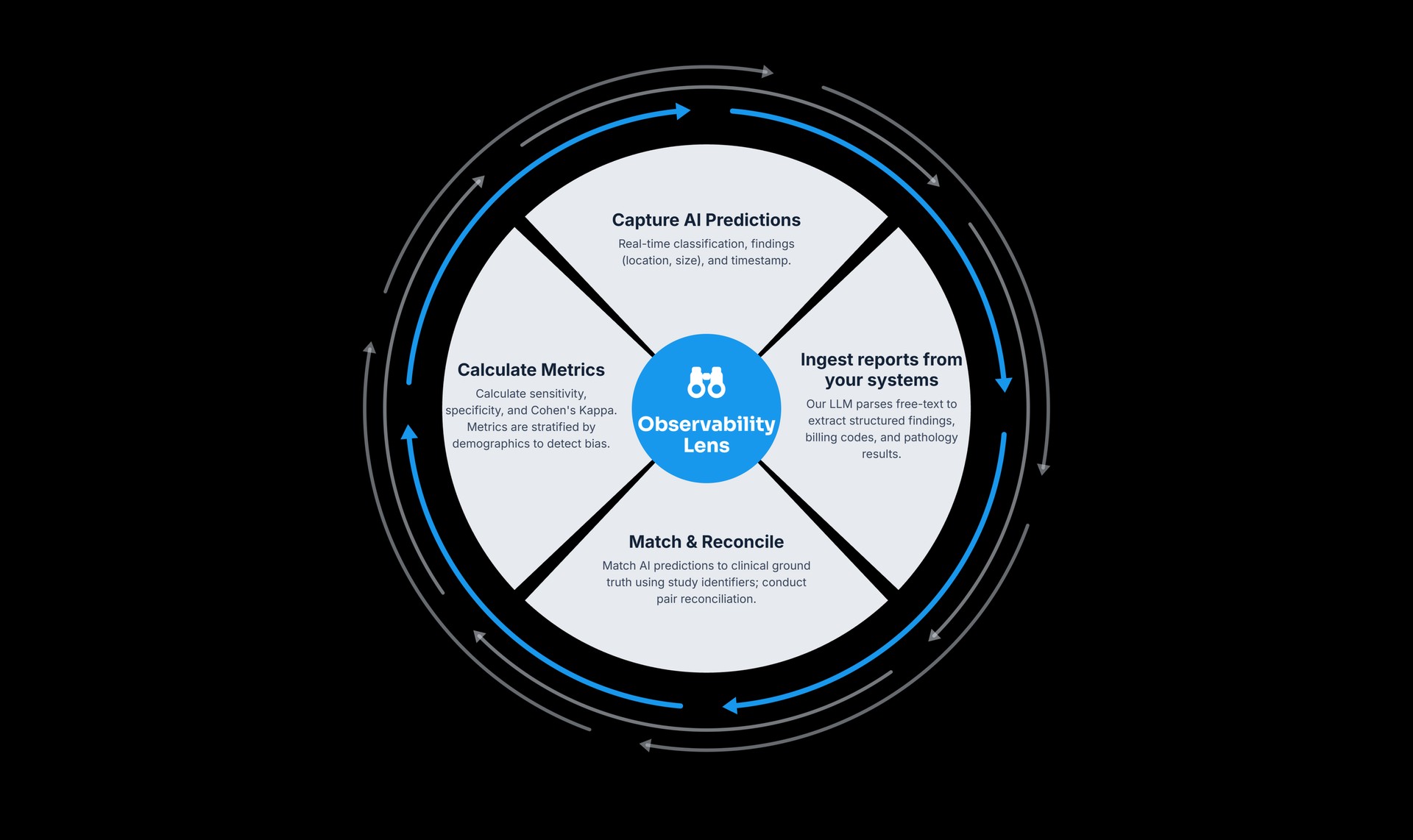
Observability Lens is the piece most relevant to AHN's monitoring promise. Ferrum's product page describes a four-step cycle.
| Observability Lens step | What Ferrum says it does |
|---|---|
| Capture AI predictions | Records real-time classifications and findings, including location, size and timestamp |
| Ingest reports from your systems | Uses a language model to parse free-text reports and extract structured findings, billing codes and pathology results |
| Match and reconcile | Matches AI predictions to clinical ground truth using study identifiers, with pair reconciliation |
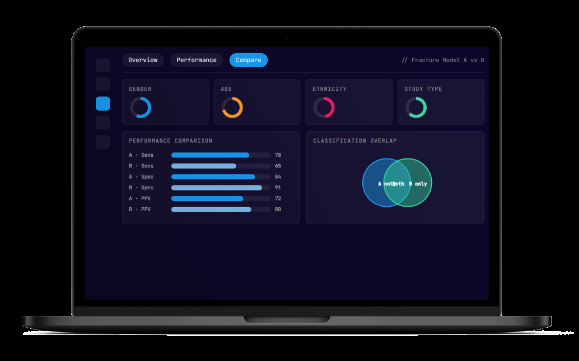
| Calculate metrics | Calculates sensitivity, specificity and Cohen's kappa, stratified by demographics to detect bias |
Source: Ferrum Health, Observability Lens product page.
The design matters because it ties model output to what actually happened to the patient. A model that flags a suspected finding is only useful if the system can check that flag against the final report and, where available, pathology. Doing that automatically, for every model and every study, is what turns AI monitoring from an annual audit into a running dashboard.
Model Hub is the catalogue. Ferrum's site organizes it by service line, including cardiology, musculoskeletal, neurology, oncology, thoracic, women's health and operational models. Through Model Hub, the release says, AHN has access to leading FDA-cleared models and can move new tools from selection to live clinical use in weeks. That speed is a company claim.
Ferrum's leadership page lists Pelu Tran as co-founder, Ken Ko as chief technology officer and co-founder, and Peter Eason as chief executive officer.
Who AHN is, and why the payer side matters
AHN operates 16 hospitals and serves about half of Pennsylvania's 67 counties, as well as patients in parts of New York, Ohio and West Virginia, according to the release. It has roughly 27,000 employees.
| Allegheny Health Network at a glance | Detail | Source |
|---|---|---|
| Parent | Highmark Health, which also includes a Blue Cross Blue Shield health plan | Ferrum release |
| Hospitals | 16 | Ferrum release |
| Geography | About half of Pennsylvania's 67 counties, plus parts of New York, Ohio and West Virginia | Ferrum release |
| Employees | Roughly 27,000 | Ferrum release |
| AI program | Enterprise-wide Imaging AI Program built on Ferrum | Ferrum release |
The payer link is the most interesting part of the deal. Most health systems justify imaging AI on clinical grounds or radiologist productivity. An integrated payer-provider can, in principle, also see whether earlier or more accurate findings change downstream costs: fewer missed diagnoses, fewer repeat scans, earlier treatment. The release says this raises the bar: clinical AI has to improve care, earn clinicians' trust and show a real return.
Whether AHN can actually link a model's flags to claims data and long-term outcomes is not described in the release. If it can, it would be one of the few places where imaging AI return on investment is measured on both sides of the ledger.
The market forming around AI governance
AHN's move fits a broader shift. Health systems are building programs to manage many AI tools, and vendors are competing to supply the layer that does it.
We have covered several pieces of this market in recent weeks. TestDynamics announced a $9 million Series A on November 16 for its vendor-neutral Satori platform, which runs a hospital's imaging AI tools as one program and tests each tool on the hospital's own patients. RevealDx, a lung nodule AI company, launched ReViz on November 20, a dashboard that lets providers monitor and track AI performance. Imaging vendors such as GE HealthCare are adding AI assistants to their own platforms ahead of RSNA.
| Approach to managing imaging AI | Example in recent coverage | What it emphasizes |
|---|---|---|
| Independent governance platform | Ferrum Health at AHN | Selection, deployment, monitoring and return across vendors |
| Independent evaluation and orchestration | TestDynamics Satori | Testing each tool on the hospital's own patients |
| Single-vendor performance dashboard | RevealDx ReViz | Monitoring one vendor's AI in practice |
| Imaging platform vendor | GE HealthCare Imaging 360 | AI features inside an existing imaging platform |
| Build in-house | Health system data science teams | Full control, high staffing cost |
The competitive question is who owns the management layer. Independent platforms argue they are vendor-neutral and keep evidence in the health system's hands. Imaging platform vendors argue that governance belongs where the images already live. Health systems with large data science teams may build their own. AHN's choice is a vote for the independent model, and its plan to include in-house models alongside commercial ones means the platform has to govern tools Ferrum did not sell.
What it means for health systems, payers and investors
For health systems. The AHN program is a template worth studying: one front door for selecting AI, one deployment path, continuous monitoring of every model, and measurement of return that can lead to retiring tools. The release explicitly says tools that do not earn their place are retired. That is the part most AI programs lack, because stopping a tool is politically harder than starting one.
For radiology leaders. Monitoring changes the conversation with vendors. If a department can show a model's sensitivity and specificity on its own patients, stratified by demographics, renewal negotiations move from vendor slides to local evidence. It also exposes the department: once performance is measured, poor results become visible too.
For payers. Highmark's structure means the plan side can, in principle, see whether imaging AI changes cost. If AHN publishes even partial results, other integrated systems such as payer-owned providers will have a benchmark.
For investors. Governance platforms are a picks-and-shovels play on imaging AI. Their value grows with the number of models a health system runs, not with the success of any single model. The risk is that the layer is contested by large imaging vendors and EHR platforms that already own the workflow. Ferrum did not disclose deal size, revenue or funding in the release.
Regulation and accreditation
The regulatory backdrop favours monitoring. In December 2024 the FDA finalized guidance on predetermined change control plans for AI-enabled device software functions, which lets manufacturers describe planned model modifications in advance so authorized changes can be made without new submissions. As models change more often, health systems need their own way to confirm that a modified model still performs locally.
Accreditation is moving in the same direction. In September 2025 the Joint Commission and the Coalition for Health AI released initial guidance on the responsible use of AI in healthcare. The guidance calls for AI governance structures and policies, ongoing quality monitoring, risk and bias assessment, data protections and staff education. It is not binding, but it gives hospital boards a reference point for what a responsible program looks like.
| Rule or guidance | What it covers | Relevance to AHN's program |
|---|---|---|
| FDA PCCP final guidance (Dec 4, 2024) | Planned modifications to AI-enabled device software | Models may change under an authorized plan; local monitoring confirms performance |
| Joint Commission and CHAI guidance (Sept 2025) | Governance, monitoring, bias assessment, education | Sets expectations a governed program can show it meets |
| FDA AI-enabled device list | Public list of authorized AI devices | Defines the pool of cleared models AHN can draw from |
In-house models built on foundation model technology raise a separate question. Software that a health system builds and uses itself may sit in a different regulatory position from a commercial device, depending on its function and use. The release does not describe the regulatory status of AHN's in-house models, and health systems taking this route should get a clear legal view model by model.
Evidence Ladder
How should readers judge whether AHN's program works? We use five rungs.
| Rung | What it would show | Status today |
|---|---|---|
| 1. Deployment | Models live across the four modalities in all 16 hospitals | Announced, not yet reported |
| 2. Monitoring | Drift and bias alerts generated and acted on | Capability described, no results published |
| 3. Local performance | Sensitivity and specificity of each model on AHN patients, by demographic group | Not published |
| 4. Operational value | Measured changes in turnaround time, radiologist workload or follow-up completion | Not published |
| 5. Financial and outcome value | Changes in cost or patient outcomes visible to the health plan | Not published |
Today the program sits on the first rung, announced but not yet reported. Every outcome claim is Ferrum's or AHN's statement of intent.
Counter-thesis
The case against reading too much into this deal is straightforward. A governance platform does not make any model better; it only shows how good or bad the models are. If most cleared imaging AI delivers modest gains, a monitoring layer may mainly document that, and the program could end up retiring tools faster than it adopts them. That is useful, but it is not the productivity story the market wants.
There is also a dependency risk. Putting selection, deployment and monitoring with one partner simplifies operations but concentrates control. If the partner's view of what counts as good performance differs from the radiologists', or if the platform itself has gaps, the health system has fewer independent checks. And integrated monitoring depends on clean ground truth: free-text reports, pathology and follow-up data are messy, and automated matching will have its own error rate.
Finally, the payer-provider advantage may be smaller in practice than on paper. Linking a model's flag on a CT scan to a change in claims costs years later is hard, and few organizations have done it convincingly.
Risks and open questions
- No numbers yet. The release gives no deal value, no model count, no named vendors and no performance figures.
- Ground truth quality. Observability Lens depends on parsing reports and pathology; errors in that step will flow into every metric.
- Bias detection in practice. Stratifying metrics by demographics is only as good as the demographic data and sample sizes for each group.
- In-house models. The program includes models AHN builds itself; their validation and regulatory position are not described.
- Retirement decisions. The release says tools that do not earn their place are retired. Who decides, on what threshold, and whether vendors accept that data, are open questions.
- Clinician experience. Adding models across four modalities can add alerts and interface load for radiologists, even with a single platform.
What to watch next
- Whether AHN or Ferrum publishes the list of models live across the four modalities and the number of hospitals using each.
- Whether AHN reports drift or bias alerts, and what action followed.
- Whether AHN retires any tool on measured performance or return, and says so publicly.
- Whether Highmark links imaging AI results to health plan cost data and shares any findings.
- What Ferrum and its competitors show at RSNA 2026, which runs from November 29 at McCormick Place in Chicago. Ferrum lists booth 4941.
The Bottom Line for Health System Leaders, Payers and Investors
What changed this week is that a 16-hospital network owned by a health plan chose to run imaging AI as one governed program, with every model monitored and every investment measured. The market signal is that the value in imaging AI is shifting from individual models to the layer that selects, watches and retires them, and that integrated payer-providers want to see AI's effect on cost as well as care.
What remains uncertain is evidence. Health system leaders should copy the structure but insist on publishing the results, including the tools that fail. Investors should treat governance platforms as a real category with an open fight for ownership, and wait for disclosed model counts, monitoring results and contract terms before pricing the opportunity.
Sources
- Ferrum Health release (PR Newswire): Ferrum Health Selected as Enterprise Imaging AI Partner for Allegheny Health Network, Part of Highmark Health, November 23, 2026
- Ferrum Health: Observability Lens product page
- Ferrum Health: About
- Ferrum Health: Leadership
- Ferrum Health: Model Hub
- FDA: Artificial Intelligence-Enabled Medical Devices list
- Federal Register: FDA final guidance on predetermined change control plans for AI-enabled device software functions, December 4, 2024
- Joint Commission: Joint Commission and CHAI release initial guidance to support responsible AI adoption, September 2025
- TestDynamics: Series A announcement, November 16, 2026
- RevealDx: RevealDx Announces New Products Ahead of 2026 RSNA, November 20, 2026