On November 19, Banner Health (official site), a nonprofit system that operates 33 hospitals in six states, announced that it has invested in Layer Health (official site) and will put more than a dozen of its clinical registries on the company's AI platform. The announcement came from Layer, which is based in Boston. Neither side disclosed the amount of the investment.
The deal combines a vendor contract with an equity stake. Banner says it wants to bring registry work back in-house after relying on an outsourced model, lower its total cost of ownership and own its registry data. Layer's CEO and co-founder, David Sontag, called registries the place where clinical intelligence proves its value first. Banner's Chief Quality Officer, Dr. Will Holland, said the company sees Layer less as a solution provider and more as a strategic partner for transforming quality and care delivery.
Registries are a rare place where hospital AI is checked against a rulebook, an auditor and a benchmark. That makes Banner's bet easier to judge than most.
In This Story
- What Banner and Layer announced
- Why registries are the first target
- How Layer's platform works
- Layer's run of announcements
- Banner's side of the deal
- Competitors and context
- Evidence Ladder
- What it means for health systems, pharma and investors
- Counter-thesis
- Risks and open questions
- What to watch next
What Banner and Layer announced
Layer's release describes three linked moves. Banner has become a strategic hospital investor in Layer's Series A financing. Banner is beginning a multi-year partnership to use Layer for AI-assisted abstraction and standardization of its registry program across the enterprise. And Banner has chosen to consolidate the majority of its registry efforts on Layer's platform, rather than spread them across vendors and outsourced teams.
The release says Layer will support more than a dozen registries spanning cardiovascular, surgical, oncology and stroke care. It names the national bodies those registries report to: the American Heart Association, the American College of Surgeons and the American College of Cardiology. Layer's platform reviews the entire longitudinal patient record, structured and unstructured data alike, and surfaces source-linked evidence for every answer.
| Item | What the release says | Status |
|---|---|---|
| Investor | Banner Health, as a strategic hospital investor in Layer's Series A financing | Disclosed |
| Customer | Banner Health, across more than a dozen registries | Disclosed |
| Registry areas | Cardiovascular, surgical, oncology, stroke | Disclosed |
| Reporting bodies | American Heart Association, American College of Surgeons, American College of Cardiology | Disclosed |
| Expected automation | About 60% of abstraction effort at go-live | Forecast by Banner |
| Investment amount | Not stated | Not disclosed |
| Contract value and term length | "Multi-year" only | Not disclosed |
| Go-live date | Not stated | Not disclosed |
| Accuracy results | Not stated | Not disclosed |
Tier (A) for the items marked disclosed, taken from Layer's release. The 60% figure is Banner's expectation.
Why registries are the first target
A clinical registry is a standardized dataset that a hospital submits to a national program so it can be benchmarked against peers. Each registry defines its own data elements and clinical definitions, and trained abstractors read the chart to answer them. Layer's own description of the market is blunt: abstractors manually review thousands of patient records each year, and as case volumes grow, backlogs follow.
That makes registries a good test for chart AI. The questions are fixed, the answers can be audited, and the submitting organization is accountable to an external program. If a model gets a field wrong, the error can be found, counted and corrected.
The programs named across Layer's recent announcements are large. The American College of Surgeons describes its National Cancer Database as a joint program of the Commission on Cancer and the American Cancer Society covering more than 1,500 Commission-accredited cancer programs, capturing some 72 percent of newly diagnosed cancer cases in the United States and holding approximately 40 million records since 1989 (ACS). The American College of Cardiology's NCDR lists several hospital registries on its selection page, including CathPCI, Chest Pain MI, IMPACT, LAAO and the STS/ACC TVT registry, plus EP device and AFib ablation registries (ACC NCDR).
| Registry program | Run by | What we can verify |
|---|---|---|
| Get With The Guidelines Stroke | American Heart Association | Named in Layer's Fairview and Banner releases |
| National Cancer Database (NCDB) | American College of Surgeons and American Cancer Society | More than 1,500 accredited programs; about 72% of new U.S. cancer cases; about 40 million records (ACS) |
| NCDR hospital registries | American College of Cardiology | CathPCI, Chest Pain MI, IMPACT, LAAO, STS/ACC TVT listed (ACC) |
| Surgical quality programs | American College of Surgeons | Named in the Banner release as a reporting body |
How Layer's platform works
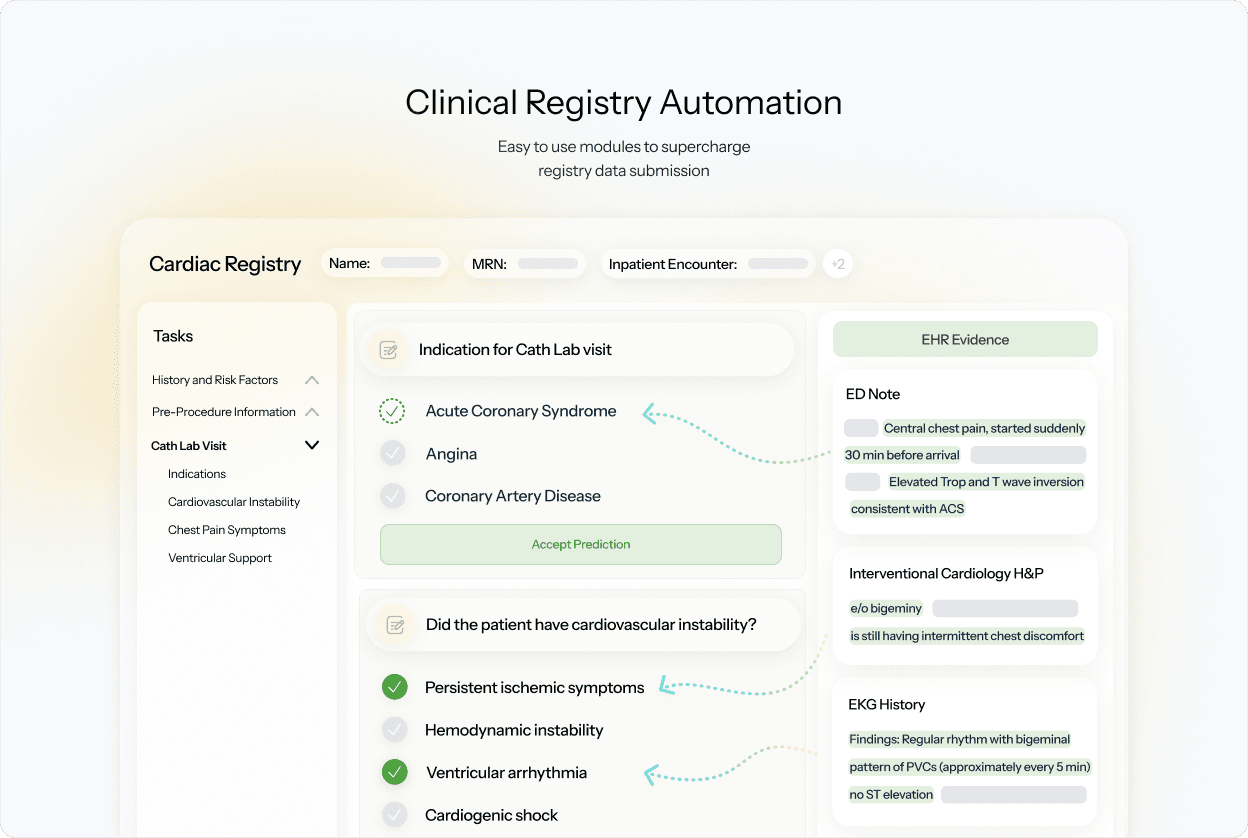
Layer's product pages show the intended workflow. A registry task presents a question, such as the indication for a cath lab visit, and the platform proposes an answer. Beside it, an evidence panel pulls the supporting text from the chart, such as an emergency department note, an interventional cardiology history and physical, and an EKG history. The abstractor can accept the prediction or correct it. In the example screen, highlighted phrases in the notes link to the answer.
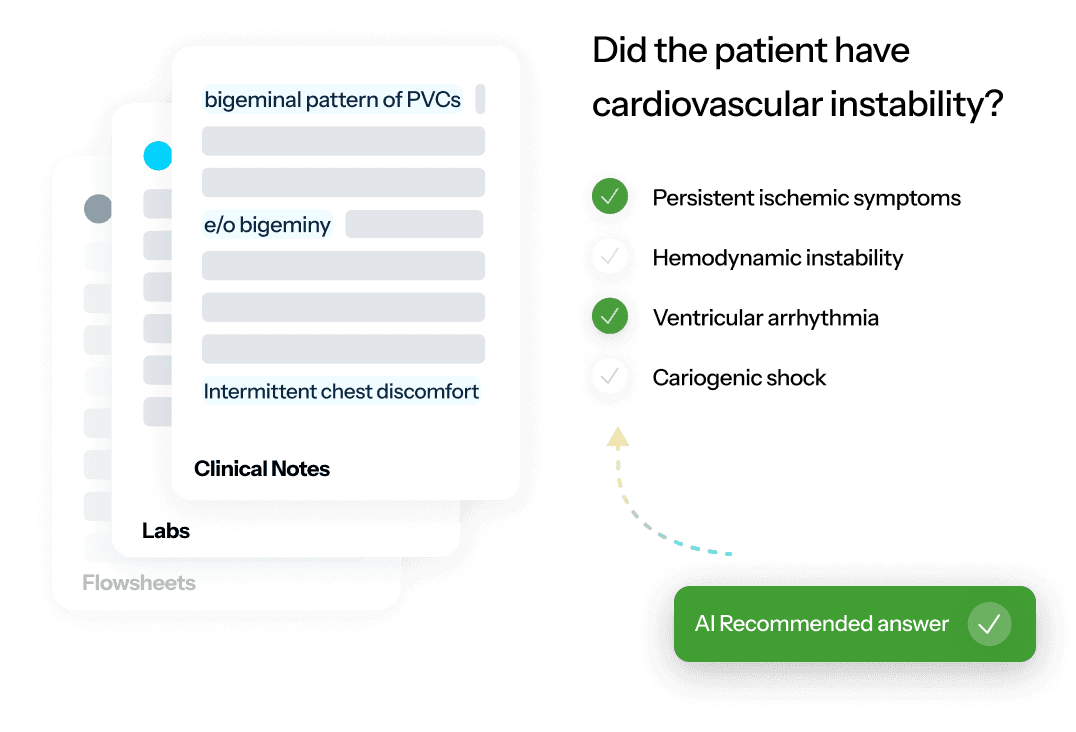
The design keeps a human in the loop. Layer's Fairview release describes the platform as giving abstractors a faster, more consistent way to work while keeping clinical judgment in their hands. That is the safer way to deploy and the one that fits registry rules, but it also means the 60% figure refers to effort, not to cases handled without review.
Layer says its platform was built by veteran AI and clinical leaders from institutions such as MIT, Harvard, Microsoft and Google, and its CEO Sontag is described in its 2025 funding release as an MIT professor (Layer Health, March 27, 2025). The company says its model reasons across the whole chart, rather than relying only on predefined rules.
Layer's run of announcements
The Banner deal is the third Layer announcement in about two weeks, and the pattern is as informative as the deal.
| Date | Announcement | Detail |
|---|---|---|
| March 27, 2025 | $21 million Series A | Led by Define Ventures, with Flare Capital Partners, GV and MultiCare Capital Partners |
| November 4, 2026 | Fairview Health Services selects Layer | Starts with the AHA Get With The Guidelines Stroke registry, then expands to the National Cancer Database and ACC NCDR registries after validation on Fairview's own data |
| November 10, 2026 | Top Innovator, 2026 Accenture HealthTech Innovation Challenge | Recognition listed on Layer's press page |
| November 19, 2026 | Banner Health invests and expands | More than a dozen registries; about 60% of abstraction effort expected to be automated |
Two differences between Fairview and Banner stand out. Fairview is starting with one registry and expanding after validation on its own data, which is the cautious path. Banner is committing to more than a dozen registries and taking equity. Both are described as multi-registry platform decisions, and both come from large systems with in-house quality teams.
The March 2025 round was $21 million. Layer's November 19 release says Banner's investment is part of the Series A financing, but it does not say whether the round was extended or how much Banner contributed.
Banner's side of the deal
Banner Health is headquartered in Phoenix and says it operates 33 hospitals, including three academic medical centers, with more than 60,000 employees across Arizona, California, Colorado, Nebraska, Nevada and Wyoming (Banner Health).
| Banner Health fact | Detail (Banner) |
|---|---|
| Headquarters | Phoenix, Arizona |
| Hospitals | 33 acute-care hospitals, including three academic medical centers |
| Employees | More than 60,000 |
| States | Arizona, California, Colorado, Nebraska, Nevada, Wyoming |
| Status | Nonprofit; largest private employer in Arizona |
Layer's release gives the reasoning in Banner's terms. Moving from an outsourced model to an in-house program is described as a strategic imperative to lower the total cost of ownership, exert greater ownership of registry data and free teams to act on that data, shifting registries from a box-checking exercise to a strategic asset for quality improvement. The release adds that Banner's choice reflects a wider movement among leading health systems away from fragmented and costly outsourced models.
Holland's quote is the clearest statement of intent. He said Layer has already demonstrated what it can do for Banner's teams, increasing speed, consistency and confidence in registry efforts, and that the reason Banner invested is how the relationship will shape quality and clinical initiatives in the future. In other words, Banner is not only buying a tool for abstraction. It is signaling that registry data, once cheaper to produce, becomes an input to improvement work.
The equity stake is the unusual part. A health system that invests in its vendor aligns its interests with the vendor's success, and it may get influence over the roadmap. It also ties its program to a company that has raised a $21 million Series A, which is modest next to the size of the systems it now serves.
Here is an illustrative way to read the 60% figure. It is a labeled example, not a Banner number: if a registry team spent 10,000 hours a year on abstraction and 60% of that effort were automated, 6,000 hours would be freed for review, quality improvement or growth in case volume. The release does not give Banner's hours, headcount or savings, so the example only shows how the percentage translates to capacity.
Competitors and context
Layer is not alone. Carta Healthcare, which says it supports more than 70 clinical registries, announced on June 16, 2026 that its Lighthouse platform now supports 21 additional registries across eight families, including ACC/NCDR, the STS National Database, AHA Get With The Guidelines, ACS quality programs, the SVS Vascular Quality Initiative, oncology, perinatal and core measures (Carta Healthcare). Carta says its hybrid approach, which pairs AI with credentialed abstractors, reduced abstraction time by up to 66% and kept inter-rater reliability above 98%, and that health systems using it have cut abstraction costs by 50% or more. On October 27, 2026, Carta reported that 11 hospitals in the ACS NSQIP program achieved an average audit score of 99.36% in 2026 using its AI-assisted platform, against 99.32% at hospitals using manual abstraction, with every site meeting the 98% benchmark (Carta Healthcare). All of these figures are company-reported.
| Approach | Example | Claim (company-reported) | Human role |
|---|---|---|---|
| Software platform, health system in-house | Layer Health at Banner | About 60% of abstraction effort automated at go-live (Banner expectation) | Abstractors validate AI answers |
| Hybrid platform with vendor abstractors | Carta Healthcare Lighthouse | Up to 66% less abstraction time; 99.36% NSQIP audit score across 11 hospitals | Credentialed abstractors approve every case |
| Outsourced abstraction | Third-party abstraction services | Not assessed here | Vendor staff do the work |
| Manual in-house abstraction | Hospital registry team | NSQIP audit score of 99.32% at comparison hospitals (Carta) | Abstractors do the work |
Carta's own data point is useful context. Its comparison shows manual abstraction already scores above 99% on NSQIP audits, so the case for AI is cost and speed rather than accuracy. Carta also argues that a general-purpose AI platform lacks registry-specific expertise, which is a direct challenge to any platform that claims breadth. Layer's counter is that the ability to read and reason over the patient record is foundational and applies beyond registries, which is how Sontag framed it.
Evidence Ladder
How should a health system judge claims like Banner's? We use five rungs.
| Rung | Question | Where Banner and Layer stand |
|---|---|---|
| 1. Mechanism | Does the system show its evidence for every answer? | Yes, per Layer: source-linked evidence |
| 2. Local validation | Has it been tested on the buyer's own charts? | Banner says Layer has already shown speed, consistency and confidence; no data published |
| 3. Audit accuracy | Does the output meet registry audit benchmarks? | Not published; Carta's 98% NSQIP benchmark shows the bar |
| 4. Capacity | Do hours saved turn into faster submissions or redeployed staff? | Banner expects about 60% of effort automated |
| 5. Economics | Is total cost of ownership lower than the outsourced model? | Stated goal; no figures |
Tier (B) for this framework, which is ours.
What it means for health systems, pharma and investors
For health systems, the lesson is sequence. Fairview and Banner both chose registries, a task with a rulebook, before anything riskier. A system that wants to test chart AI can learn from the pattern: pick a use case with an external audit, run the AI beside abstractors, and publish the audit scores internally before widening scope. Quality leaders should ask vendors for field-level accuracy against the registry's own benchmark and for the share of cases changed by the abstractor.
For pharma and life sciences, registries are also a source of real-world evidence, and Layer's 2025 release lists clinical research and real-world data abstraction among its use cases. If hospitals standardize chart-reading AI, the cost of building research-ready datasets could fall. That is a possibility, not something either company announced on November 19.
For vendors, the Banner deal sets a benchmark. A buyer that takes equity and consolidates a dozen registries on one platform raises expectations about integration depth and support. Competitors will be asked to match both the technical claim and the commercial structure.
The HealthTech Investor's Signal
The Banner deal is a customer reference and a strategic investor in one. Hospital-backed rounds can signal validation, and they can also signal a sole-source dependence. The disclosed facts are limited: a Series A that was $21 million when announced in March 2025, a Banner stake of undisclosed size, and a customer base that now includes Fairview and Banner among the systems Layer has named in its announcements. We make no price or stock calls.
What would change the picture is evidence. Audited accuracy from a named customer, a disclosed contract scale or a follow-on round with public terms would all be more informative than another press release.
Counter-thesis
The first objection is that registries are a narrow market. Abstraction is a cost line with a limited number of programs, and a platform built on it must expand into research, documentation integrity or revenue cycle to justify a large valuation. Layer's 2025 release lists those uses, but the November announcements are about registries.
The second is that manual abstraction is already accurate. If hospitals using human abstractors score above 99% on audits, as Carta's own comparison shows, AI offers savings but little quality gain, and savings depend on how registry teams are paid and staffed.
The third is vendor concentration. Banner has consolidated the majority of its registry efforts on one platform and taken equity in it. If that vendor's roadmap, price or financial position changes, Banner's switching costs will be high.
Risks and open questions
- Accuracy: no audit results from Banner's deployment have been published. Registries penalize errors, and a system that passes submission but contains mistakes can distort benchmarking.
- Definition drift: each registry changes its definitions and data elements over time. A platform must track those changes for every registry it supports.
- Oversight: the 60% figure refers to effort. Who reviews the remaining 40%, and how is a missed field caught?
- Data rights: Banner says it wants more ownership of registry data. The release does not describe how Layer may use data from Banner's charts.
- Concentration: a single platform across a dozen registries is efficient and also a single point of dependency.
- Disclosure: the investment amount is unknown, so it is not possible to judge how much influence Banner has over Layer's roadmap.
What to watch next
- Whether Banner or Layer publishes audited accuracy against AHA, ACS and ACC registry standards after go-live.
- Whether Layer announces further health system customers or a disclosed funding round.
- How Carta Healthcare and other abstraction vendors respond with comparable evidence and pricing.
- Whether Fairview's validation on its own stroke data leads to the oncology and cardiology registries on the schedule Layer described.
- Whether registry bodies such as the AHA, ACS or ACC publish guidance on AI-assisted abstraction.
The Bottom Line for Health System Leaders and Investors
What changed this week is that a 33-hospital system chose to run more than a dozen registries on one AI platform and put money into the vendor. Registries are a good public test for hospital AI because they come with rules, audits and benchmarks, and Banner has just volunteered to be measured against them.
What remains uncertain is whether the platform delivers the audit accuracy and the capacity gain Banner expects. Health system leaders should start with one audited use case, ask for field-level accuracy and review rates, and watch their dependence on a single vendor. Investors should wait for published results before treating the 60% figure as anything but a forecast.
Sources
- Layer Health: Banner Health Makes Strategic Investment in Layer Health and Implements its Clinical Registries Solution Across the Enterprise, November 19, 2026
- Layer Health: Fairview Health Services Selects Layer Health to Modernize Clinical Registry Abstraction, November 4, 2026
- Layer Health: Layer Health Raises $21 Million Series A, March 27, 2025
- Layer Health: Health Systems product page, Clinical Registry Automation
- Banner Health at a Glance
- American College of Surgeons: About the National Cancer Database
- American College of Cardiology: NCDR registry selection
- Carta Healthcare: Lighthouse expands to 21 additional clinical registries, June 16, 2026
- Carta Healthcare: Accuracy held at 99% as hospitals moved NSQIP abstraction to AI, October 27, 2026