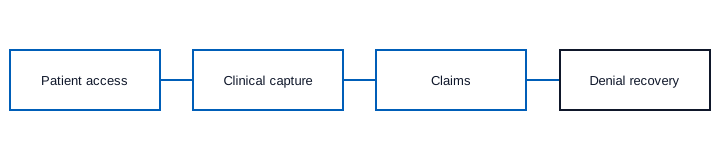
Inside a large health system's revenue cycle office, a single claim can touch an eligibility tool, a prior authorization portal, a coding product, a claim scrubber, a denial management system and a patient payment vendor before the money arrives. Each one has its own contract, login, data model and renewal date. When a denial comes back, finding where it went wrong can mean working across several of them.
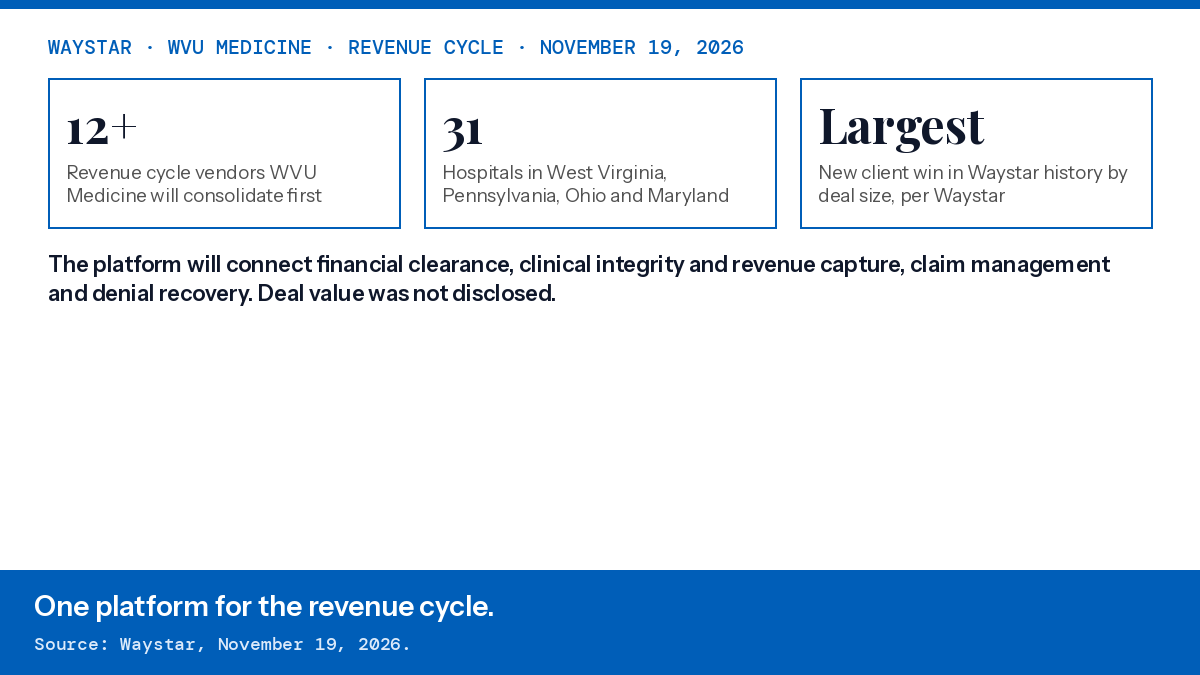
On November 19, WVU Medicine said it would stop doing it that way. It chose Waystar to replace more than a dozen revenue cycle vendors, in what
Waystar called its largest new client win by deal size. Below we look at what was agreed, why consolidation is gaining ground, who health systems are choosing between, what the 2027 prior authorization rules change, and the risks that come with putting the revenue cycle on one platform.
The vendor selection is a bet that one data layer and AI across every step will beat a dozen best-of-breed tools.
In This Deep Dive
- Why this matters now
- What actually happened
- The obvious read versus the deeper signal
- Category map and taxonomy
- Evidence Ladder
- Regulation: CMS-0057-F, prior authorization APIs and the 2027 deadline
- Capital flows and bottom-up economics
- The HealthTech Investor's Signal
- Counter-thesis
- Forward Intelligence
- The Bottom Line for Health System CFOs and Health Tech Investors
Why this matters now
Health system margins depend on getting paid accurately and on time, and the revenue cycle has become an arms race between providers and payers, each with more automation. Waystar's CEO, Matt Hawkins, put the provider view plainly in the announcement: managing the revenue cycle across dozens of disconnected solutions is no longer sustainable. His company's third-quarter results support the trend he describes, with subscription revenue up 34% and providers adopting more of its platform.
Regulation adds a deadline. Under CMS-0057-F, impacted payers, including Medicare Advantage organizations, state Medicaid and CHIP programs, and qualified health plan issuers on the federal exchanges, must meet prior authorization decision timeframes from January 2026 and implement prior authorization APIs by January 2027. As payers expose more of that process electronically, providers need systems that can connect clinical documentation to coverage rules across the whole cycle, not in separate silos.
AI raises the stakes further. Agents that check eligibility, draft appeals or flag documentation gaps work best when they can see data from every step. That favours platforms that already sit across the cycle, and it pushes health systems to ask whether a patchwork of vendors can support the automation they now want.
What actually happened
- The selection. West Virginia University Health System, operating as WVU Medicine, selected
Waystar's AI-powered platform to transform revenue cycle operations across the enterprise.
- The scope. WVU Medicine will initially consolidate more than a dozen revenue cycle vendors onto
- The goals. The release says the system aims to prevent revenue leakage, reduce denials, accelerate reimbursement and automate manual work, and that it targets millions in potential incremental reimbursement. No contract value, implementation timeline or baseline metrics were disclosed.
- The people. Bahar Bazmi, chief revenue officer for the WVU Health System, said the system is investing in technology that simplifies administration and strengthens its financial foundation. Matt Hawkins,
- The scale on each side. WVU Medicine runs 31 hospitals with more than 47,000 employees and $10 billion in operating revenues, anchored by an 890-bed academic medical center in Morgantown.

The obvious read versus the deeper signal
The obvious read: A software vendor won a big contract. Good for Waystar's numbers.
The deeper signal: The deeper signal is a change in how large health systems buy. For years, the safe choice was best-of-breed: pick the strongest tool for each step and integrate them. WVU Medicine is choosing breadth over depth, on the bet that a shared data layer lets AI catch problems earlier in the cycle, before they become denials. That shifts power toward a small number of platforms that can cover the whole cycle, including EHR vendors with their own revenue cycle tools and agents, such as Epic's Penny. It also concentrates risk, because a single outage or contract dispute now affects every step at once.
Historical playbook
The industry has also seen the outsourcing version of consolidation. R1 RCM, which takes on revenue cycle operations for health systems, was taken private in 2024 by TowerBrook and Clayton, Dubilier & Rice in a deal valued at about $8.9 billion. The choice for a system like WVU Medicine is therefore not only which software to buy, but whether to run the revenue cycle itself on a platform, hand it to the EHR vendor's tools, or outsource it.