"Nobody confuses the cameras with the car, but there is no self-driving car without them." That is how Mohan Giridharadas, founder and CEO of LeanTaaS, explained to Fierce Healthcare why his company bought a computer vision business instead of partnering with one. The metaphor is worth taking seriously. LeanTaaS has spent 15 years building what it calls the intelligence that drives hospital operations: scheduling and capacity software for operating rooms, infusion centers and inpatient beds. What it lacked was perception. It could predict when a bed would free up. It could not see that the patient in it was trying to stand.
On November 3, LeanTaaS announced it had acquired LookDeep Health and launched iQueue for Virtual Care. The headline category is virtual sitting and virtual nursing, a market hospitals already buy to cope with staffing shortages. The strategy behind it is larger. LeanTaaS wants the camera in the patient room to become one more input to the software that runs the hospital. Below we look at what was bought, why the bet is about orchestration, how it differs from the rest of the category, where the regulatory and trust lines sit, and what evidence would prove it.
Virtual sitting was sold as a way to replace a sitter. LeanTaaS is selling it as a way to give the hospital's operating system eyes.
In This Deep Dive
- Why this matters now
- What actually happened
- The obvious read versus the deeper signal
- Category map and taxonomy
- Evidence Ladder
- Regulation, privacy and international divergence
- Capital flows and bottom-up economics
- The HealthTech Investor's Signal
- Implementation priorities
- Forward Intelligence
- The Bottom Line
Why this matters now
Hospitals have been buying virtual patient observation for several years, mostly for one reason. In-person sitters, staff who watch patients at risk of falls or self-harm, are expensive and hard to find. A single remote observer watching many rooms through cameras costs less and can be staffed more flexibly. Virtual nursing grew from the same pressure: experienced nurses working remotely to handle admissions, education and discharge, so bedside nurses can focus on hands-on care.
Those programs created a new asset that most hospitals have not fully used: cameras and two-way audio and video in patient rooms. Once the hardware is on the wall, the question becomes what else it can do. Computer vision models can detect events, such as a patient sitting up, leaving the bed, or being alone for a long period, and turn them into alerts or tasks. That is the opening LookDeep was built for.
At the same time, operations software vendors have been looking for better real-time signals. Capacity management today relies heavily on what is documented in the EHR, and documentation lags reality. Giridharadas told Fierce that the physical care environment produces high-value signals "that may never reach the EHR, or may reach it too late to be useful," including whether a patient has been out of bed, when a nurse was last in the room, and whether a room is ready for the next patient. For a company whose products depend on knowing exactly when capacity becomes available, that is the missing data.
Certainty: (A) LeanTaaS's statements as reported by Fierce Healthcare; (B) the market history of virtual sitting and virtual nursing is our general summary.
What actually happened
LeanTaaS announced the acquisition and product launch on November 3, with a first-look interview given to Heather Landi at Fierce Healthcare.
The deal
- Target: LookDeep Health, a computer vision company for virtual patient monitoring.
- Terms: not disclosed.
- Sequence: LeanTaaS's second acquisition in about two months, following its purchase of care transition platform Aidin.
- People: Narinder Singh, LookDeep's co-founder and former CEO, joins LeanTaaS as SVP of ambient intelligence.
- Rationale for buying: executives said they acquired rather than partnered in order to integrate ambient intelligence deeply into iQueue.
The product
- iQueue for Virtual Care: Virtual Observation for AI-assisted monitoring and escalation; Virtual Nursing for admissions, rounding, patient education and discharge preparation; Virtual Medicine connecting patients with remote physicians and specialists.
- Hardware approach: works with compatible cameras and in-room devices already in place, or supported hardware as needed. Giridharadas: "Vendor-specific camera silos will not last as health systems demand greater interoperability."
- Workflow: AI surfaces events to a virtual observation team, which can assess, engage the patient remotely or escalate to bedside staff. Urgency and routing follow the patient's context and the health system's protocols, and human clinicians remain responsible for clinical decisions.
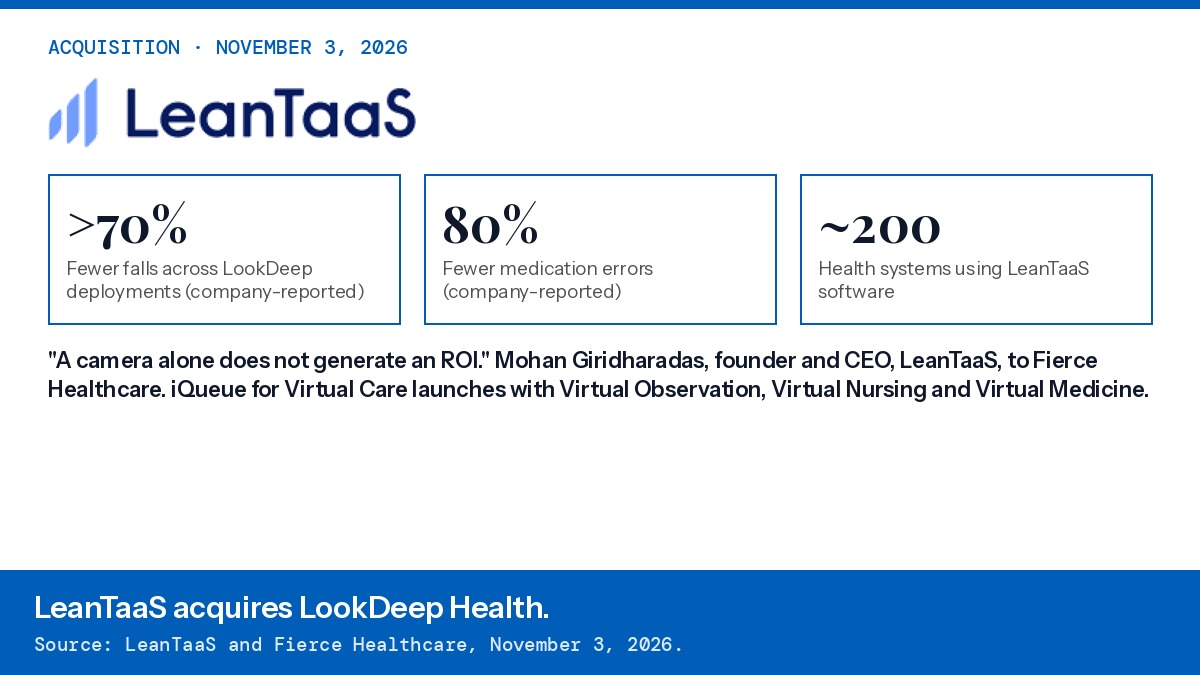
- Reported results: across LookDeep deployments and operating models, company-reported reductions of more than 70% in fall rates, twice as much nursing contact, 80% fewer medication errors and what the company describes as "3x cost savings" versus traditional virtual sitting, according to the companies. LeanTaaS says LookDeep's vision AI has been evaluated in peer-reviewed research.
- Roadmap: "We will bring the vision capability into all of our products beginning with inpatient flow and operating rooms and then moving on to infusion centers and other areas of the hospital."
LeanTaaS says its software and services are used by nearly 200 health systems in more than 1,200 hospitals, centers and clinics in the US.
Certainty: (A) deal facts, product scope and quotes from LeanTaaS and Fierce Healthcare; (B) the outcome figures are company-reported, reported across different deployments and operating models, and not presented with study designs or baselines.
The obvious read versus the deeper signal
The obvious read: a hospital operations software company has bought a virtual sitting vendor to cross-sell into its customer base. That is true, and on its own it would be a sensible, ordinary deal.
The deeper signal: LeanTaaS describes itself as building "the central nervous system of healthcare operations," and it treats vision as a sense organ for that system rather than a product line. Giridharadas put the goal plainly: "The value is in closing the gap between knowing and doing." In operations terms, most hospital capacity problems are not prediction problems. They are latency problems. The bed is clean but nobody has marked it clean. The patient is ready for discharge but transport has not been called. The operating room turned over early but the next case was not pulled forward. If a camera can see those states as they happen, scheduling software can act minutes or hours earlier.
Three implications follow. First, the buyer changes. Virtual sitting is usually bought by nursing leadership as a staffing and safety tool. Vision as an operations input is bought by the COO and capacity leaders, with a different budget and a different ROI case. Second, the data asset changes. A virtual sitting vendor sees fall risk. An orchestration platform with vision across rooms, ORs and infusion chairs could see the physical tempo of the whole hospital, which is very hard for a competitor to reproduce. Third, the integration fight changes. The EHR is the system of record. LeanTaaS is positioning iQueue as the system of action that "combines data from EHRs, clinical AI and ambient technologies." That is a direct claim on territory EHR vendors also want.
The open hardware stance is the quiet part of the strategy. By promising to work with existing compatible cameras, LeanTaaS lowers switching costs for hospitals that already bought virtual sitting hardware from someone else, and turns competitors' installed hardware into potential inputs for its own software.
Certainty: (A) LeanTaaS's stated strategy and roadmap; (B) the latency framing and implications for buyers and EHR vendors are our analysis; (C) whether vision signals will be accurate and timely enough for operations use at scale.