How many places does a clinician look before making a hard call? In a typical clinic day the answer is several: a drug reference, a risk calculator on a website, a guideline PDF, a review article, a colleague down the hall. Each one sits outside the chart. Each one costs a few minutes and a little attention. Multiply that by every complex patient and the cost is real, even if nobody bills for it.
On November 3, Mayo Clinic Platform launched a product aimed squarely at that detour. Its new AI-enabled Clinical Decision Support solution offers a specialty-specific chat and 22 clinical calculators, with integration available in a growing number of EHR environments, built on Mayo Clinic knowledge and its subspecialty model of care. The launch is modest in scope and careful in language. Its strategic intent is not modest at all. Below we look at what launched, why distribution is the real story, how it compares with the other contenders for the point-of-care answer, where the regulatory lines sit, and what evidence would make it matter.
Clinical reference used to be a place clinicians went. Mayo is betting it becomes something that arrives inside the chart, with a famous name attached.
In This Deep Dive
- Why this matters now
- What actually happened
- The obvious read versus the deeper signal
- Category map and taxonomy
- Evidence Ladder
- Regulation and international divergence
- Capital flows and bottom-up economics
- The HealthTech Investor's Signal
- Implementation priorities
- Forward Intelligence
- The Bottom Line
Why this matters now
Three things have changed in the past two years. First, large language models made conversational clinical reference practical. A clinician can ask a question in plain language, about a specific patient context, and get a synthesized answer with citations, rather than reading a long topic review. AI-native evidence tools built on that idea have spread quickly among physicians, often through individual sign-ups on phones rather than enterprise contracts.
Second, the incumbents responded. The established clinical reference publishers have added generative AI to their products, and EHR vendors have been building AI assistants directly into their own platforms. The point-of-care answer has become a contested space, with publishers, EHR vendors and AI-native startups all claiming it.
Third, health systems have become more cautious buyers. CMIOs and AI governance committees now ask where an answer came from, how often the underlying evidence is refreshed, who is accountable when it is wrong, and whether the tool runs inside the organization's approved workflow. A tool that a clinician installs on a personal phone answers none of those questions well. A tool that runs inside the EHR, under an enterprise agreement, answers several of them.
Mayo Clinic Platform arrives in that market with something the startups lack and the publishers have only partly: a clinical brand that physicians already treat as an authority, and a subspecialty structure it can map onto the product. Its press release says the chat "reflects Mayo Clinic's subspecialty model of care." That is the differentiation it is selling.
Certainty: (A) Mayo's description of the product and its positioning; (B) the competitive shifts described here are our summary of a widely reported market trend, not a measured market share analysis.
What actually happened
Mayo Clinic Platform announced the CDS solution on November 3 through the Mayo Clinic News Network, with coverage the same day from HCI Innovation Group, HIT Consultant and Becker's Hospital Review.
The product at launch
- Integration: the solution "can be integrated directly within a growing number of electronic health record (EHR) environments." Mayo did not name the EHRs.
- Availability: Mayo Clinic clinicians, and healthcare professionals at organizations participating in Mayo Clinic Platform's healthcare provider programs. Access begins in November 2026.
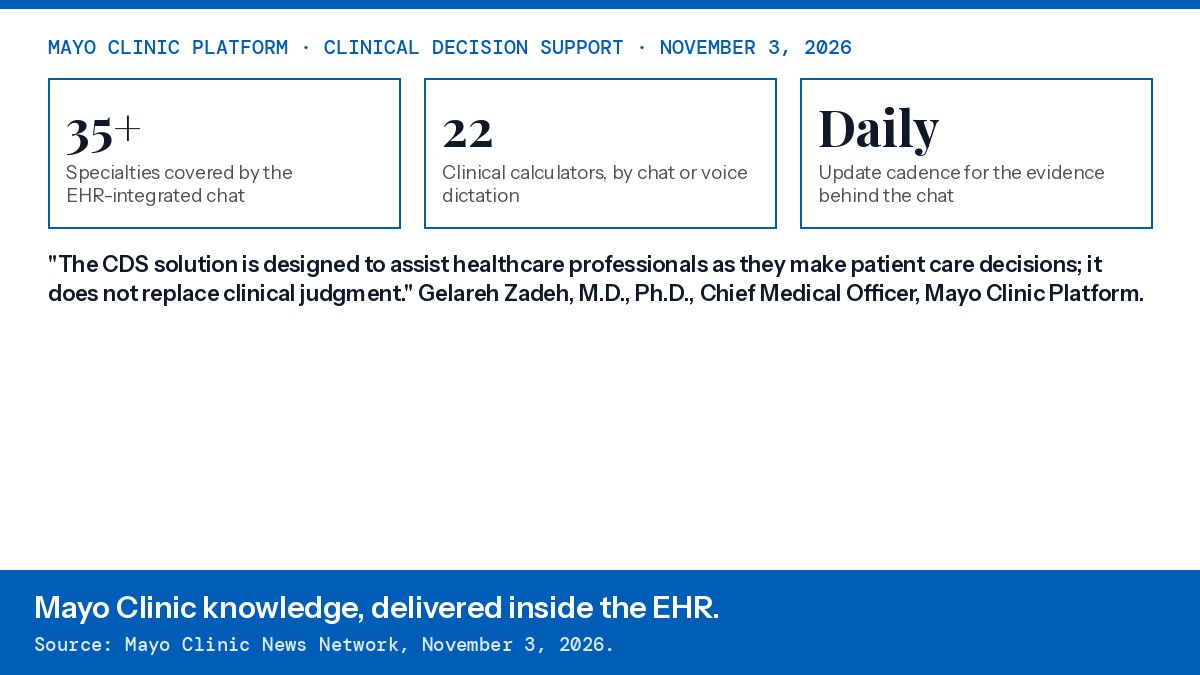
- Specialty chat: powered by a large language model, covering more than 35 specialties, surfacing information "to help clinicians reason through complex cases," citing peer-reviewed literature and updated daily.
- Calculators: 22 clinical calculators, accessible by chat or voice dictation, providing "industry-standard medical information and evidence-based decision support." Proprietary Mayo Clinic-developed calculators are included.
- Roadmap: the solution "is designed to evolve as more tools are added to the Mayo Clinic Platform experience."
What Mayo said
Maneesh Goyal, chief operating officer of Mayo Clinic Platform, framed the problem as search time: "Clinicians have access to a vast amount of medical knowledge, but finding relevant information for individualized patient care takes valuable time." The product, he said, lets clinicians "spend less time searching for information across multiple resources and more time focused on patient care."
Gelareh Zadeh, M.D., Ph.D., chair of the Department of Neurosurgery at Mayo Clinic in Rochester and the David C. and Flora C. Pratt Distinguished Chief Medical Officer for Mayo Clinic Platform, drew the line on autonomy: "The CDS solution is designed to assist healthcare professionals as they make patient care decisions; it does not replace clinical judgment." She added that Mayo physicians gave feedback on the tools.
Mayo also restated its responsible AI approach: evaluation for safety, effectiveness, privacy, security and clinical value, with human oversight and ongoing monitoring. It did not publish evaluation results, accuracy figures, pricing or a list of participating organizations.
Certainty: (A) product scope, availability and quotes as published by Mayo Clinic; (A) the absence of disclosed EHR partners, pricing and evaluation data at launch.
The obvious read versus the deeper signal
The obvious read: a famous health system has built a medical chatbot. It cites literature, it has calculators, and it lives in the EHR. Another entrant in a crowded field of AI clinical assistants.
The deeper signal: look at the distribution model. Mayo is not selling an app to individual clinicians, and it is not just licensing content to a publisher. It is delivering its own knowledge layer inside the workflows of other organizations, through its platform network. That is a different business. It turns Mayo's subspecialty expertise, historically delivered through referrals, second opinions and publications, into software that reaches the point of care at many sites at once.
Three implications follow. First, the answer moves to the chart. If clinicians can get a cited, specialty-specific answer without leaving the EHR, the standalone reference and the phone app both lose a reason to be opened. Second, brand becomes a feature. In a market where governance committees worry about where answers come from, "built on Mayo Clinic knowledge" is a selling point that a startup cannot copy. Third, Mayo's platform strategy gets a product that every participating organization can use every day. Platform programs built around data collaboration and AI development are valuable but abstract. A daily clinical tool makes membership concrete.
There is a fourth point that matters for the rest of the market. The calculators are quiet but important. Risk calculators are among the most used decision aids in medicine, and they are often run on external websites with manual data entry. Bringing 22 of them into the chat, with voice dictation and proprietary Mayo calculators included, is the kind of unglamorous utility that can drive daily use more reliably than open-ended chat.
Certainty: (A) the distribution model as described by Mayo; (B) the implications for competitors and for platform membership are our analysis; (C) whether clinicians will in fact shift their reference habits to the in-EHR tool.