An emergency physician at a children's hospital sees a feverish six-week-old at 3 a.m. The hospital has a carefully built pathway for exactly this patient: which labs, which cultures, when a lumbar puncture is indicated, who can go home. It lives in a PDF on the intranet, two clicks behind a SharePoint login, last updated after a committee meeting the physician did not attend. The national guideline is easy to find. The local version, the one the hospital actually expects to be followed, is not.
On November 12, Abridge said its AI assistant will now find that local version for the clinician, matched to the patient in the chart, with a link back to the original. It sounds like a small feature. Our view is that it marks a shift in what ambient AI companies are competing over: not only who writes the note, but who answers the clinician's first question, and whose rules that answer follows. What follows is how that market is forming, what governs it and where it could break.
A national guideline tells a clinician what is reasonable. A local pathway tells them what this hospital expects. The AI that delivers the second one is doing governance, not just search.
In This Deep Dive
-
Why this matters now
-
What actually happened
-
The obvious read versus the deeper signal
-
Category map and taxonomy
-
Evidence Ladder
-
Where the rules sit: decision support, transparency and institutional duty
-
Capital flows and bottom-up economics
-
The HealthTech Investor's Signal
-
Counter-thesis
-
Forward Intelligence
-
The Bottom Line for CMOs, CMIOs and Clinical AI Investors
Why this matters now
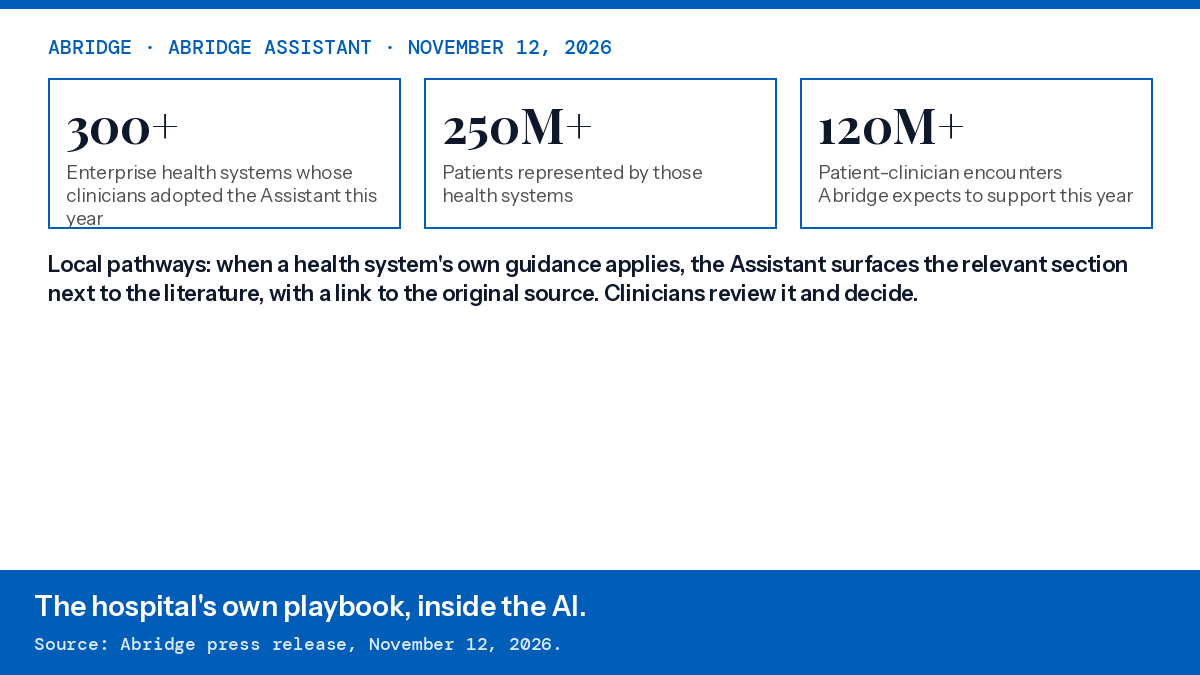
First, ambient AI has become infrastructure. Abridge says the Assistant alone has been adopted by clinicians at more than 300 enterprise health systems this year and the platform will support more than 120 million encounters. When a product is already open in the clinician's workflow for every visit, the incremental cost of using it for decisions as well as documentation falls close to zero.
Second, clinical AI answers are converging. Several assistants can now summarize a chart and cite the literature. What they cannot easily copy is each customer's own content: the order sets, care pathways, antimicrobial guidance and protocols a health system has spent years agreeing. Those documents encode local formularies, resources and risk tolerance, and they are what quality and safety leaders are accountable for.
Third, the policy climate has shifted toward lighter federal rules and heavier institutional responsibility. ONC's HTI-5 final rule, published in late October 2026, removed 14 of 60 health IT certification criteria and, according to trade press, dropped the AI source-attribute transparency requirements HTI-1 had introduced for EHR decision support. With fewer federal requirements on vendors, health systems carry more of the burden of deciding which AI guidance is trustworthy in their own walls. A tool that routes clinicians to the institution's own vetted content fits that reality.
Certainty: (A) adoption and encounter figures are Abridge's; HTI-5's scope is from ONC and Fierce Healthcare; the model card point is as reported by trade press; (B) the convergence of assistant answers and the governance framing are our interpretation.
What actually happened
-
The announcement: on November 12, 2026, Abridge announced support for local pathways in the Abridge Assistant. When an applicable institutional pathway is identified, the Assistant surfaces the relevant content from that pathway alongside relevant medical literature, with a link to the original source so the clinician can review the full guidance.
-
The context: the Assistant is connected to the patient's chart and the clinician's workflow, so pathways are matched to the patient in front of them. It already summarizes what has changed since the last visit across clinicians, labs and vitals, runs pre-filled medical calculators, drafts handoff letters and answers clinical questions with cited sources.
-
The example: for an infant who presents to the emergency department with fever, the clinician can review the hospital's pathway, which sets out which evaluation is indicated at that age and which next steps depend on the results.
-
The guardrails: Abridge says clinicians review the source and determine how the pathway applies using their own judgment, and that the Assistant runs on infrastructure that has already passed each institution's security and data governance review. Health systems can enable it for every clinician through their existing Abridge deployment.
-
The scale: clinicians across more than 300 enterprise health systems representing over 250 million patients have adopted the Assistant since its launch earlier this year, according to Abridge. The company says its platform will support more than 120 million patient-clinician encounters this year, has been validated in 28+ languages, and was named Best in KLAS for Ambient AI in 2025 and 2026.
-
People: Shiv Rao, MD, a cardiologist who co-founded Abridge in 2018 and leads it as CEO, said health systems have put years of clinical expertise into defining how to care for their patients and those pathways should be accessible at the point of decision. Physician informatics leaders at UCI Health and Dayton Children's Hospital were quoted emphasizing workflow fit, easy source review and clinician control.
Certainty: (A) all product details and figures are from Abridge's November 12 release; no independent usage data or outcome data have been published for local pathways.
The obvious read versus the deeper signal
The obvious read: An ambient AI company ships another feature, this time a smarter search over hospital documents.
The deeper signal: Abridge is moving from note writer to the clinician's default reference, and doing it with content its competitors cannot license: each customer's own rules. Once a health system's pathways are indexed, maintained and surfaced through one assistant, that assistant becomes part of how the institution enforces its standard of care. That is a stickier position than documentation, and it puts Abridge in direct competition with clinical reference publishers, standalone evidence engines and the EHR vendors' own assistants.
Certainty: (A) the product scope is from the release; (B) the competitive implications are our interpretation.
Historical playbook
Health systems have tried to put local guidance at the point of care for decades. Order sets and care pathways built into computerized provider order entry in the 2000s and 2010s were the main tool, and integrated systems such as Intermountain Healthcare showed that standardized care process models could reduce unwarranted variation. The lesson was that guidance works when it is embedded in the workflow, kept current and owned by clinicians, and fails when it becomes a library nobody maintains.
The cautionary precedent is the proprietary EHR alert and prediction model. A 2021 external validation in JAMA Internal Medicine found that a widely deployed vendor sepsis prediction model performed far worse in one health system than its developer had reported. The lesson for AI that surfaces guidance is twofold: local validation matters, and tools that interrupt or steer clinicians must be measured in the institution where they run, not just in the vendor's evaluation.