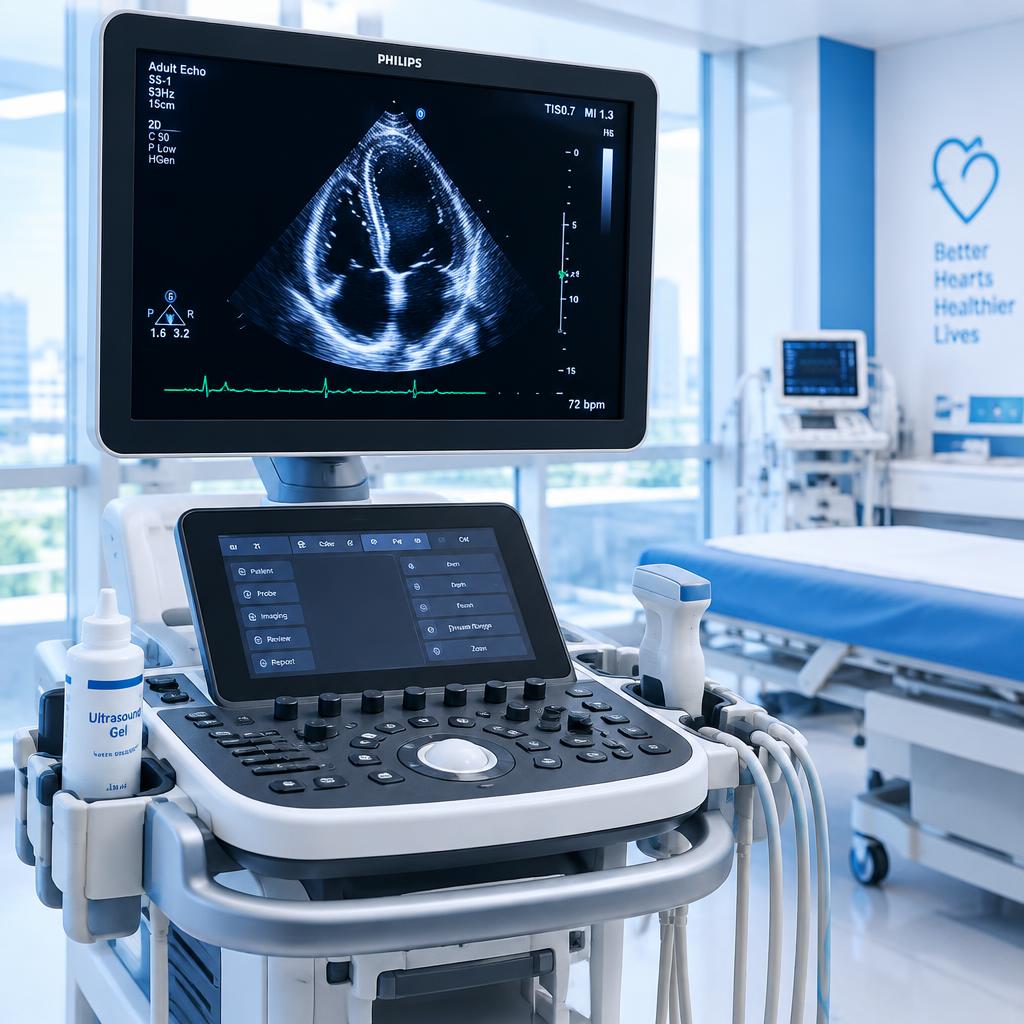
Every echo lab has a queue. Sonographers acquire the images, a cardiologist reads them, and in many labs a sonographer or a fellow writes a preliminary draft so the reading physician can edit rather than start from a blank page. The draft is where much of the time goes, and it is invisible in most productivity metrics because nobody bills for it. AI ECHO INSIGHT, presented on November 9 at the American Heart Association Scientific Sessions in Chicago, put an AI model into that exact slot and asked a narrow question: when cardiologists cannot tell who wrote the draft, do they change the AI's work more often?
They did not, at least not meaningfully. That result is more useful than another accuracy benchmark, because it tests the AI where the work actually happens. Below we walk through what the trial measured, why its design matters, where it sits among echo AI tools already on the market, and why the economic winner may not be the model developer at all.
AI ECHO INSIGHT did not test whether AI can see a heart. It tested whether a cardiologist treats an AI draft differently from a colleague's, and found no meaningful difference.
In This Deep Dive
- Why this matters now
- What actually happened
- The obvious read versus the deeper signal
- Category map and taxonomy
- Evidence Ladder
- Regulation: who has to authorize an AI that writes the report
- Capital flows and bottom-up economics
- The HealthTech Investor's Signal
- Evidence boundaries
- Forward Intelligence
- The Bottom Line for Cardiology Service Line Leaders and Imaging Investors
Why this matters now
Echocardiography is the most widely used form of cardiac imaging, and the AHA release cites projections from the U.S. Health Resources and Services Administration of a national shortfall of about 7,000 cardiologists by 2036, referenced in a July 2026 Journal of the American Heart Association study. Echo volume does not wait for workforce planning. When reading capacity is tight, the minutes per study become the constraint on turnaround time, and turnaround time becomes a constraint on discharge, surgery scheduling and outpatient access.
AI in echo is not new. Measurement automation, acquisition guidance and single-disease detection tools have been cleared by FDA for years. What has been missing is prospective, randomized evidence that a model can produce a complete preliminary report, spanning structure, function, valves and measurements, of a quality that clinicians accept at the same rate as human drafts. Most published work compares a model with a reference read after the fact. A randomized, blinded design that embeds the model in the reading workflow is a different kind of evidence.
The timing also matters. The model family behind the trial, EchoPrime, was published in Nature in November 2025 as a vision-language model trained on more than 12 million echo videos paired with cardiologist interpretations, and released as open source. A year later, the same research network has a randomized workflow result. That cadence, from model paper to prospective trial in about twelve months, is faster than most imaging AI has moved, and it was possible because one integrated system controlled the data, the readers and the workflow.
Certainty: (A) workforce projection as cited in the AHA release; (A) EchoPrime training scale and open-source release from Kaiser Permanente Division of Research; (B) our characterization of what prior echo AI evidence lacked.
What actually happened
- Presentation: November 9, 2026, late-breaking science at the AHA Scientific Sessions in Chicago (meeting dates November 6 to 9). The AHA notes abstracts are not peer reviewed and are considered preliminary until published in full.
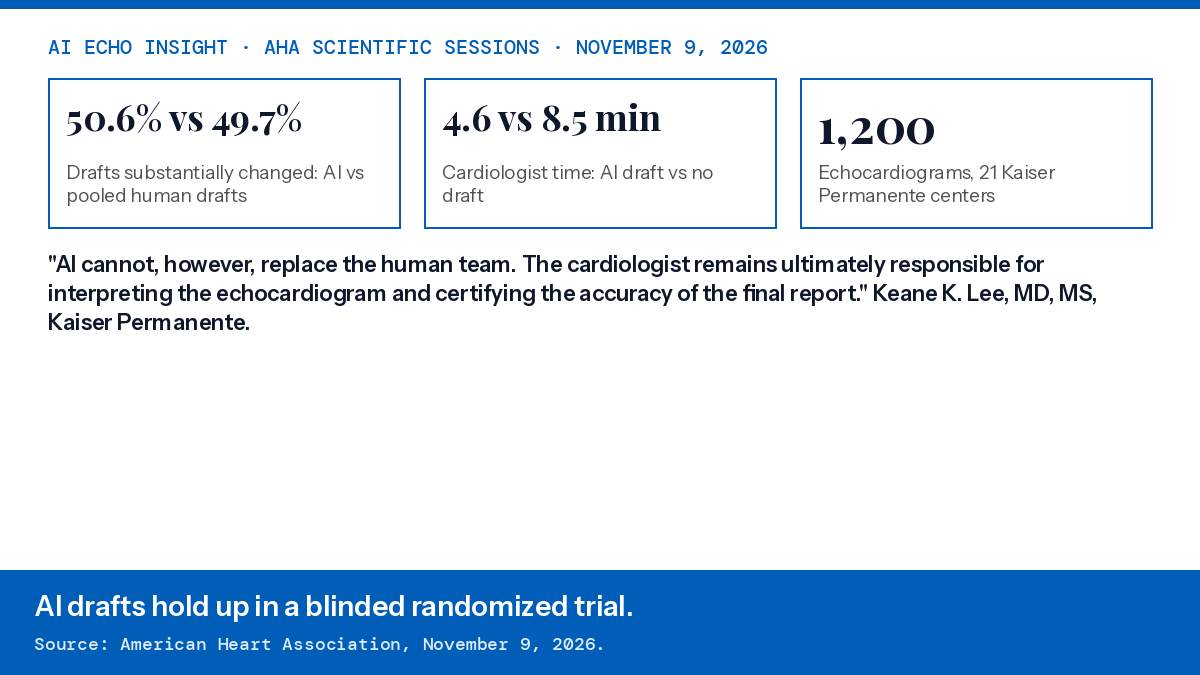
- Design: Prospective, randomized, blinded. For each of 1,200 historical transthoracic echocardiograms, an AI model, a sonographer and a cardiologist each prepared a preliminary report. Drafts were randomly assigned to cardiologists, who finalized them without knowing the source. The published protocol describes 1,000 consecutive unselected studies plus 200 with moderate or greater valvular disease.
- Setting and readers: Exams performed over two weeks in March 2025 in hospital and outpatient settings across 21 Kaiser Permanente Northern California medical centers. Nine sonographers (average 7.2 years of experience) and 20 cardiologists (average 11.7 years) took part.
- Population: Average patient age 69; 47% women. About 54% self-identified as white, 16% Hispanic, about 16% Asian, 8.8% Black and 5.8% other.
- Primary endpoint: Rate of substantial change between preliminary and final report. AI drafts: 50.6%. Pooled sonographer and cardiologist drafts: 49.7%. Healio reports the upper confidence limit of the difference fell below the prespecified 5% noninferiority margin, with P for noninferiority = .0035.
- Time: Cardiologists spent an average of 4.6 minutes reviewing and finalizing AI drafts versus 8.5 minutes producing a report without AI assistance, about 46% less, per the AHA release. Healio adds that any preliminary draft, human or AI, cut reading time to roughly 280 seconds from about 507 seconds.
- Consistency: AI-assisted final reports agreed more often with historical reports in the medical record. Lee described agreement across workflows ranging between 77% and 82%, with less variability under AI assistance.
- Blinding check: Reviewing cardiologists could not identify whether a draft came from the AI, a sonographer or another cardiologist.
- Model: Healio reports the model as EchoPrime/EchoNet, developed by Lee and colleagues. The AHA release does not name a commercial product, and neither source states an FDA authorization for this use.
- People: Co-senior author Keane K. Lee, MD, MS, is a cardiologist at Kaiser Permanente Santa Clara Homestead Medical Center and a clinical investigator in the Kaiser Permanente Northern California Division of Research. The protocol paper lists co-authors including Andrew P. Ambrosy, Alan S. Go, Vincent Liu, David Ouyang and Bryan He.
- Limitations stated by the investigators: No test of long-term patient outcomes; cardiologists knew they were in a study and may have changed their usual habits; more research is needed at larger scale and volume.
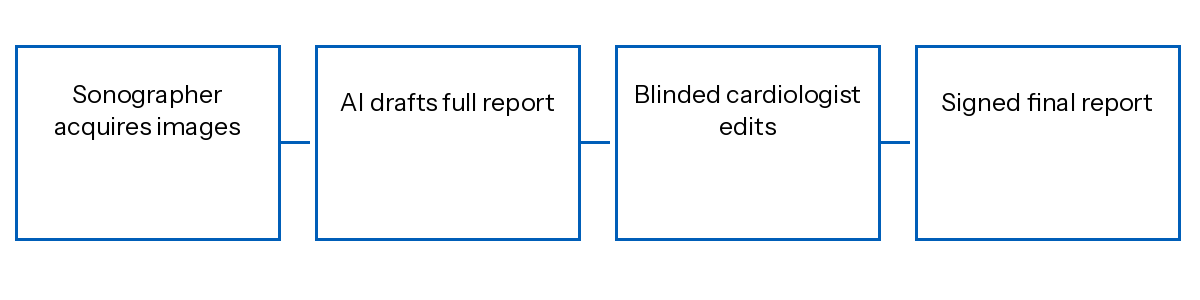
Certainty: (A) design, population, primary result and timing from the AHA release and the KP protocol listing; (A) noninferiority statistics and model name as reported by Healio from the presentation; (C) none of the above includes outcomes data, because the trial did not collect it.
The obvious read versus the deeper signal
The obvious read: AI now reads echocardiograms as well as cardiologists, so labs can cut physician reading time in half.
The deeper signal: the trial compared drafts, not final reads, and the cardiologist stayed in the loop for every study. The reading-time saving is real but largely comes from having any draft at all; human drafts saved similar time. So the strategic change is that the drafting step, which today consumes sonographer and trainee time and is not separately paid, can be automated without a measurable quality penalty. That shifts value toward whoever controls the reading workflow and away from the idea of AI as an autonomous reader. It also makes the half of drafts that still needed substantial changes, for humans and AI alike, the most interesting number in the trial: echo reporting has a high baseline edit rate, and the AI matched it rather than solved it.
Certainty: (A) the comparison structure and the 50.6% versus 49.7% rates; (B) our inference that the drafting step is the main locus of value; (C) the commercial implications.
Historical playbook
The closest precedent comes from the same research network. In 2023, Nature published EchoNet-RCT, a blinded randomized trial of sonographer versus AI assessment of left ventricular ejection fraction. Cardiologists substantially changed 16.8% of AI initial assessments versus 27.2% of sonographer assessments, and the AI met both noninferiority and superiority criteria. That trial covered one measurement. AI ECHO INSIGHT covers the entire report, and the result is noninferiority rather than superiority, which is what you would expect when the task broadens from one number to dozens of findings.
The pattern resembles how radiology adopted computer-aided detection: the first tools that stuck were narrow, measurable and attached to a physician sign-off, and broader report generation followed only when evidence and workflow integration caught up. In echo, measurement automation and acquisition guidance came first, with FDA-cleared tools from several vendors. Full-report drafting is the next layer, and it inherits the same rule: the physician signs, so the physician's workflow decides adoption.
A second lesson concerns integrated systems. Kaiser Permanente owns the data, employs the readers and runs the labs, so it can randomize drafts across 21 centers without negotiating with separate hospitals and vendors. Integrated delivery systems have repeatedly been early sites for workflow evidence in digital health. The question for everyone else is whether the result transfers to fee-for-service labs, academic centers with fellows writing drafts, and community practices with different vendor stacks.