For decades, the default treatment for heart block has been a pacemaker lead in the right ventricle. It prevents dangerous slow rhythms and has saved countless lives, but pacing only the right side can make the ventricles contract out of step. Over time, in some patients, that mismatch weakens the heart. Left bundle branch pacing tries to avoid the problem by delivering the signal into the heart's own conduction system.
On November 8, the OptimPacing trial gave the most direct randomized comparison so far. It stopped early because left bundle branch pacing was superior on a composite of death, heart failure hospitalization and pacing-induced cardiomyopathy. The result is important, and it is also narrower than a headline of fewer deaths. We walk through what changed, what did not, and what each audience should do with it.
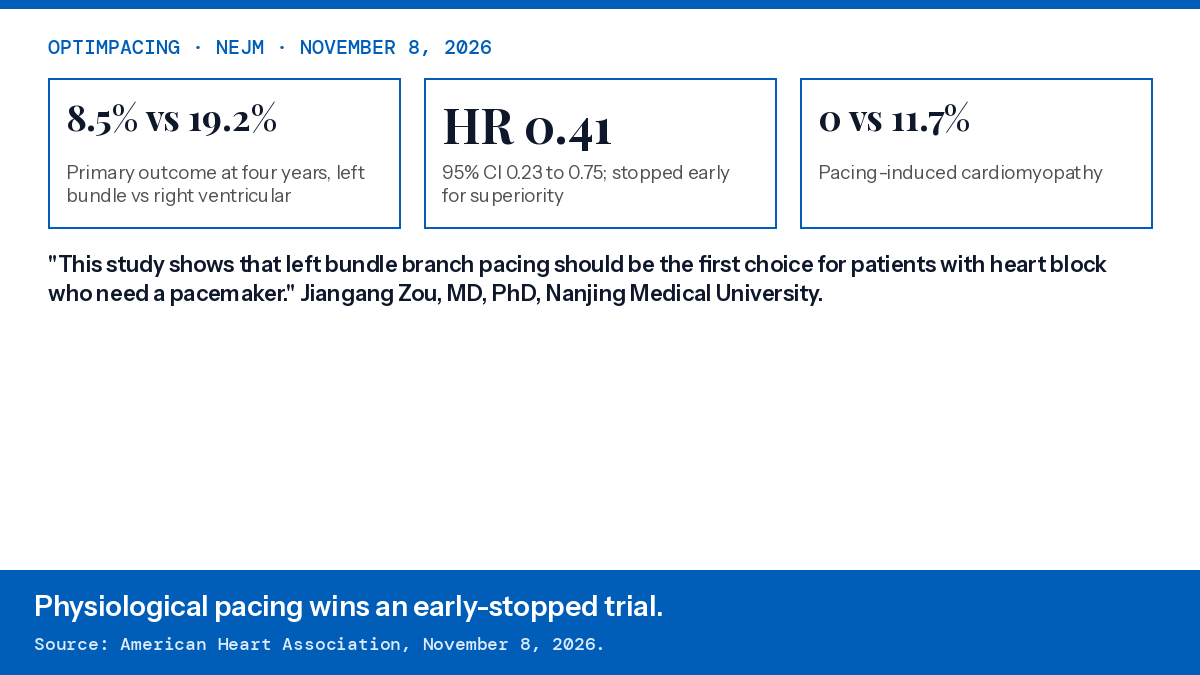
The benefit is real and concentrated: pacing-induced cardiomyopathy fell from 11.7% to zero, but all-cause death was nearly identical, at 7.4% and 7.7%.
In This Deep Dive
- Why this matters now
- What actually happened
- The obvious read versus the deeper signal
- Category map and taxonomy
- Evidence Ladder
- Regulation, labeling and guidelines
- Capital flows and bottom-up economics
- The HealthTech Investor's Signal
- Evidence boundaries
- Forward Intelligence
- The Bottom Line for Electrophysiology Leaders and Device Strategists
Why this matters now
Pacemakers are among the most common implanted cardiac devices, and a meaningful share of patients need them because of heart block. If a different lead position reduces heart failure and cardiomyopathy, the effect scales across a large population and a mature device market. Evidence of that kind can change implant technique, lead design, training and guidelines.
Conduction system pacing has been moving from the margins to the mainstream on observational data and physician preference. Medtronic received FDA approval for expanded labeling of its Model 3830 lead for left bundle branch area pacing on October 17, 2022, the first lead so labeled, and Boston Scientific received an expanded indication for INGEVITY+ pacing leads on September 17, 2024. Regulatory labeling followed practice. OptimPacing is the type of randomized evidence that practice has been waiting for.
The trial also illustrates a broader HealthTech lesson. A composite endpoint can be real and still hide which component moves. Here the composite benefit comes from pacing-induced cardiomyopathy and heart failure hospitalization, with no visible difference in death at the interim analysis. That matters for how clinicians counsel patients and how payers and device makers describe the finding.
For hospital and device leaders, the immediate effect is on conversations rather than contracts. Electrophysiologists who already implant left bundle branch leads will cite the trial; those who do not will be asked why. Training capacity, procedure time and complication profiles will matter as much as the headline hazard ratio.
Certainty: (A) trial results and approval dates from the AHA release, ACC summary, Healio coverage and company announcements; (B) our reading that practice preceded evidence; (C) market implications are analysis.
What actually happened
- Presentation date: November 8, 2026, at the AHA Scientific Sessions (late-breaking abstract 27841), with simultaneous publication in NEJM (doi:10.1056/NEJMoa2612972).
- Design: Investigator-initiated, international, multicenter, open-label, randomized trial. Sponsor listed in the registry (NCT04624763): The First Affiliated Hospital with Nanjing Medical University.
- Population: 702 patients with an indication for permanent pacing and high ventricular pacing burden, left ventricular ejection fraction above 35% and NYHA class I to III; 685 were in the modified intention-to-treat analysis (mean age 68; 58% men). AHA reports 17 centers in mainland China, Hong Kong, the United Kingdom, Poland and the United States between June 2021 and January 2025.
- Interim analysis: Planned when at least 50 primary events had occurred, with early termination allowed for p below 0.003. It occurred at a median follow-up of 35.1 months after 51 events.
- Primary outcome: Death, heart failure hospitalization or pacing-induced cardiomyopathy: 16 patients (8.5% at four years) with left bundle branch pacing versus 35 (19.2%) with right ventricular pacing; HR 0.41 (95% CI 0.23 to 0.75).
- Components: Pacing-induced cardiomyopathy: none versus 11.7%. Heart failure hospitalization: 1.5% versus 2.9%. All-cause death: 7.4% versus 7.7% (Healio).
- Secondary signals: Left ventricular volumes were lower and ejection fraction higher with left bundle branch pacing; pacing thresholds, sensing and impedance were stable in both groups (Healio).
- Interpretation by the authors: Zou said the difference between groups was greater than expected and that the study supports left bundle branch pacing as first choice for patients with heart block who need a pacemaker; he also called for research on which technique suits which patients, comparisons of conduction system approaches, and long-term safety and cost-effectiveness.
- Authors and discussant: Jiangang Zou, MD, PhD, professor of cardiology at the First Affiliated Hospital, Nanjing Medical University, is the senior author; the reference lists Qian Z as first author. Elaine Wan, MD, of Columbia University Medical Center, discussed the results and discloses consulting for Boston Scientific; Zou reports no relevant financial disclosures.
- Limitations stated by the authors: Early termination may overestimate benefit and reduce precision; most patients had normal ejection fraction; all left bundle branch procedures used the same lead type.
- What this is not: It is not a guideline change, not proof of a survival benefit and not evidence for other lead models or for patients with already reduced ejection fraction.
Certainty: (A) numbers and design from the AHA release, ACC summary and Healio; (B) registry sponsor and masking labels may differ across sources, so we cite the release's description; (C) final box is our framing.
The obvious read versus the deeper signal
The obvious read: left bundle branch pacing beats the standard, so every pacemaker patient should get it and survival will improve.
The deeper signal: the effect is mostly on cardiomyopathy and heart failure hospitalization at a median 35 months, in patients with mostly normal ejection fraction, using one lead type, in a trial stopped early. Survival did not separate at this point. For device companies, hospitals and guideline committees the question is not whether physiological pacing has merit but which patients, which lead and how much follow-up are required to convert a strong composite into a durable standard.
Certainty: (A) component results and limitations; (B) the interpretation that survival is unresolved rather than absent; (C) commercial implications.
Historical playbook
Right ventricular pacing has been standard since the early decades of pacemakers because it is simple and reliable. Concerns about pacing-induced cardiomyopathy grew with long-term follow-up of patients with high pacing burden. Biventricular pacing and His bundle pacing emerged as alternatives, and left bundle branch area pacing arrived later as a technique that many implanters found easier than His bundle pacing.
Regulators and companies followed implanter behavior. Medtronic described its 2022 approval as the first for pacing the heart's natural conduction system, and Boston Scientific expanded INGEVITY+ labeling in 2024 using data from about 400 patients in the INSIGHT-LBBA analysis plus bench testing. The labeling approvals showed safety and feasibility for the technique; OptimPacing is the first large randomized clinical comparison of its kind.
The history also warns about premature certainty. Pacing technique debates have swung before, and a single randomized trial, particularly one stopped early, rarely ends them. A longer follow-up and a second independent trial would turn a strong signal into a durable standard.

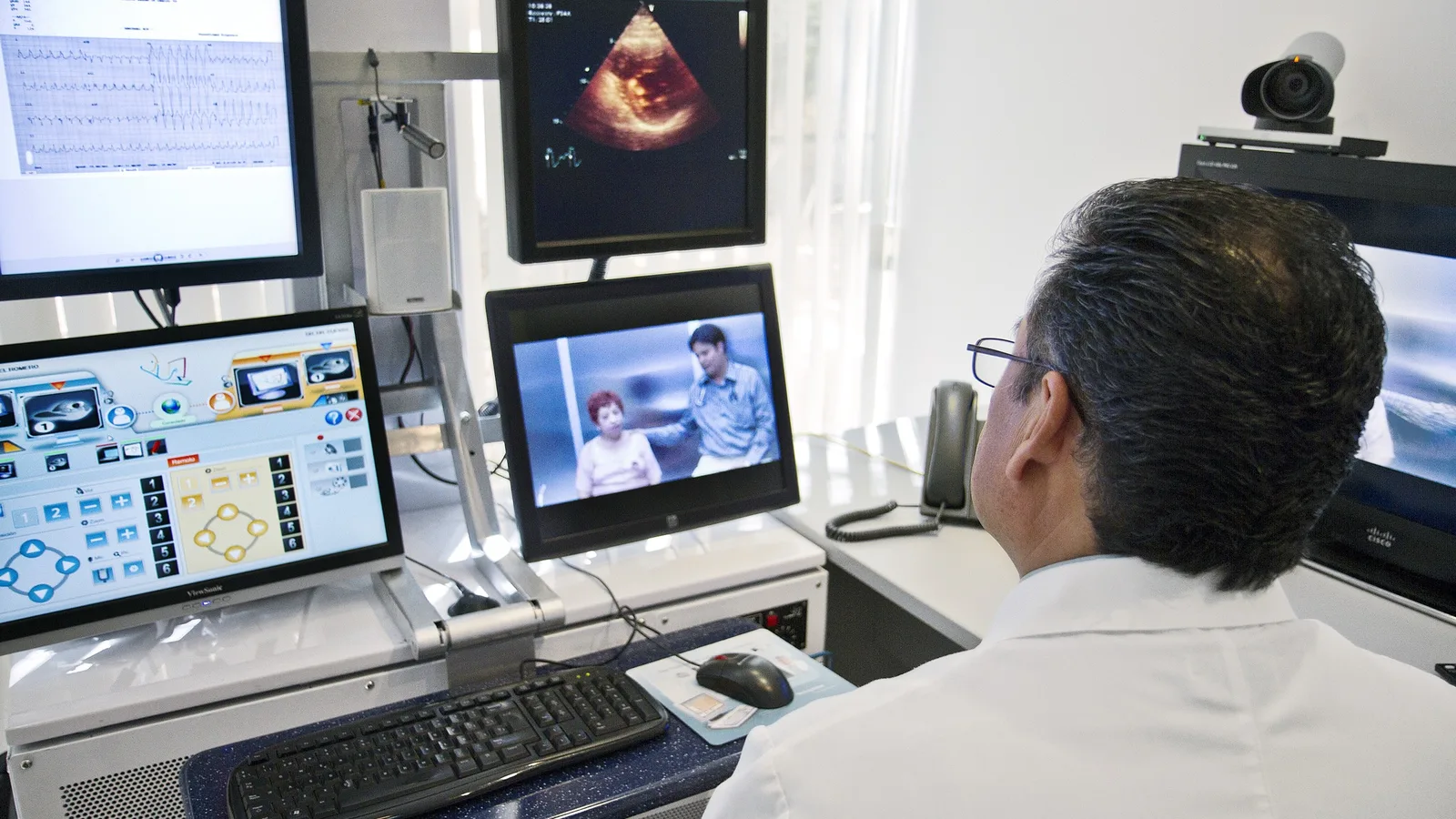
An echocardiography workstation displays a cardiac ultrasound image. Existing editorial illustration, not an OptimPacing trial participant.