
A 44-year-old patient leaves the hospital after a stroke that no one can explain. The MRI shows an embolic pattern, the heart rhythm monitor is clean, and the vessels look normal. The stroke team wants to know whether a hole between the upper chambers of the heart, a patent foramen ovale, let a clot slip from the venous side into the brain. Finding out usually means a bubble study by echocardiography, often transesophageal, or a transcranial Doppler test run by a specialist sonographer in a vascular lab.
On November 19, BURL Concepts said the FDA had cleared FOQUS, a portable system it says can scan the whole brain for embolic signals in 40 seconds, operated by a single nurse. If the device performs as claimed, PFO screening could move from specialist labs into cardiology offices and outpatient centers. This briefing explains how screening works today, what automation changes and what evidence and payment questions remain open.
The clearance lowers the operator barrier to PFO screening. Accuracy data and a payment path will decide whether it lowers the access barrier.
In This Deep Dive
- Why this matters now
- What actually happened
- The obvious read versus the deeper signal
- Historical playbook
- The world forming around outpatient stroke and shunt testing
- Category map and taxonomy
- Evidence Ladder
- Regulation: 510(k) clearance, EU marking and coding
- Capital flows and bottom-up economics
- The HealthTech Investor's Signal
- Counter-thesis
- Forward Intelligence
- The Bottom Line for Stroke Program Leaders and MedTech Investors
Why this matters now
Cryptogenic stroke, meaning stroke without an identified cause after standard workup, is common, and it disproportionately affects younger patients compared with other stroke types. Since 2017, randomized trials have shown that closing a PFO reduces recurrent stroke in selected patients, and closure devices have FDA approval for this use. That makes finding a PFO clinically actionable rather than academic.
The bottleneck is testing. Transesophageal echocardiography is considered the reference for anatomy but is invasive and usually requires sedation. Transthoracic echo with bubbles is less sensitive. Transcranial Doppler bubble studies are sensitive for right-to-left shunt but depend on skilled operators who must find an acoustic window and a specific vessel. Many hospitals and most outpatient practices do not have those operators readily available.
BURL's pitch is to remove that operator dependence. For health systems, that could mean faster stroke workups and fewer sedated procedures. For device companies selling PFO closure, it could mean more patients identified. For payers, it raises the question of whether easier testing increases appropriate or inappropriate downstream procedures.
There is also an operational angle. Stroke units often hold patients while they wait for an echocardiogram or a specialist Doppler slot, and delays in completing a workup can extend length of stay or push testing into outpatient follow-up that some patients never attend. A test that a nurse can run at the bedside or in clinic in minutes could shorten that path, if the result is trusted enough to act on.
Tier (A) for the clearance and BURL's stated performance claims, the existence of PFO closure trials and approved devices. Tier (B) for the downstream implications.
What actually happened
- The clearance: The FDA granted 510(k) clearance for the FOQUS ultrasound system, powered by SONAS, a medical ultrasound device indicated for measuring the occurrence of transient embolic signals in the brain blood stream.
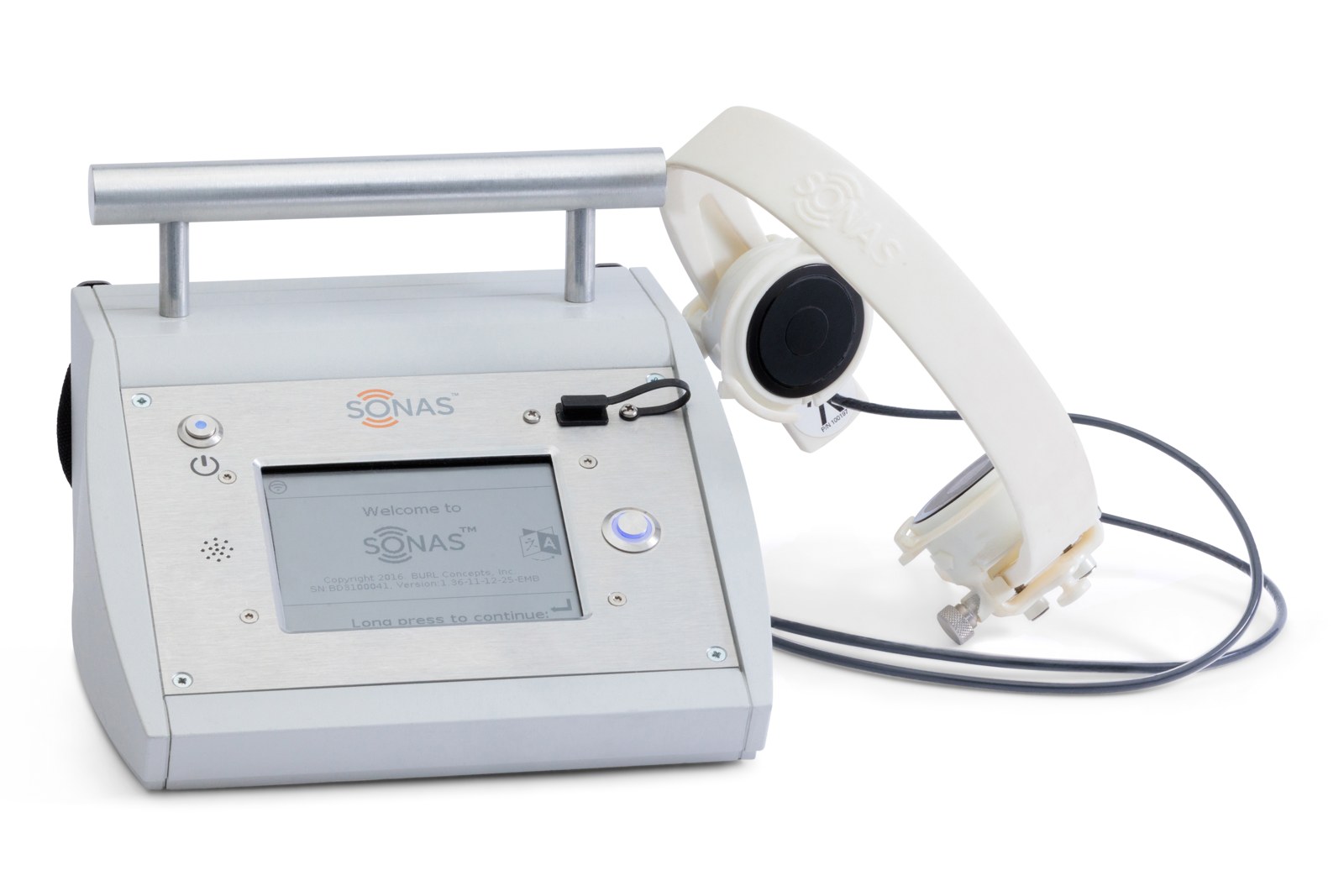
- How it works: FOQUS combines a battery-powered console with a headset. BURL says it uses low-energy, low-frequency ultrasound to penetrate the skull and evaluate the whole brain, detecting acoustic signals from the entire circulation, including macro and microvasculature, rather than a single vessel segment.
- First use: A standard PFO bubble test: an air bubble solution is given intravenously, and acoustic signals from bubbles passing through the brain circulation indicate a right-to-left shunt. The test produces an immediate display and a report indicating whether embolic signals were detected.
- Experience so far: SONAS has a CE Mark for stroke detection, FOQUS is in use in the Netherlands and the United Kingdom, and early experience has included detection of embolic signals associated with right-to-left shunting. Additional trials are underway in the U.S. and Europe.
- The people: CEO Peter van der Sluis said the focus now turns to U.S. commercial launch. Chief medical officer Thilo Hoelscher, MD, described a test of about five minutes. Matthew J. Price, MD, director of the cardiac catheterization laboratory at Scripps Clinic, said FOQUS has the potential to disrupt how PFOs are currently diagnosed.
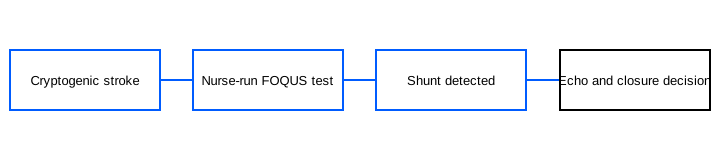
Tier (A). Facts are from BURL Concepts' November 19 release and product site. The care pathway in the diagram is our simplified illustration.
The obvious read versus the deeper signal
The obvious read: A faster, easier PFO test means more PFOs found and more strokes prevented.
The deeper signal: A screening test changes care only if its results are accurate and lead to the right next step. FOQUS detects right-to-left shunting; it does not show the anatomy of the PFO, which clinicians still need from echocardiography before deciding on closure. The realistic role is triage: rule out shunting quickly in low-probability patients and send positive results for imaging. That could reduce the number of sedated transesophageal echos and speed up decisions, but it could also increase the number of incidental PFOs found in patients who would not benefit from closure. The value depends on who gets tested and what clinicians do with positives.
Tier (B) interpretation, based on the cleared indication (embolic signal detection) and established PFO care pathways.
Historical playbook
PFO closure went through a long period of uncertainty. Earlier randomized trials, reported between 2012 and 2013, did not show clear benefit in their primary analyses, and closure was used inconsistently. In September 2017, the New England Journal of Medicine published results from the CLOSE and REDUCE trials and long-term RESPECT data, which together showed reduced recurrent stroke after closure in carefully selected patients. The FDA had approved the first device for PFO closure to reduce recurrent stroke in 2016, and a second followed in 2018.
Professional guidance followed. The American Academy of Neurology's 2020 practice advisory update said clinicians may recommend closure for selected patients younger than 60 with an embolic-appearing infarct and no other mechanism identified, after shared decision making. Risk scores such as the RoPE score help estimate whether a PFO is likely causal.
Diagnostics did not change as much. Transcranial Doppler bubble testing has existed for decades and published comparisons have found it sensitive for right-to-left shunt, but it stayed a specialist test. Automated and robotic transcranial ultrasound systems have appeared in recent years, aiming to reduce operator dependence. FOQUS is part of that wave, with a whole-brain approach rather than a single-vessel one.
The world forming around outpatient stroke and shunt testing
Cardiology is moving more diagnostics into outpatient settings, as happened with ambulatory heart rhythm monitoring, which BURL's CEO cited as an analogy. Outpatient diagnostic centers and cardiology groups look for tests that are simple to staff, reimbursed and connected to downstream procedures.
PFO closure device makers have an interest in better identification of appropriate patients. Echocardiography vendors sell the imaging that remains necessary for anatomy. Neurology and stroke programs want faster workups and fewer missed causes.
Payers and health system value teams will watch utilization. Easier testing can expand the tested population, which is good if it finds patients who benefit and costly if it finds incidental shunts that lead to unnecessary procedures.