Every wearable company eventually hits the same wall. The ring or the watch notices something: a temperature that will not settle, resting heart rate drifting up for a week, sleep that collapsed after a new medication. The app shows a chart, maybe a gentle nudge to talk to a doctor. Then the member is on their own, booking an appointment with a clinician who has never seen the data and has about one short visit to make sense of it. The insight is real, but the action happens somewhere else, and so does the revenue.
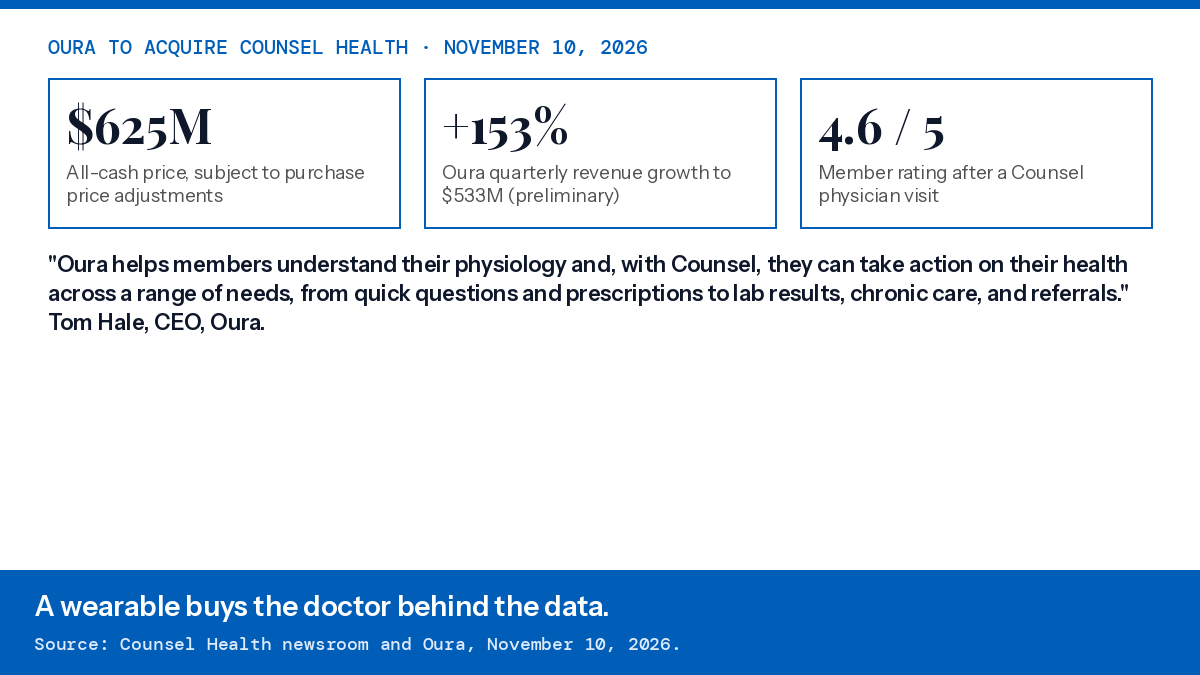
On November 10, Oura decided to stop sending members somewhere else. It agreed to buy Counsel Health, the AI-native primary care company it has partnered with since earlier this year, for $625 million in cash. Below we look at what Oura actually bought, how the consumer health market is sorting itself by mechanism and care model, who pays for a visit that begins with a biometric trend, and the specific signals that would tell us whether this is a new front door to primary care or an expensive feature.
Oura did not buy a better algorithm. It bought the ability to act on what its ring already sees, with a licensed physician on the other end.
In This Deep Dive
- Why this matters now
- What actually happened
- The obvious read versus the deeper signal
- Category map and taxonomy
- Evidence Ladder
- Regulation and international divergence: a wellness device attached to a medical practice
- Capital flows and bottom-up economics
- The HealthTech Investor's Signal
- Evidence boundaries
- Forward Intelligence
- The Bottom Line for Health System Strategy Leaders, Payers and Consumer Health Investors
Why this matters now
Three pressures meet here. The first is access. Oura's own announcement cites a typical U.S. primary care visit of about 18 minutes and a projected shortage of as many as 86,000 physicians by 2036. Members who notice something in their data often have nowhere fast to take it. Counsel's model, a medical AI that handles intake and guidance and escalates to a board-certified physician within minutes, is built for exactly that gap.
The second is Oura's own growth. The company reported preliminary fiscal fourth quarter revenue of $533 million, up 153% year over year, with $87 million of adjusted EBITDA, and fiscal 2026 revenue of about $1.75 billion, up 92%. Growth like that creates options to add services alongside hardware.
The third is competition at the wrist and the finger. Continuous physiological data plus licensed care offers differentiation beyond sensor hardware alone.
Certainty: (A) deal terms, financials and usage figures from the Counsel and Oura announcements; (B) our reading of hardware convergence as the strategic driver.
What actually happened
- The deal: a definitive agreement for Oura to acquire Counsel Health for $625 million in cash, subject to purchase price adjustments, expected to close before the end of the calendar year subject to customary conditions.
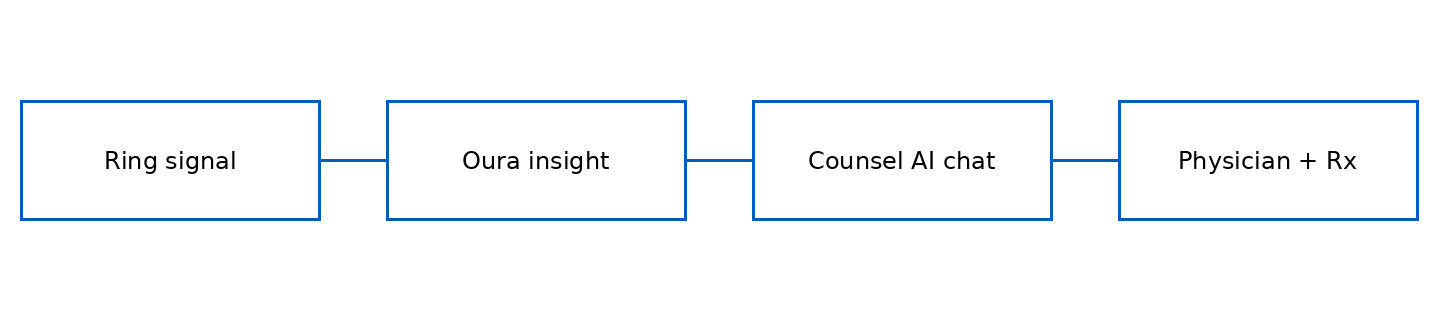
- What Counsel does: members begin with Counsel's medical AI, which draws on connected medical records, prior conversations, guidelines and, with permission, Oura data. At any point they can add a Counsel physician who can diagnose, prescribe and refer. On the back end, physicians use a proprietary Clinician Cockpit that synthesizes the record and longitudinal trends.
- The AI architecture: Counsel describes a clinical AI harness that invokes specialized agents for history-taking, guideline retrieval, records review and emergency detection, each evaluated for safety and quality and improved with physician feedback.
- What already exists: Counsel has been available to Oura members through Oura Labs since the partnership began (Oura dates it to May 2026; Fierce Healthcare reports June). More than half of Counsel users in Oura Labs have shared their Oura data with their physicians, more than 90% of members surveyed say it helped them get better care, and physician visits are rated 4.6 out of 5.
- Price point: Counsel's site offers a free AI conversation and says a doctor can be added to the same conversation for $29.
- Who stays served: Counsel will keep serving health plans, health systems, consumer health organizations and employers, including people who do not wear an Oura Ring.
- People: Tom Hale, CEO of Oura since April 2022, and Muthu Alagappan, MD, Counsel's founder and CEO. Counsel raised a $25 million Series A co-led by Andreessen Horowitz and GV in October 2025.
Certainty: (A) all items from the Counsel newsroom release, the Oura blog and Counsel's live site; (A) Series A from Counsel's October 2025 release; partnership start month differs between Oura (May) and Fierce (June), so we cite both.
The obvious read versus the deeper signal
The obvious read: A wearable company adds telehealth to sell more subscriptions. Oura gets a new feature, Counsel's investors get an exit, and members get a faster way to ask a question.
The deeper signal: Oura is changing what it is. With Counsel it becomes a care delivery organization that happens to make a sensor, and the sensor becomes the intake form. That flips the usual telehealth problem. Most virtual care companies pay heavily to acquire patients and then know little about them. Oura already has more than six million members, years of trended physiology on many of them, and a daily habit. Counsel's enterprise contracts point the other way, toward people who have never bought a ring. If both work, Oura sells care to its members and sells data-informed care to plans and employers, which is a different and larger market than consumer hardware.
Certainty: (A) member count, enterprise continuation and stated rationale from the release; (B) our interpretation of the strategic shift.
Historical playbook
Consumer technology has a long record of hardware companies buying their way into services when devices commoditize. The pattern is familiar from phones moving into payments and media. In healthcare the closest precedent is Amazon's acquisition of One Medical, completed in 2023, which bought a membership primary care network to anchor a broader consumer health push. The lesson from that deal is that owning clinicians brings licensure, staffing, quality and payer contracting obligations that a technology company does not face when it only sells software.
Digital health itself offers a second precedent: direct-to-consumer telehealth platforms that grew by owning the prescription step. Our November 8 lead covered Lilly and Hims & Hers putting branded GLP-1 medicines on one platform. Those businesses show that a consumer brand plus a prescribing clinician can scale quickly, and also that their economics depend on what is prescribed. Oura's version is different in one important way: it starts from continuous physiological data rather than a product catalog, which pushes it toward preventive and chronic care rather than single-product prescribing.