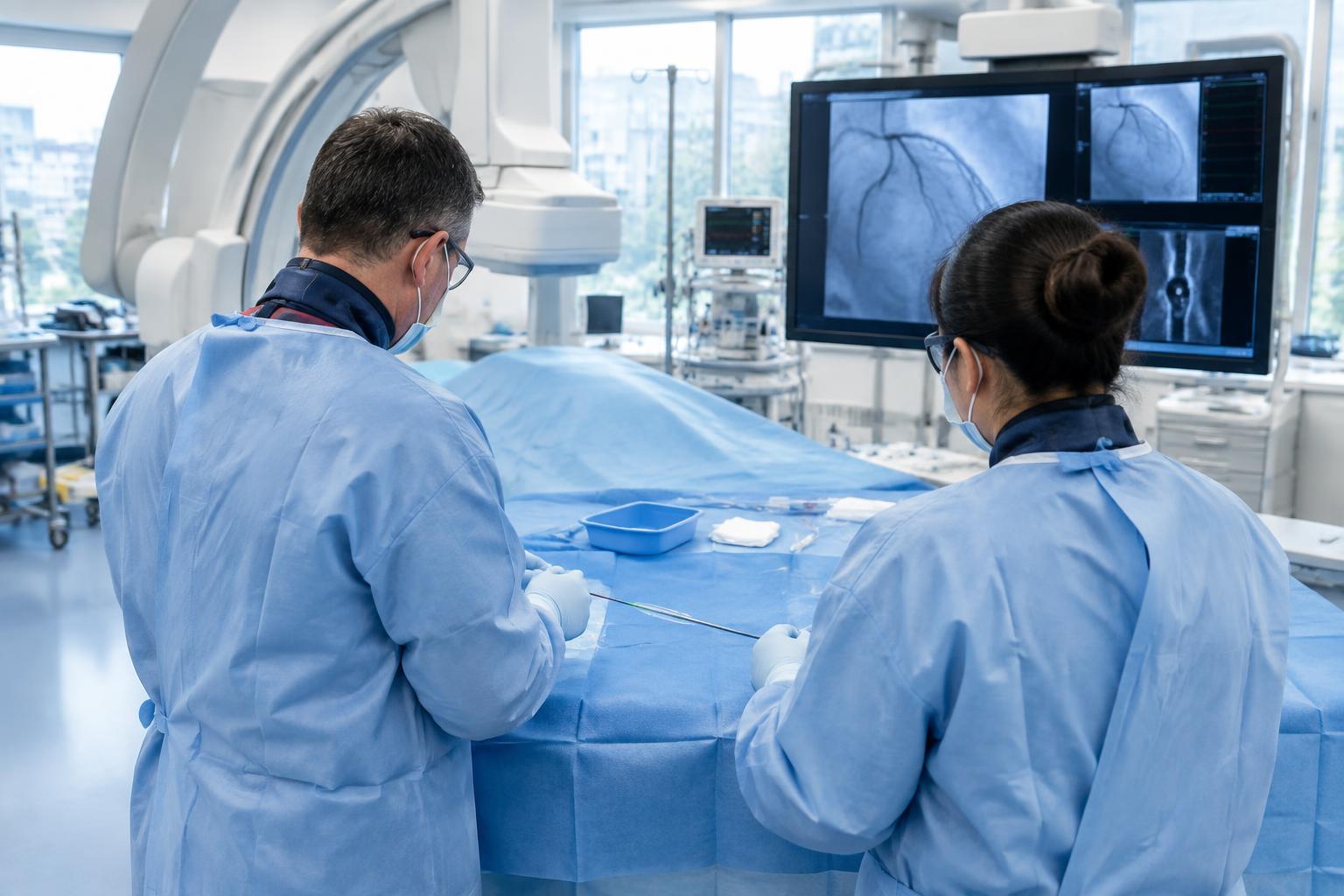
Who actually sees the heart during a structural heart procedure? Usually it is not the interventional cardiologist moving the device. It is an imaging specialist, often running transesophageal or intracardiac ultrasound, reading the images and calling out positions in real time. The proceduralist depends on that second expert. When that expert is unavailable, the case waits, or does not happen at that hospital at all.
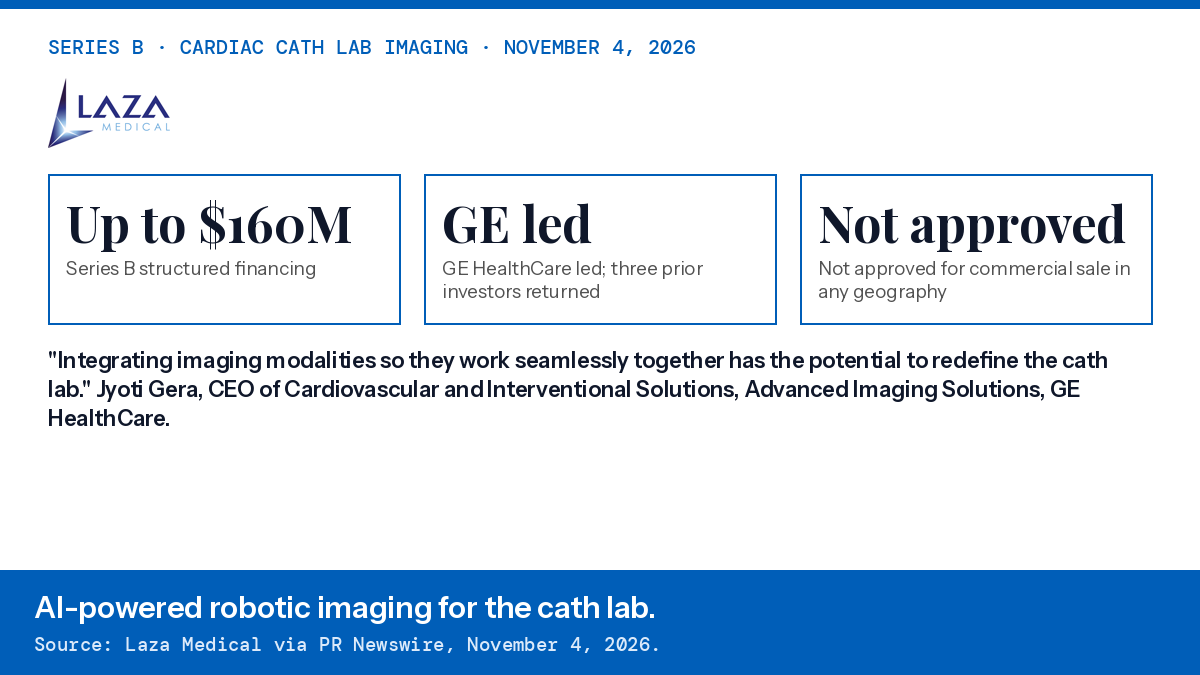
Laza Medical is building a system to change that dependency. On November 4, the Los Gatos, California company, a Shifamed portfolio company, announced it has raised up to $160M in Series B structured financing led by GE HealthCare, which says it is expanding its collaboration with Laza. Laza's system combines AI-powered 3D heart modeling, guidance based on echo tracking, and robotic control of the ultrasound probe. Below we look at what Laza says it is building, why GE HealthCare wants a seat at the table, how the approach compares with other cath lab technologies, and what evidence and regulatory steps must come before any of it reaches patients.
The cath lab has spent decades getting better devices. Laza and GE HealthCare are betting the next gain comes from making imaging expertise scale.
In This Deep Dive
- Why this matters now
- What actually happened
- The obvious read versus the deeper signal
- Category map and taxonomy
- Evidence Ladder
- Regulation and international divergence
- Capital flows and bottom-up economics
- The HealthTech Investor's Signal
- Counter-thesis
- Forward Intelligence
- The Bottom Line
Why this matters now
Catheter-based procedures have taken over a growing share of structural heart and rhythm care. Valve repair and replacement, left atrial appendage closure and ablation for atrial fibrillation are now routinely performed through catheters rather than open surgery. Many of these procedures depend on ultrasound guidance inside the body, through a probe in the esophagus or a catheter in the heart, to show where devices sit relative to the anatomy.
That guidance takes skill. Laza's own website puts it plainly: in structural heart and electrophysiology procedures, "traditional systems tether experts to the machine, requiring constant input and years of training to master." Laza argues this "limits how many patients can be treated and places a heavy burden on already stretched clinical teams." The release adds that care teams need "more intuitive and consistent image guidance amid growing demands for specialized imaging expertise."
At the same time, cath lab imaging is becoming software-defined. On the same day as Laza's financing, Evident Vascular announced FDA 510(k) clearance of its Evident Vascular Guidance System and peripheral intravascular ultrasound catheters, with voice control and real-time processing on NVIDIA accelerated computing (the company says the system is not yet available for sale). Imaging in the procedure room is moving from a box with a probe toward a computing platform with AI on top.
That is why a strategic investor matters here. GE HealthCare already sells imaging systems used in cardiac care. When a company of that size leads a round in a pre-approval startup and talks about "smarter, robotic procedures tomorrow," it is signaling where it thinks the cath lab is heading.
Certainty: (A) Laza and Evident Vascular statements from their own releases and website; (B) the general shift of structural heart and rhythm care to catheter-based procedures and the role of ultrasound guidance, which is well established clinical background.
What actually happened
The financing
- Laza Medical raised up to $160M in Series B structured financing. "Up to" and "structured" usually mean some funding is tied to future conditions or tranches; Laza did not disclose the structure.
- GE HealthCare led the round. Returning investors Unorthodox Ventures, PA MedTech and AMED participated.
- Laza says the money supports its mission to transform the cardiac catheterization lab through intelligent imaging designed to "simplify procedures, increase autonomy, alleviate resource constraints, and unlock the possibilities for future robotic-enabled interventions."
- Laza previously announced a $36M Series A, according to its website. Sidley Austin represented Laza in the Series B.
The technology, as Laza describes it
- AI-powered 3D heart modeling: designed to give a real-time view of the patient's heart with spatial and anatomical context.
- Procedural guidance: intended to provide step-by-step guidance using echo-based tracking of anatomy and devices.
- Robotic probe control: engineered to enable image-guided probe navigation.
- Interface: designed for anatomy-based image guidance and operator autonomy.
The system is built for structural heart, electrophysiology and diagnostic procedures. Laza is explicit that the Laza Medical System is under development and not approved for commercial sale in any geography.
The people
Jyoti Gera, CEO of Cardiovascular and Interventional Solutions, Advanced Imaging Solutions at GE HealthCare, said: "Integrating imaging modalities so they work seamlessly together has the potential to redefine the cath lab, enabling more efficient workflows today and paving the way for smarter, robotic procedures tomorrow." Amr Salahieh, Founder and Board Chairman at Laza Medical, who also founded Shifamed, said intelligent imaging "will play a defining role in what comes next." The release also quotes Dr. Firas Zahr, Head of Interventional Cardiology at Oregon Health Sciences University Hospital, who had experience with the software during the first-in-human study: "High-quality imaging is foundational to all successful cases."
Certainty: (A) financing terms, investors, quotes and product descriptions from Laza's release and website; (B) our explanation of "up to" and "structured" financing as a general market convention.
The obvious read versus the deeper signal
The obvious read: another AI medtech startup raises a big round. Robotics and AI attract capital, and a strategic investor brings credibility.
The deeper signal: the target is not a device that treats the heart. It is the imaging workflow that every device depends on. Most cath lab innovation has gone into the therapeutic device, a better valve, a better ablation catheter, a better closure device. Laza is going after the layer underneath: how the team sees what it is doing. If that layer becomes easier, faster or less dependent on a scarce specialist, it lifts every procedure that uses it.
The second signal is about who captures value. If guidance becomes software plus robotics, the platform that controls the imaging and the model of the heart becomes a hub. Device makers would plug into it. That is a natural place for a large imaging company to want influence, and it helps explain why GE HealthCare chose to lead rather than simply license.
The third signal is about autonomy. Laza uses words like "procedural autonomy" and "robotic probe control." The near-term ambition is to let a smaller team run imaging with more confidence. The longer-term ambition, stated in the release, is a foundation for "future robotic interventions." Investors are funding the first step with an eye on the second.
Certainty: (A) Laza's stated goals; (B) the platform and value capture argument is our analysis; (C) whether Laza's approach becomes a standard.