A patient spends ten days in a French rehabilitation unit after a hip replacement. The care is documented in the record: physiotherapy sessions, dependency scores, complications. But unless the medical information team codes all of it correctly, the hospital is paid for less care than it gave. Multiply that across hundreds of thousands of stays and the gap between care delivered and care coded becomes real money for public hospitals under budget pressure.
On November 24, Parallel, a young company building AI agents for hospital administration, bought Methodim, whose PRODIM software is used by more than 700 French facilities to analyse that coding. The deal takes Parallel's agents beyond acute care into rehabilitation, hospital at home and psychiatry, and shows how AI startups are buying distribution rather than waiting for it.
In hospital coding, the model is the easy part. The hard part is being inside 700 hospitals' workflows. Parallel just bought that.
In This Deep Dive
- Why this matters now
- What actually happened
- The obvious read versus the deeper signal
- Historical playbook
- The world forming around AI hospital coding
- Category map and taxonomy
- Evidence Ladder
- Rules, audits and data
- Capital flows and bottom-up economics
- The HealthTech Investor's Signal
- Counter-thesis
- Forward Intelligence
- The Bottom Line for Hospital Leaders and Investors
Why this matters now
French hospital funding depends on coded activity. Each stay is recorded in the national medical information programme (PMSI), and the codes, especially the principal diagnosis, determine the diagnosis-related group and therefore the payment. Parallel's own product note explains that a poorly chosen principal diagnosis skews the value of a stay however well the secondary diagnoses are coded.
Each field of activity has its own rules. Methodim's founders say rehabilitation coding was reshaped by a recent funding reform, and Parallel says each area, acute, rehabilitation, hospital at home and psychiatry, needs its own logic. A coding AI that only handles acute care leaves much of a hospital's activity untouched.
And administration is expensive. Parallel says up to 30% of healthcare spending goes on administration, while ageing populations raise demand and staffing cannot keep pace. Coding is a contained, measurable place to start, because every correction has a value.
What actually happened
- The deal: Parallel acquired Methodim, publisher of PRODIM, a PMSI coding analytics suite used by more than 700 facilities across acute care, rehabilitation, hospital at home and psychiatry. Terms were not disclosed.
- The target: Methodim was founded in Bordeaux in 2017 by Florence Perret and Jean-Christophe Pellevoizin. It grew without outside funding. Its team joins Parallel, and PRODIM remains available to all existing clients.
- The acquirer: Parallel was launched in 2025 by Paul Lafforgue and Chris Rydahl. Its agents work inside existing hospital software, learning to use it as a person would, and it says deployment can take as little as a week.
- The product direction: A new generative AI coding product for rehabilitation, built on PRODIM, and an AI assistant to help hospital teams and management analyse and steer activity.
- The people: Lafforgue, co-founder and CEO, said the goal is to give every hospital the automation and analytics it needs to secure activity revenue in every field. Perret said much information behind hospital stays is documented but never coded, billed or used.

The obvious read versus the deeper signal
The obvious read: A well-funded AI startup buys a small, profitable software publisher.
The deeper signal: Parallel is converting an analytics installed base into a channel for agents. PRODIM users already trust it to analyse their coding; adding AI suggestions to a tool they use daily is a shorter sale than winning each hospital from scratch. It also gives Parallel the domain rules for non-acute care that would take years to rebuild.
Historical playbook
Coding optimisation is an established business in France. Medical information departments, led by DIM physicians, have long used analytics software to find under-coded stays and check quality, and PRODIM is one of those tools, designed by DIM physicians.
What changed is the AI layer. Language models can read discharge summaries and notes and propose diagnoses with justifications. Parallel's November 9 update added principal diagnosis suggestions, offered only when the change increases the stay's value and can be justified with quotes from the record and the official methodological guide. The original principal diagnosis stays visible, so the coder can see what changed.
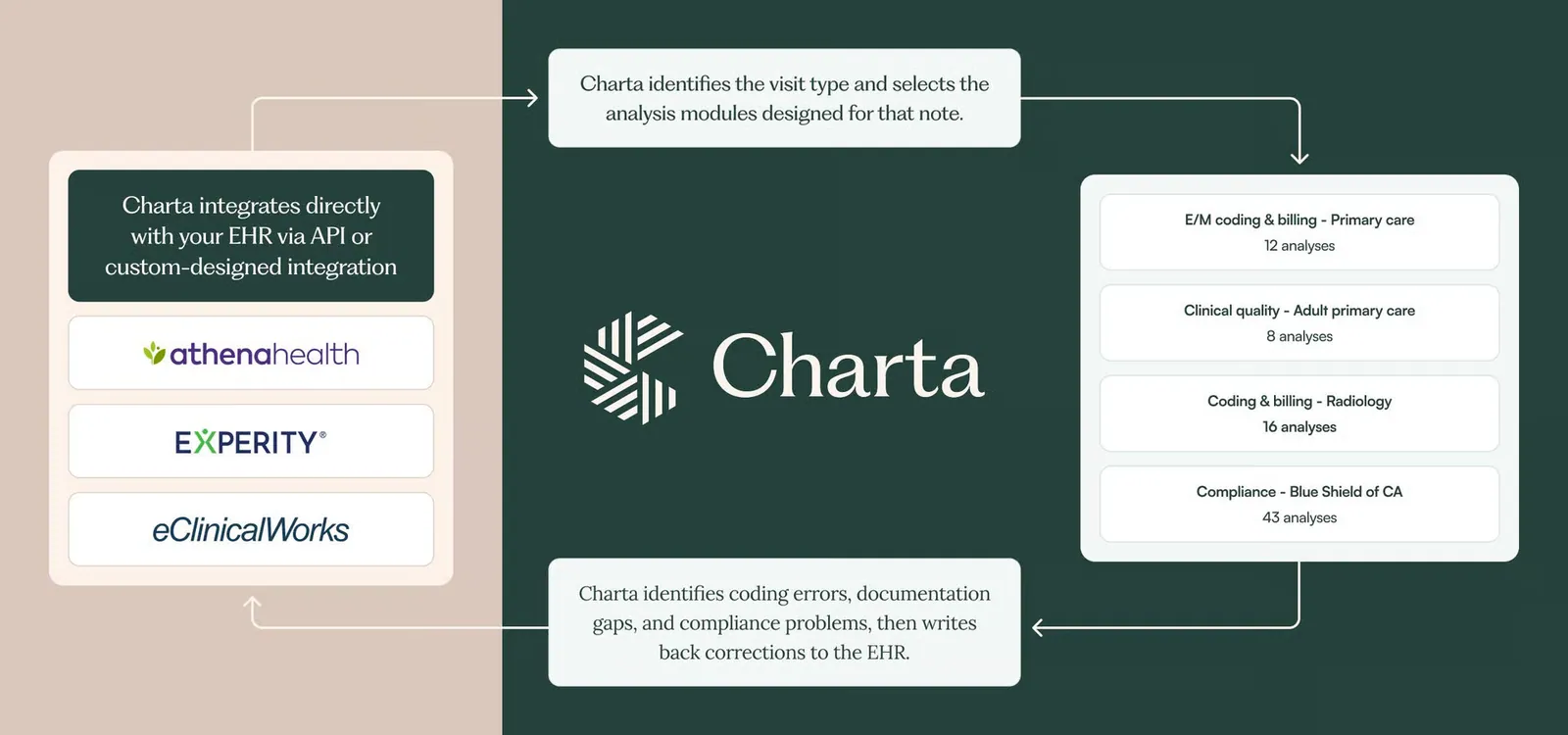
The U.S. market is moving the same way. Charta Health raised a $55 million Series B led by Insight Partners in November for AI chart review, and Credo Health bought Affineon to form Pajama.ai, which automates chart preparation, lab results and prescription renewals. Consolidation and distribution are the theme on both sides of the Atlantic.
The world forming around AI hospital coding
Three types of players compete for hospital coding. Established analytics and coding software publishers, like Methodim before this deal, own the workflow and the rules. AI-native startups such as Parallel bring agents that can read records and act inside existing software. And EHR and hospital information system vendors can add coding assistance to their own platforms.
The winners will likely combine all three assets: the rules, the AI and the installed base. That is why acquisitions like this one make sense for AI startups with fresh capital. Parallel's Series A came with angels including Arthur Mensch, co-founder of Mistral, and a lead from Index Ventures, which gives it the means to keep buying.