Good morning, HealthTech insiders. On November 24, DeepHealth won FDA clearance for Mammo Risk, which it calls the first AI to predict five-year breast cancer risk from a 3D mammogram. Great Ormond Street Hospital began a 15-month NHS-funded trial of AI agents with Hyland and AWS. Tagomics closed a $13 million seed extension for a blood test that tracks organ damage from drugs.
Each story is about getting more signal from work already being done: a routine scan, routine paperwork, a routine blood draw. The common test is evidence. DeepHealth has not published its accuracy figures, GOSH promises formal reviews, and Tagomics' pharma partners have yet to report results.
DeepHealth wins FDA clearance for Mammo Risk, which estimates three to five-year breast cancer risk from existing 3D mammograms.
Great Ormond Street Hospital starts a 15-month Agentic Hospital programme, testing AI agents in finance and policy search first.
Tagomics closes a $13 million seed extension co-led by Werfen's venture arm for its LiquiPath drug safety test.
Plus: Playbook's €8 million round, GE HealthCare's InteleOrchestrator Clarity, and Photon's prescribing plugin for ChatGPT.
Sponsored · Advertisement
In partnership with

AI is the new search engine. Start showing up.
Your buyers still search. They just do it in ChatGPT, Claude, Gemini and Perplexity now, and they act on the answer they get.
Those answers have rankings too. A few companies get named. The rest don't show up.
ChatFeatured is the AEO platform that does the work to get you named:
See where you rank against competitors on every major AI engine.
Find the questions where AI names them and not you.
Get the content that changes the answer written and published for you.
WikiSleep grew brand mentions 113% while competing head-on with Calm and Headspace.
If you already invest in search, this is the next place your buyers look.
LATEST DEVELOPMENTS
IMAGING AI
1. DeepHealth Wins First FDA Clearance for 3D Mammogram Risk AI

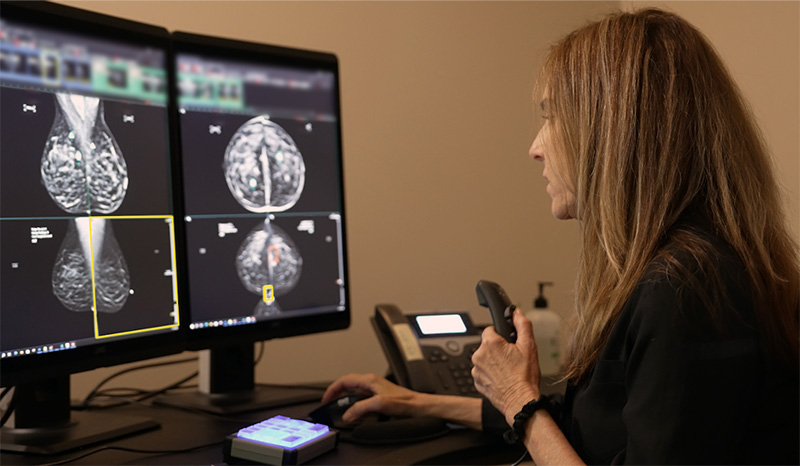
A radiologist reads screening mammograms at a workstation, as shown on DeepHealth's website. Source: DeepHealth
On November 24, DeepHealth, a RadNet subsidiary, said the FDA cleared Mammo Risk (510(k) K262709), which it calls the first FDA-cleared tool that predicts breast cancer risk from a 3D mammogram. The software estimates three, four and five-year risk from images a clinic already has, with no extra scan. It is available in the U.S. now.
The evidence: DeepHealth says an independent pivotal study of more than 65,000 screening mammograms at 10 U.S. sites showed strong predictive performance, consistent for Black women and women with dense breasts. The release gives no accuracy figures.
The payment gap: The AMA has created a Category III CPT code, effective January 1, 2027, to track use of image-based breast cancer risk tools. Category III codes gather evidence and do not guarantee payment, so providers will mostly fund risk scoring themselves for now.
The people: President and CEO Kees Wesdorp leads DeepHealth. Dr. Niccolò Stefani, its business and product leader for clinical AI, said the goal is to move from detecting cancer to preventive pathways. RadNet will add Mammo Risk to its Enhanced Breast Cancer Detection program in the coming months.
The Signal: Most U.S. screening still runs on age, and questionnaire risk models are used unevenly. A score from the routine 3D image could steer women to supplemental MRI or ultrasound at scale, and RadNet owns both imaging centres and the software. The test is the published accuracy data and whether payers cover the extra imaging higher scores trigger.
AGENTIC AI
2. Great Ormond Street Hospital Tests AI Agents in an NHS First

A staff member at a reception desk inside Great Ormond Street Hospital, where the Agentic Hospital programme starts with administrative work. Source: Great Ormond Street Hospital
On November 24, Great Ormond Street Hospital (GOSH) said it will run a 15-month Agentic Hospital programme with Hyland and Amazon Web Services, funded by NHS England. AI agents will run alongside existing manual processes, starting in finance and policy search. The programme runs until the end of October 2027.
The first tasks: Phase 1 tests agents that match supplier statements with invoices and flag discrepancies for staff, plus a tool that helps staff find and apply Trust policies. Later phases may cover steps after a clinical decision, such as booking tests. The tools will not make clinical decisions.
The stack: Hyland is designing and building the platform on its Content Innovation Cloud, with its AI Control Tower auditing agent activity. AWS provides cloud credits, technical guidance and Amazon Bedrock, so the team can use different models for different tasks. GOSH is working with the Information Commissioner's Office.
The people: Dr Shankar Sridharan, GOSH's chief clinical information officer and NHS England's national clinical lead for AI, said the challenge is making agents work safely and reliably at scale. Hyland CEO Jitesh S. Ghai called it a blueprint.
The Signal: This is a governance pilot first and a productivity pilot second, the right order for software that acts. Each phase gets a formal review on safety, accuracy and governance before the next begins. The test is whether GOSH publishes those reviews with error rates and staff time saved, since findings are meant to be shared across the NHS.
DIAGNOSTICS
3. Tagomics Raises $13 Million to Track Drug Damage in Blood

The Tagomics team at its office on the Babraham Research Campus in Cambridge, UK. Source: Tagomics
On November 24, Cambridge, UK company Tagomics closed a $13 million (£10 million) seed extension co-led by We Venture Capital, the venture arm of diagnostics maker Werfen, and existing investor Calculus Capital. IQ Capital, Mercia Ventures, Illumina Ventures and Meltwind also took part. Total funding is now $25 million (£19 million).
The platform: LiquiPath, launched in August 2026, traces cell-free DNA in blood back to the tissue it came from, using epigenetic markers and cell-type atlases. The aim is to detect organ injury from a drug earlier and more precisely, in both preclinical and clinical development.
The demand: Tagomics says its early access programme is oversubscribed, with projects at six of the world's largest drugmakers across several development stages and treatment types. The money will scale commercial operations and move its lead lung cancer detection test toward the clinic.
The people: CEO and co-founder Dr Jack Kennefick said the oversubscription shows strong demand for new ways to monitor drug safety. Louise Warme, head of We Venture Capital, praised the team's execution. Anthony Vallance-Owen of We Venture Capital and Dr Robert Hornby of Mercia Ventures join the board.
The Signal: Organ toxicity is a common reason drugs fail or carry warnings, and standard blood markers can lag behind the damage. A test that names the injured organ would sell to pharma first, which is where Tagomics is starting. The test is whether a partner publishes data showing earlier or more specific detection than current markers.
QUICK HITS
👀 WHAT WE'RE WATCHING NEXT
DeepHealth's numbers: Whether DeepHealth publishes the pivotal study's accuracy figures, including the RSNA podium on image-only risk, and how many women a high score sends to supplemental imaging.
GOSH's first review: Whether the Phase 1 review reports reconciliation error rates, policy-answer accuracy and staff hours saved, and when Phase 2 is approved.
LiquiPath data: Whether any of Tagomics' six pharma partners presents LiquiPath results against standard organ injury markers.
💰 FOLLOW THE MONEY
€8 million, Playbook (official site): Round led by Heal Capital with Bayern Kapital and Capnamic, announced November 23. The Munich company turns pharma SOPs and work instructions into structured data that AI agents can read but not change. CEO and co-founder Dr. Nikolai Wessendorf leads it, and the company says it has more than 50 customers.
A$7.75 million, WearOptimo (official site): Raise announced November 24, backed by Synthesis Capital, including a vehicle it manages for the superannuation fund HESTA. Founder and CEO Professor Mark Kendall's company builds sensors that sit just beneath the skin, starting with hydration and heat stress, ahead of a planned Series A.
£860,000, Nilocas (official site): Pre-seed investment and grant funding announced November 24 by Queen Mary University of London for its spinout's AI chest patch, which screens for coronary artery disease in under 15 minutes. CEO Athar Ali leads it; backers include NLC Health Ventures and an NIHR grant.
Undisclosed, Cosmo (official site) and Scialytics (official site): Seed round announced November 24, led by Cosmo, which takes a 23% stake. The Strasbourg spinout of IHU Strasbourg builds AI that analyses keyhole surgery video, starting with gallbladder removal. Its devices are in development and not cleared for clinical use.
The pattern: Today's deals back control and earlier signals: rules that keep AI agents inside approved procedures, sensors and patches that read the body sooner, and video AI that checks safety steps during surgery. All four are early, and none has published outcome data yet.
📆 UPCOMING HEALTHTECH EVENTS
RSNA 2026: November 29 to December 3 | Chicago, USA
DeepHealth plans to show Mammo Risk, and GE HealthCare will demo InteleOrchestrator Clarity, at McCormick Place.
GIANT Health 2026: December 7 to 8 | London, UK
A health technology event for NHS and industry buyers, a week after RSNA.
45th Annual J.P. Morgan Healthcare Conference: January 11 to 14, 2027 | San Francisco, USA
The annual kick-off for healthcare dealmaking and corporate announcements.
🛠️ Trending HealthTech AI Tools
GE HealthCare InteleOrchestrator Clarity: Report drafts and prior summaries for radiologists. Announced November 24 and built by Intelerad, a GE HealthCare company, it gives source-linked summaries of prior reports and turns dictation into a structured draft the radiologist edits and signs. Scott Miller, CEO of GE HealthCare's Solutions for Enterprise Imaging, says it cuts time spent assembling information.
CGI AI Head Analysis: Brain bleed detection on head CT. On November 24, CGI said the tool, built with Helsinki University Hospital (HUS) and Planmeca, won EU MDR class IIb certification. It flags suspected acute non-traumatic intracranial hemorrhage on head CT for physicians to review, which suits busy emergency departments.
PatientNow Communications Hub: AI phone, CRM and messaging inside the EMR. Launched November 23 for med spas, wellness clinics and plastic surgery practices, it puts VoIP calls, CRM and AI call handling inside PatientNow's EMR. CEO Keri Gohman says AI handles routine calls and follow-ups while staff see the full conversation history.
🛠️ Trending HealthTech AI Startups
PolyCypher Health, polygenic risk for clinics. On November 24, the New Jersey company launched Priora, which estimates an adult's risk of 15 common conditions by combining polygenic risk scores with personal health information. CEO and co-founder Dr. Gilead Kedem leads it. The company says the estimates are informational and not clinically validated.
Zentist, agentic AI for dental billing. On November 24, Zentist added Autoposting Skills to its Remit AI platform, so dental groups can see and edit the rules its agents follow when posting insurance payments. CEO Ato Kasymov says groups wanted to know why a payment was posted a certain way.
Photon, prescribing inside ChatGPT. On November 16, the Brooklyn company launched a plugin that lets verified U.S. clinicians draft, review and send prescriptions from ChatGPT, with interaction screening as they draft. CEO Otto Sipe leads Photon. Controlled substances are not supported, and access is free through December 31.
DECISION INTELLIGENCE
Highlights: Deep Dives & Industry Reports
Which of today's AI uses would you fund first? |
|
That's it for today!
A routine mammogram, a supplier invoice and a blood sample each carry more information than health systems use today. DeepHealth, GOSH and Tagomics are betting AI can extract it safely.
Watch for DeepHealth's accuracy data at RSNA, which starts on Sunday, GOSH's first phase review and the first LiquiPath results from pharma partners.
The HealthTech Signal is independently funded. Sponsorships help us invest in better reporting, research, and a stronger newsletter for our readers. Want to reach HealthTech founders & executives while supporting the Signal? Get in touch.
Until tomorrow,
The HealthTech Signal
 Dr. Dereck Mush, MD, MBA