Ask a hospital CIO what keeps them up at night and the answer is rarely a new AI model. It is the morning the EHR goes dark. Clinicians switch to paper, pharmacy cannot see orders, imaging stacks up, and the downtime procedures that looked fine in a binder meet a full emergency department. Recent years gave every health system a vivid version of that morning, from the Change Healthcare cyberattack in February 2024 to the CrowdStrike software outage in July 2024 and the ransomware attack that disrupted Ascension's hospitals in May 2024.
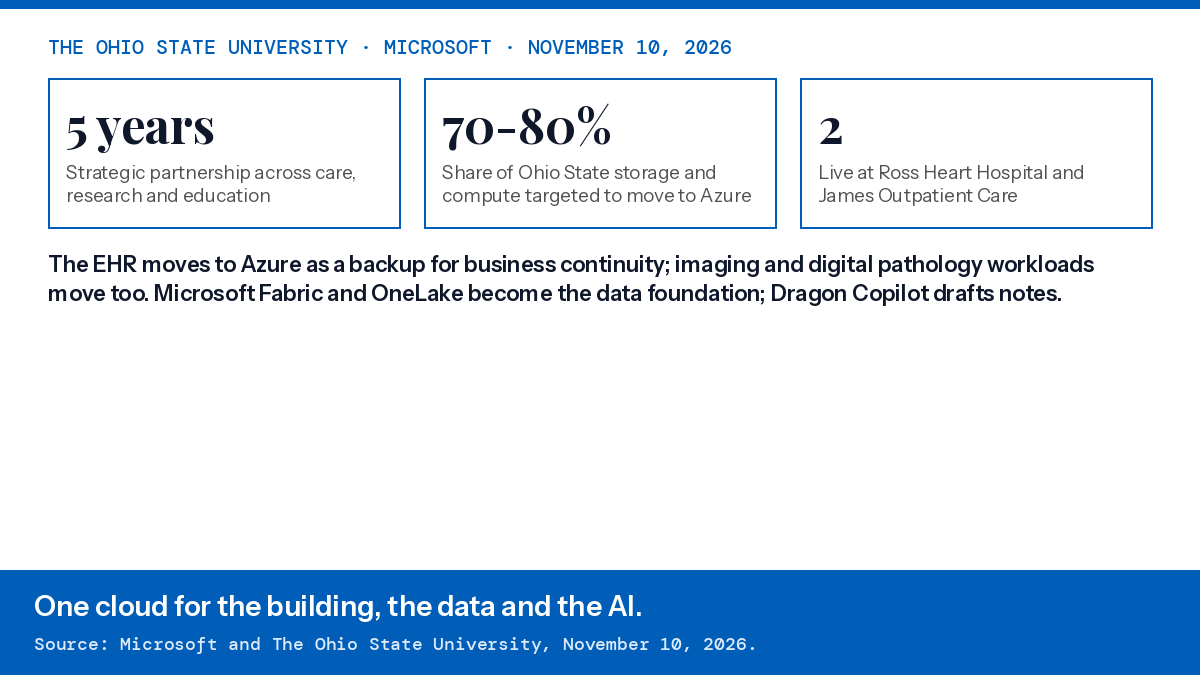
Read in that light, the most consequential line in the November 10 Ohio State and Microsoft announcement is not about AI. It is that the medical center is moving its electronic health record to Azure as a backup for business continuity, alongside a plan to put roughly 70% to 80% of the university's storage and compute in the same cloud. What follows is what the deal covers, why academic centers are buying platforms rather than projects, where the value and the lock-in sit, and what would tell us it is working.
This is not a cloud contract with some AI on top. It is a bet that the building, the data and the AI should run on one platform, and that resilience is the reason to do it now.
In This Deep Dive
-
Why this matters now
-
What actually happened
-
The obvious read versus the deeper signal
-
Category map and taxonomy
-
Evidence Ladder
-
The rules that shape a hospital moving to one cloud
-
Capital flows and bottom-up economics
-
The HealthTech Investor's Signal
-
Counter-thesis
-
Forward Intelligence
-
The Bottom Line for Health System CEOs, CIOs and Infrastructure Investors
Why this matters now
First, resilience has become a board-level issue. Large outages and cyberattacks have shown that downtime is a patient safety event and a financial one. HHS proposed in January 2025 to strengthen the HIPAA Security Rule with more explicit requirements on areas such as encryption and recovery planning. Whatever its final form, the direction is clear: regulators, boards and insurers want proof that critical systems can be restored quickly. A cloud-hosted EHR backup is one concrete answer.
Second, imaging and pathology are outgrowing on-premise storage. Digital pathology slides and modern imaging studies are large, and AI tools increasingly need them close to compute. Ohio State's plan explicitly includes digital pathology and imaging workloads, which is where storage growth is fastest and where AI for tumor boards and diagnostics will draw its inputs.
Third, academic centers want one data foundation for care, operations and research. Fragmented data platforms make every AI project start with plumbing. Ohio State is building on Microsoft Fabric and OneLake to connect clinical, operational and research data, with forecasting of surgical demand, staffing and operating room use as early targets. Those are the decisions where better data turns into capacity and margin.
Certainty: (A) outages, the HIPAA proposal and the deal's scope are matters of public record or from the November 10 release; (B) the ranking of resilience as the key driver is our interpretation.
What actually happened
-
The announcement: on Tuesday, November 10, 2026, The Ohio State University and Microsoft announced a five-year strategic partnership bringing the Ohio State Wexner Medical Center together with Microsoft's AI and cloud technologies to strengthen patient care, research, workforce support and student opportunity across Ohio.
-
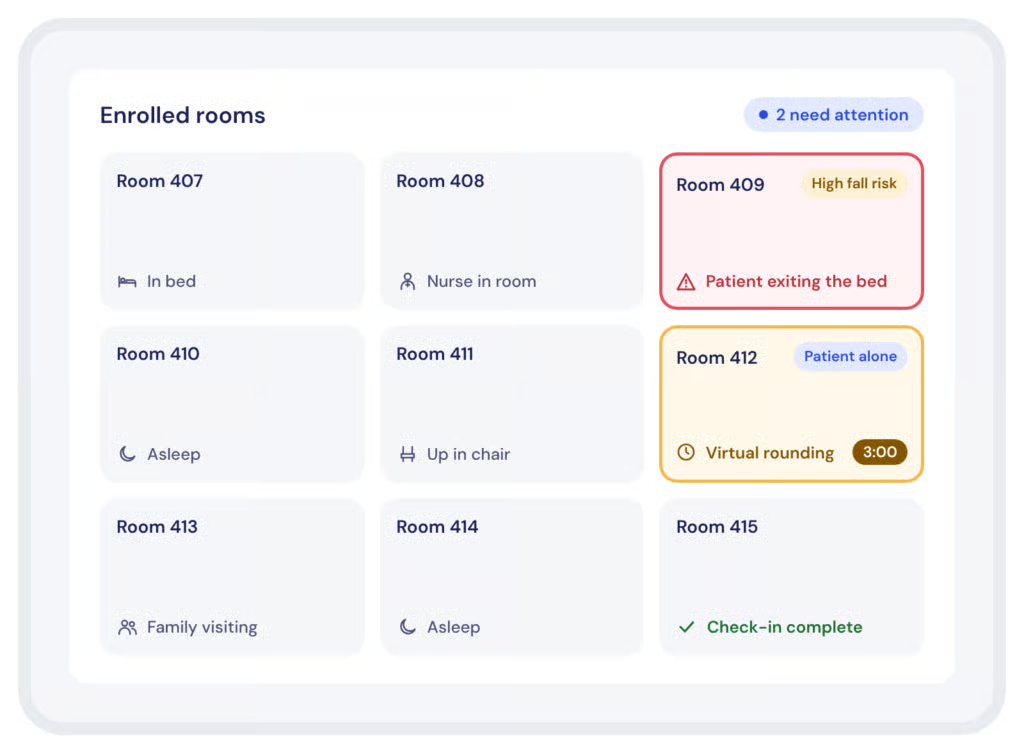
Smart hospital: the partners are co-developing a smart hospital model that connects facility, operational and clinical-support systems. The platform is already in use at the Richard M. Ross Heart Hospital and the James Outpatient Care facility, where initial work is improving energy efficiency and resource use on a foundation of Azure and IoT capabilities. It will be extended to more facilities and will inform how the new University Hospital operates.
-
Cloud migration: the ambition is to move approximately 70% to 80% of Ohio State's storage and compute to Azure, including digital pathology and imaging workloads. The medical center is also moving its EHR to Azure as a backup for business continuity.
-
Data foundation: a unified foundation on Microsoft Fabric and OneLake will connect clinical, operational and research data across the medical center, colleges and regional campuses. The high-level design is complete. Early opportunities include forecasting surgical demand, staffing needs and operating room use. A secure research environment on Azure can give investigators governed access to de-identified data.
-
AI for care teams: clinicians are using Dragon Copilot's ambient capabilities to draft notes from visits for review and finalization. The partners are exploring AI-supported tumor board workflows that bring pathology, imaging, genomics and clinical history into a coordinated view.
-
Workforce: Ohio State will become a Microsoft Training Services Provider, expanding AI learning and certification for caregivers, researchers, faculty, staff, students and community members.
-
People: John J. Warner, MD, CEO of the Wexner Medical Center and executive vice president of Ohio State since April 1, 2023, said AI is one of the most significant opportunities to transform and improve how hospitals care for patients. A Microsoft vice president for U.S. state, local and education business was also quoted.
Certainty: (A) every element above is from the November 10 Microsoft release and corroborated by HIT Consultant; financial terms were not disclosed.
The obvious read versus the deeper signal
The obvious read: A big academic medical center signs a cloud deal with a hyperscaler, and both sides call it AI transformation.
The deeper signal: The scope is unusual: facilities, infrastructure, the EHR's continuity, imaging and pathology, research data and clinician AI under one partner, over five years. That turns Microsoft from a vendor into the medical center's operating platform. The likely payoff is resilience and faster AI deployment; the likely cost is dependence. Both are features of a broader pattern in which large health systems choose a primary cloud and AI partner rather than assembling dozens of point solutions.
Certainty: (A) scope is from the release; (B) the platform framing and the pattern across health systems are our interpretation.
Historical playbook
Health systems have done strategic cloud deals before, and the early ones teach patience. Mayo Clinic signed a 10-year partnership with Google Cloud in 2019, Providence chose Microsoft as its strategic cloud provider in 2021, and HCA Healthcare announced a partnership with Google Cloud the same year. The common pattern is that the infrastructure move takes years, the visible clinical products arrive later than announced, and the most durable value often comes from data platforms that let analytics and AI teams work faster rather than from any single headline application.
There is also a lesson from hospital IT outages. When hospitals run critical systems in one place and depend on one vendor for updates, a single failure can take everything down at once, as the July 2024 CrowdStrike incident showed across many industries. Moving to the cloud does not remove that risk; it changes it. Resilience depends on architecture, tested failover and downtime procedures, not on the hosting location alone.