
What does a normal menstrual cycle actually look like?
Is it 28 days? Is some pain expected? What about mood changes, fatigue, or irregular bleeding? And at what point does something that seems normal become a reason to see a doctor?
For decades, much of the conversation around menstrual health has revolved around what's considered normal. But Clue CEO Rhiannon White thinks that idea needs rethinking.
Clue has been doing research on its users' data for 10 years, and White said one of its biggest findings is simple. "There is no normal, actually, and this is a myth," she told The HealthTech Signal during an exclusive interview at Web Summit 2026 in Lisbon.
Her point isn't that every symptom is harmless or that medical reference ranges don't matter. It's that women's bodies and experiences vary considerably, and understanding what's typical for one person can be more useful than measuring everyone against the same “normal.”
How Clue Is Building for Women Who Don't Fit the Average
Period tracking sounds straightforward. Record when menstruation begins, note a few symptoms, and get a prediction about when the next period might arrive. At Clue, however, women are recording much more than dates. According to White, pain, mood, and energy are the three most frequently tracked categories after menstruation itself. "It's never just period tracking," she explained.
That information can help women recognize patterns they might otherwise miss. One woman may notice that her energy consistently drops at a particular point in her cycle, while another experiences recurring pain or changes in mood. Tracking symptoms over months or years makes it easier to understand what's typical for her body and recognize when something changes.
Women's reproductive health needs also change throughout their lives. A woman trying to conceive may want to understand her fertile window, while another navigating perimenopause may be trying to make sense of changing symptoms. Clue has developed tracking modes for fertility, pregnancy, postpartum recovery, and perimenopause, allowing women to continue using the app as their priorities change.
The company also supports women who experience ovarian cycles without menstrual bleeding, a group White says receives very little attention in conversations about reproductive health. Including these women is another example of how Clue is building for different experiences rather than assuming every woman's cycle follows the same pattern.
There is a commercial advantage to this approach, too. A woman who downloads Clue to predict her period may later use it while trying to conceive, during pregnancy, or when experiencing perimenopausal symptoms. Developing features for these different stages gives Clue opportunities to retain users who might otherwise leave when their original needs change.
Throughout those stages, the starting point remains understanding your own body. When I asked White what every woman should know about her menstrual cycle, she said: "She should know what it is and what her normal is, so that when changes happen, she can do something about it."
What More Than a Decade of Tracking Can Reveal About Women's Health
Clue's value extends beyond the features women use in its app. Many have recorded information about their health repeatedly over months or years, creating datasets that allow researchers to study how menstrual cycles and symptoms change over time.
Unlike a medical questionnaire completed during a single appointment, ongoing tracking can reveal patterns across multiple cycles. Clue says it partners with research institutions including MIT, Oxford, and Columbia, and users choose whether their data can be used for research through a separate consent setting.
A 2026 study published in npj Women's Health, for example, drew on a de-identified Clue dataset covering more than 4 million users. Researchers led by Columbia University selected a random sample of approximately 1.2 million users, with more than 23 million menstrual cycles between them, to develop and evaluate a generative AI model. The model produced realistic synthetic cycle data without evidence of leaking individual records and outperformed baseline methods on cycle-forecasting tasks.
During our conversation, White compared women's healthcare with what software developers call the cold-start problem, which occurs when a system lacks enough information to make useful predictions. She argued that women often face something similar because research into many aspects of female health remains incomplete. AI could help researchers and technology companies extract more useful information from the data already available.

"We've always had the data, and now thanks to AI, we have the inference," White said.
Clue is applying AI to its consumer product as well. In October 2026, it introduced Chat With Your Data, an AI-powered feature so far available to a small group of users. Instead of examining several charts to understand when cramps typically occur, a woman can ask the app directly and receive an answer based on information she has already recorded.
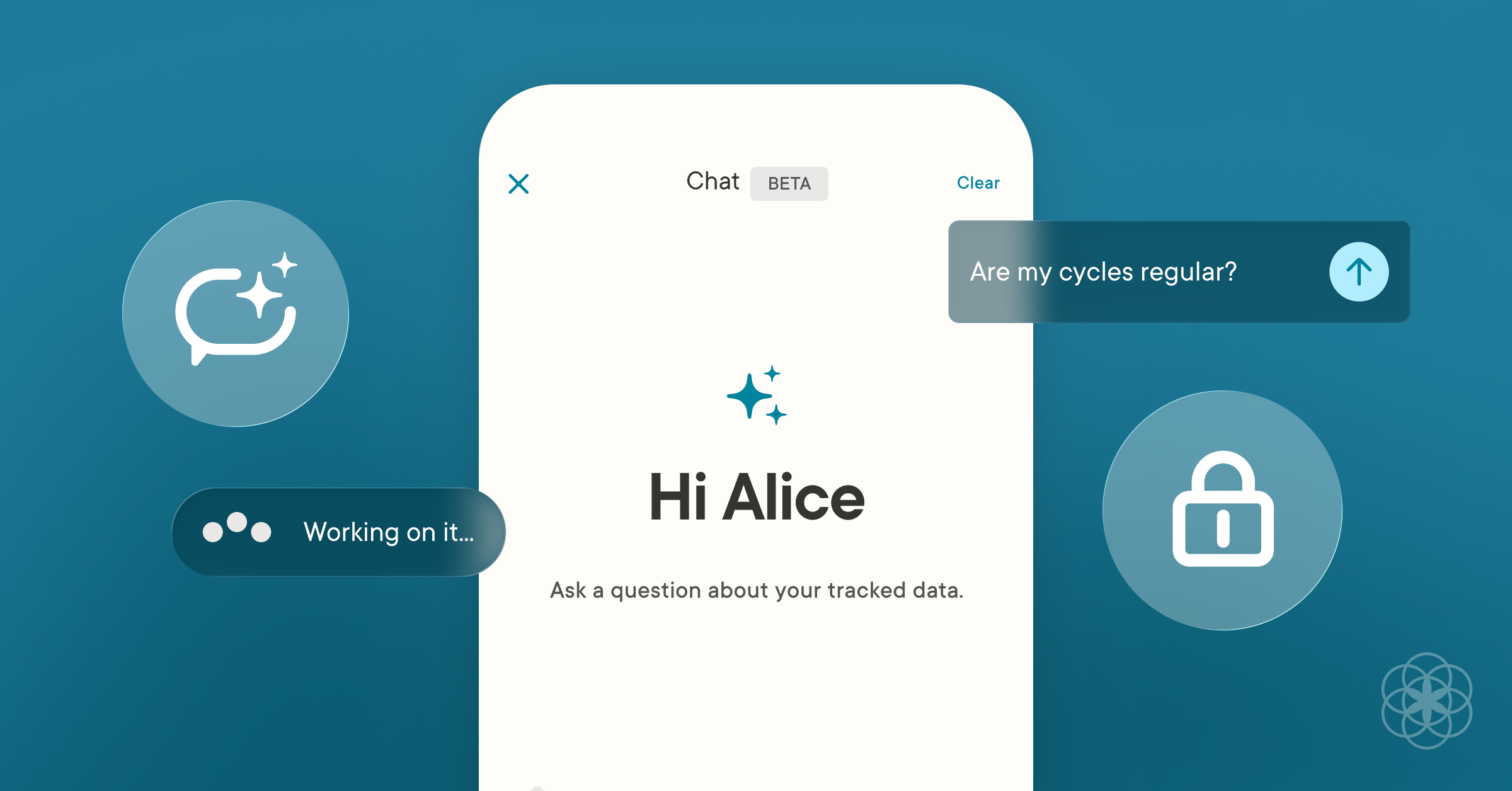
Clue says the feature uses a language model from Anthropic (anthropic.com), hosted on Amazon Web Services Bedrock within Clue's own cloud environment. The company has placed restrictions on what the system can do and involves scientific and medical experts in evaluating potential risks. The feature is intended to help women understand their tracking histories, not replace healthcare professionals or provide unrestricted medical advice.
Giving women easier access to information about their health is useful. It also makes Clue's handling of sensitive data increasingly important as AI becomes part of the product.
Why Trust Matters as Much as Technology
Women trust Clue with some of the most personal details of their health, from menstrual pain and mood changes to fertility concerns. White understands that responsibility firsthand because she uses the app herself. "There are things in Clue that only my husband and my doctor know," she told me.
Protecting that information begins with giving women control over how it's used. White said Clue has six separate consent settings, allowing users to make individual choices and change their permissions at any time. The company has also built checks into its systems to ensure those choices are respected whenever data is processed.
"We don't do bundled consents, and we don't do 'consent once and you're done,'" White explained.
This becomes particularly important as Clue expands into research and AI. The company says Chat With Your Data requires separate consent, that users' information isn't shared directly with Anthropic, and that their data cannot be used to train the underlying language model.
Beyond consent, Clue also restricts who within the company can access sensitive information. White explained why these internal controls matter just as much as encryption.
"Data governance is actually probably the least sexy part of it, but the most critical, because you can have the best encryption in the world, but if someone has the key, then they can get everything," she said.
Those restrictions apply even to the CEO. "I have never seen and I cannot see raw user data, because there's no legitimate use in my role," White explained.
Clue also stores users' data in the European Union, regardless of where they live. "It doesn't matter where you are in the world, your data is stored and controlled in the EU," White said. Its privacy policy explains that certain activities, such as connecting Apple Health or contacting customer support, may involve processing outside the EU under approved safeguards. Clue says all processing for Chat With Your Data remains within the EU.
Privacy also matters commercially. Clue depends on women feeling comfortable recording sensitive information over months or years. Maintaining that trust is essential to the long-term relationships that make personalized tracking and research possible.
From Period Tracking to Healthcare: Clue's Next Big Move
Consider a woman who has spent months recording persistent pain or irregular bleeding. She may understand when her symptoms occur and how they've changed over time. But recognizing a health concern is only the first step. Finding the right doctor, being taken seriously, and accessing affordable care can be just as difficult.
A survey by Clue's science team, published in npj Women's Health on October 31, 2026, examined the experiences of 11,910 Clue users. Among the 4,128 respondents who had consulted a healthcare professional about concerns with their cycles, 48% felt their concerns weren't taken seriously, while 34% reported being told their symptoms were normal or not a problem. Although the survey isn't representative of all women, the findings reveal how frustrating seeking care can be for some.
When I asked White about the most underrated issue in women's health, her answer was one word: "Pain."
She also identified three major barriers women face: gaps in female health knowledge, difficulty navigating healthcare services, and the cost of care. Clue has spent years helping women understand their bodies through tracking, education, and research. Now the company wants to help them find appropriate healthcare services, too.
In October 2026, Clue launched Get Care, a free in-app service connecting women with healthcare providers. Initially available in the UK, US, and Germany, it covers contraception, fertility, at-home testing, metabolic health, and mental health, with perimenopause care scheduled to follow in November.
Its partners include Hertility (hertilityhealth.com) for at-home hormone and fertility testing, Embla (joinembla.com) for weight and metabolic health, and Navicare for mental health support. Clue is also working with Novo Nordisk (novonordisk.com) on metabolic health information and access to care.
Clue doesn't provide treatment itself. Instead, women can find relevant healthcare services through an app they're already familiar with. As White explained, "Consumer software is good at building easy-to-use, smooth experiences, and we think [women] should have that when they go to healthcare as well."
The company says it vets partners for scientific evidence, regulatory compliance where required, and their commitment to improving access and choice. Finding a provider doesn't guarantee affordable treatment or better clinical outcomes, but Get Care could make navigating healthcare easier for women who already use Clue to understand their health.
Who Pays for Better Women's Health?
Clue wants to make its products accessible to more women while maintaining a sustainable business. Its approach starts with understanding what women are willing to pay for. During Rhiannon White's two and a half years as Chief Product Officer, Clue doubled annual recurring revenue, tripled paying subscribers, and quadrupled its conversion rate.
The company researched what women valued in menstrual health apps and found a clear preference. "Users want broad and shallow functionality to be free, and they are accepting of deep and personalized to be paid," White explained.
Basic period tracking remains free, while Clue Plus offers more advanced features. The company also adjusts prices to reflect purchasing power in different markets. "You can't charge the same price in Germany as you can in Malaysia, and nor should you," White said.
Clue is now going further by working with partners that cover subscription costs for eligible women. In May 2026, it announced a partnership with Süddeutsche Krankenversicherung (SDK), one of Germany's leading private health insurers (sdk.de). Clue said the deal made it the first period and menstrual cycle tracker in the world to be covered by health insurance. Thousands of SDK's fully insured members, plus about 1,600 employees of SDK and Stuttgarter Lebensversicherung, get Clue Plus at no extra cost. The company also offers premium access through partners including Wellhub, Urban Sports Club, and Vodafone.
"We want to solve the access problem," White said.
She explained that Clue may accept slightly less revenue from a partnership if it means more women can access its products without paying out of pocket. These arrangements give the company another way to grow while reducing the cost to individual users.
At the same time, Clue wants to remain financially independent enough to make decisions in its users' interests, without compromising their privacy to generate revenue.
"We do have a subscription model so that we are very clear who is paying the bills: the user," White said. "And that by paying the bills, we can be beholden only to them."
The goal is to reduce what women pay wherever possible while keeping the business sustainable. For Clue, expanding access shouldn't come at the expense of women's privacy, the trust they've placed in the company, or its financial independence.
The Takeaway
Clue's ambitions now extend well beyond period tracking. In January 2026, Clue announced the largest single investment in its history, from European growth equity firm Verdane (verdane.com), to support research, product development, international expansion, and healthcare partnerships.
For White, understanding women's needs also means listening to them directly. She still interviews Clue users every week, hearing about their experiences, hopes, fears, and concerns. "It's my favorite part of my week," she said.
Her interest is personal, too. During our conversation, White spoke openly about the fertility difficulties she and her husband experienced before having children. She described how alone they felt, and how tracking her own health helped her regain some sense of control during a difficult period.
That experience informs what she hopes Clue can offer other women. Her goal isn't to tell women what decisions to make, but to give them the information and confidence to make those decisions for themselves.
"I don't have a view on what they should do with it," she said. "It's their choice and whatever's going on for them in their life. I just want them to feel like they have the data in their hands, and therefore they can have some agency."
Interview by Dr. Dereck Mush, MD, MBA, Editor In Chief of The HealthTech Signal. This feature is based on an exclusive conversation with Rhiannon White, Chief Executive Officer of Clue, during Web Summit 2026 in Lisbon, Portugal, supplemented by publicly available company announcements and published research.