What is a pharmacy worth if it is not tied to an insurer? For most of the last decade, CVS Health answered that question by making sure it never had to. It owned the stores, the pharmacy benefit manager that steers prescriptions, the insurer that pays for care, and then the primary care clinics and in-home assessment business that deliver it. The theory was simple: control every step of a patient's journey and you can lower cost, coordinate care and capture the margin at each layer.
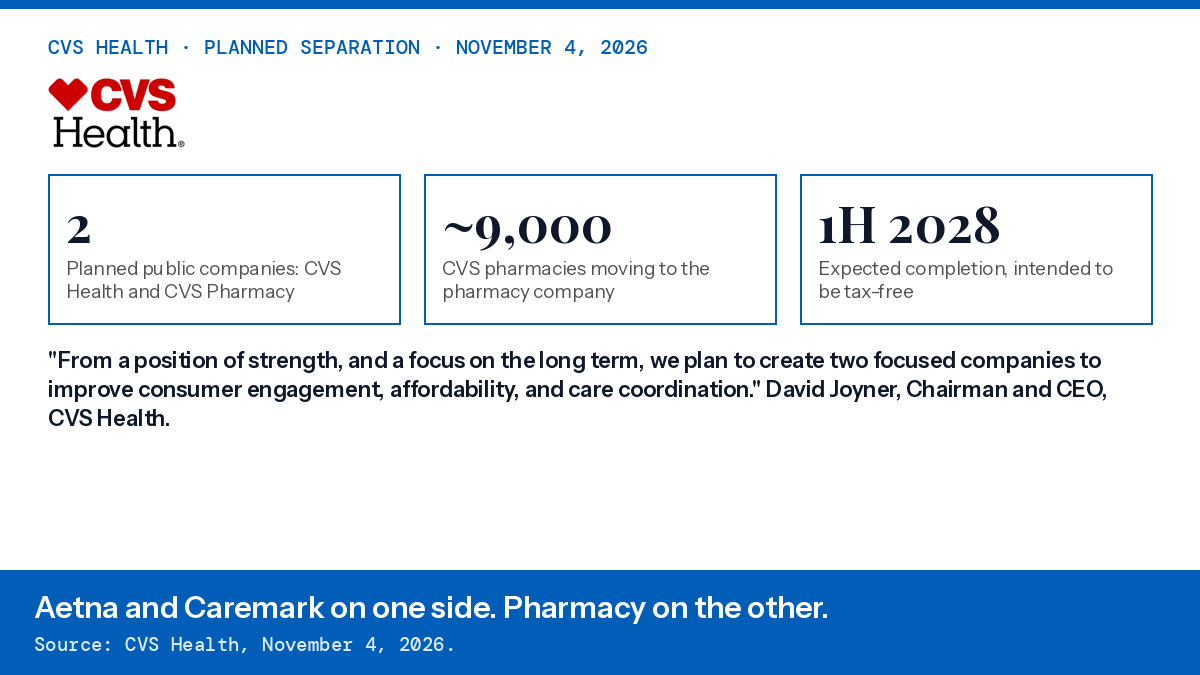
On November 4, CVS said it plans to take that structure apart. The company intends to separate into two independent, publicly traded companies: a healthcare solutions company built around Aetna, CVS Caremark, CVS Specialty, Oak Street Health and Signify Health, and a retail pharmacy and community health company called CVS Pharmacy. The separation is expected to close in the first half of 2028. Below we look at what was announced, why the integrated model is being rethought, how the two companies compare with their rivals, where the regulatory pressure sits, and what this means for anyone selling technology into payers, PBMs and pharmacies.
CVS spent years proving it could own every layer of care. Its new bet is that a pharmacy free to work with everyone is worth more than a pharmacy that works mostly for one family of companies.
In This Deep Dive
- Why this matters now
- What actually happened
- The obvious read versus the deeper signal
- Category map and taxonomy
- Evidence Ladder
- Regulation and international divergence
- Capital flows and bottom-up economics
- The HealthTech Investor's Signal
- Counter-thesis
- Forward Intelligence
- The Bottom Line
Why this matters now
CVS built its integrated model in stages. It merged with Caremark in 2007, joining a retail pharmacy chain to a PBM. It completed its acquisition of Aetna on November 28, 2018, in a deal it valued at about $70 billion, adding a national insurer. In 2023 it bought Signify Health, an in-home health evaluation business, and Oak Street Health, a primary care operator focused on Medicare patients. By September 30, 2026, CVS described itself as running approximately 9,000 retail pharmacy locations, more than 1,000 walk-in and primary care clinics, a PBM with approximately 87 million plan members, and insurance products serving an estimated 37 million people.
Three pressures have been building against that model. First, retail pharmacy is changing fast. Front-store sales face online competition, prescription reimbursement has tightened, and the wider sector has been reshaping its store footprint. A pharmacy chain that sits inside a larger company has to compete for capital with an insurer and a PBM that have very different economics.
Second, PBM policy is an active area of federal and state debate. The FTC published an interim staff report on PBMs in July 2024. Lawmakers in Congress and in several states have pushed proposals that would limit how PBMs pay pharmacies they own, or separate PBM ownership from pharmacy ownership altogether. A company that owns both a PBM and a pharmacy chain manages that policy question in one structure.
Third, the integrated thesis needed a scorecard, and the market has been asking for one. If owning the insurer, the PBM, the clinic and the pharmacy produced better outcomes and lower costs, investors would expect to see it. CVS's own framing is careful: it says it wants to create "two focused companies to improve consumer engagement, affordability, and care coordination." That is a statement that focus, not more integration, is the next lever.
Certainty: (A) CVS's acquisition history, the Aetna close date and the September 30, 2026 operating figures from CVS releases; (A) the FTC PBM interim report; (B) our characterization of retail pharmacy pressures and state and federal PBM proposals as a general market trend.
What actually happened
CVS Health made the announcement from Woonsocket, Rhode Island, on November 4, alongside its third quarter 2026 results, in which it raised full-year 2026 guidance. It filed a Form 8-K with the SEC the same day and held an investor call at 8 a.m. ET.
The two companies
- Healthcare solutions company (interim name CVS Health): Aetna, CVS Caremark, CVS Specialty, Oak Street Health and Signify Health. CVS says it "will maintain the connections that drive value for clients and members."
- CVS Pharmacy: approximately 9,000 CVS pharmacies, mail pharmacy, MinuteClinic (including virtual care) and the Health100 technology services business. CVS describes it as "the most frequently accessed consumer health touchpoint" and says it will expand services from its nearly 30,000 pharmacists.
- Health100: both companies remain committed to it. CVS says Health100 will deliver "AI-native products and services designed to address today's affordability, access and experience challenges in healthcare."
Leadership
David Joyner, currently Chairman and CEO of CVS Health, will be Chairman and CEO of the healthcare solutions company. Prem Shah, currently Group President of CVS Health, will be CEO of CVS Pharmacy. CVS says additional leadership positions and board members will be announced later.
Terms and conditions
- CVS Health shareholders will own shares in both companies.
- The separation is intended to be tax-free to CVS Health and its shareholders for U.S. federal income tax purposes.
- Both companies are expected to have a solid investment grade rating at separation and pay an attractive dividend.
- Completion is subject to final board approval, an effective Form 10 registration statement with the SEC, and customary confirmation of tax-free treatment.
- Advisors: Goldman Sachs as lead financial and strategic advisor, Consello as financial and strategic advisor, and Wachtell, Lipton, Rosen & Katz as legal counsel.
Joyner's framing was that the company is acting "from a position of strength," citing progress over the last two years on leadership, financials, operations and shareholder return. CVS says customers, patients and clients will continue to receive their medicine, care, benefits and services "uninterrupted."
Certainty: (A) all structural, leadership and transaction details as published by CVS Health and in its 8-K; (C) the final shape of the separation, which can change before completion.
The obvious read versus the deeper signal
The obvious read: a conglomerate breaks up to release shareholder value. The insurer and PBM have one set of economics, the stores have another, and investors would rather own them separately. This is a familiar playbook in other industries.
The deeper signal: look at which assets go where. The payer, the PBM, the specialty pharmacy and the care delivery businesses stay together. Only the retail pharmacy, the clinics in those stores and the new technology business go out. CVS is not abandoning integration. It is keeping the integration that touches money flows, benefit design and claims, and releasing the part that touches consumers on the street.
That says something about where CVS thinks value lives. The healthcare solutions company keeps the pieces that decide who pays, what drugs are covered and where Medicare patients get primary care. CVS Pharmacy keeps the pieces that people actually walk into. CVS's release says CVS Pharmacy will "pursue a wider set of partnerships across the healthcare system, including with payers, pharmacy benefit managers and manufacturers." In plain terms: a standalone CVS Pharmacy can court business from PBMs and insurers that compete with Caremark and Aetna, which may have been harder while it was part of the same company.
The third implication is for technology. Health100 goes with the pharmacy company, and both companies say they remain committed to it. Pharmacy is the highest frequency consumer health touchpoint CVS has. Putting the AI-native consumer business with the stores suggests CVS sees the consumer front door, not the insurance card, as the place where engagement technology pays off.
The fourth implication is for the rest of the market. UnitedHealth Group and Cigna also combine insurance or benefits with large PBMs. If a separated CVS trades well and grows partnerships, those companies will face more questions about their own structures. If it struggles, the integrated model gains a defense.
Certainty: (A) asset allocation and partnership language from CVS; (B) the strategic logic and competitive implications are our analysis; (C) how the market will value each company.