A benefits manager at a mid-sized employer is looking at next year's plan. There is a vendor for diabetes, another for back pain, a third for mental health, a fourth for sleep apnea and now a request to add GLP-1 support. Each has its own contract, its own login and its own claims about savings. The benefits manager already has a wellbeing platform that most employees have used at least once. The easiest new program to buy is the one that plugs into that platform.
That is the logic behind the deal announced on November 19. WebMD Health Services, which serves more than 3,500 employers, health plans, health systems and public sector organizations, will offer Dario's multi-condition platform to its clients. Dario expects revenue from 2027. This briefing looks at what the deal says about distribution in digital health, what it does not prove, and how buyers should judge it.
In employer digital health, the scarce asset is no longer an app. It is a trusted channel into the benefits decision.
In This Deep Dive
- Why this matters now
- What actually happened
- The obvious read versus the deeper signal
- Historical playbook
- The world forming around bundled digital chronic care
- Category map and taxonomy
- Evidence Ladder
- Regulation: HIPAA, employer wellness rules, ERISA plans and device boundaries
- Capital flows and bottom-up economics
- The HealthTech Investor's Signal
- Counter-thesis
- Forward Intelligence
- The Bottom Line for Benefits Leaders and Digital Health Investors
Why this matters now
Employer digital health has moved from a boom to a sorting phase. Buyers have accumulated point solutions and now want fewer vendors, clearer outcome evidence and simpler contracts. Independent evaluators have added pressure: the Peterson Health Technology Institute's 2024 assessment of digital diabetes management tools found limited clinical benefit relative to their cost, while its 2024 assessment of virtual musculoskeletal care was more favorable. Buyers now ask category by category whether a program pays for itself.
In that market, vendors face two problems at once: they need to show outcomes, and they need to reach buyers without spending heavily on direct sales. Channel partnerships with platforms that already hold employer relationships address the second problem. Multi-condition bundles address the buyer's desire for fewer vendors.
For investors, this matters because customer acquisition cost has been the weak point of many digital health business models. A channel that converts existing client relationships into new contracts can change unit economics, but only if clients actually add the program.
Tier (A) for the deal facts and the PHTI findings as published. Tier (B) for our reading of market dynamics.
What actually happened
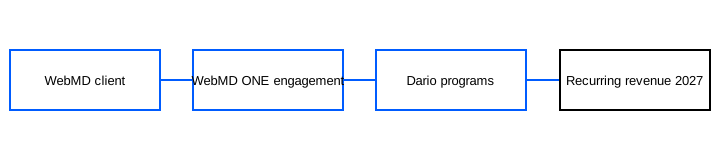
- The partnership: DarioHealth and WebMD Health Services announced a strategic partnership bringing Dario's multi-condition, whole-person care platform into the WebMD ecosystem, combining WebMD's risk identification, engagement and behavior change capabilities with Dario's care programs.
- The connection: Organizations already using WebMD Health Services can connect members from WebMD ONE into Dario's clinical interventions across multiple chronic conditions.
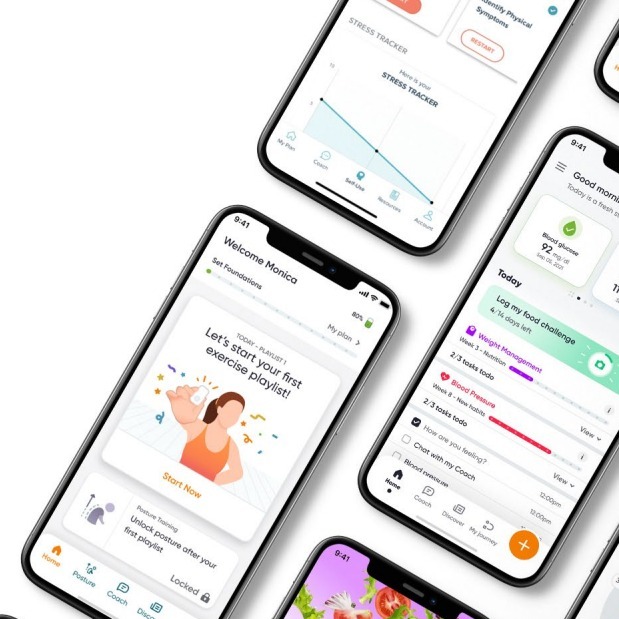
- The programs: Cardiometabolic care, behavioral health, musculoskeletal care with posture management, obstructive sleep apnea, women's health including perimenopause and menopause support, GLP-1 support programs and access to care through Dario's provider network.
- The engine: DarioIQ, which Dario describes as an AI-driven intelligence engine using proprietary longitudinal health data to personalize engagement and interventions.
- The money: Dario expects annual recurring revenue from 2027, including via distribution through the administrative services organization of a leading integrated healthcare system. Dario cites an independent analysis of published peer-reviewed studies suggesting its platform could reduce total payer costs by up to 10% in-year.
Tier (A). Facts are from Dario's November 19 release, which includes quotes from Erez Raphael, CEO of Dario, and John Harrison, president and general manager of WebMD Health Services.
The obvious read versus the deeper signal
The obvious read: Dario just gained access to millions of lives and thousands of employers, so revenue should jump.
The deeper signal: Access is not adoption. The release is careful: clients choose whether to add Dario, and revenue starts in 2027. What Dario gains is a shorter path to the buyer, a single contracting relationship that can carry several programs, and the credibility of a large wellbeing brand. What WebMD gains is a set of higher-acuity clinical programs that sit on top of its engagement platform without building them. The deeper signal is structural: engagement platforms are becoming the storefront for clinical point solutions, and vendors that cannot get on those shelves will struggle to reach mid-market employers efficiently.
Tier (B) interpretation, grounded in the release language on client choice and 2027 revenue timing.
Historical playbook
Employer digital health went through a consolidation wave in the early 2020s. The largest example was Teladoc's acquisition of Livongo, announced in 2020, which combined virtual care with chronic condition management in a single company. The thesis was that one vendor offering many programs would win against many single-condition vendors.
Public listings in 2025 for musculoskeletal and chronic care vendors showed that investors would still reward companies with scale and clear revenue. Those companies built their own large sales teams and payer relationships over many years. Smaller vendors without that scale have increasingly turned to partnerships with benefits platforms, pharmacy benefit managers, health plans and third-party administrators.
The lesson from both paths is that bundling alone does not create value. The bundle needs a buyer who prefers it, a channel that reaches that buyer cheaply and outcomes that survive scrutiny.
The world forming around bundled digital chronic care
Several types of companies now compete to be the front door for employee health: wellbeing and engagement platforms, navigation companies, health plans and their care management arms, pharmacy benefit managers and virtual primary care groups. Each wants to curate which clinical programs employees see.
Point-solution vendors respond by bundling conditions themselves, partnering with these front doors, or both. Dario's announcement does both: it presents a multi-condition platform, and it sells it through WebMD's channel. GLP-1 support is an increasingly common addition because employers want help managing the cost and appropriate use of these drugs.
Evaluators and consultants are the other force. Independent assessments and outcomes-based contracts are pushing vendors to prove value condition by condition, which can sit awkwardly with the bundle story.