Every benefits leader in America has been asked the same question for two years: do GLP-1s pay for themselves? Manufacturers point to cardiovascular outcomes trials. CFOs point to the pharmacy line. On November 15, 
In this deep dive we unpack how the analysis was built, what the numbers can and cannot tell us, why the members who stay on therapy widen the cost gap rather than close it, how the cash-pay market is reshaping the negotiation, and which business models in pharmacy benefits and digital weight care stand to gain. We close with the strongest case that this paper is less a study than a negotiating position.
The drugs work, the savings are real, and the price is still wrong. That is the whole paper in one line.
In This Deep Dive
- Why this matters now
- What actually happened
- The obvious read versus the deeper signal
- Category map and taxonomy
- Evidence Ladder
- Policy, pricing and the rules shaping GLP-1 coverage
- Capital flows and bottom-up economics
- The HealthTech Investor's Signal
- Counter-thesis
- Forward Intelligence
- The Bottom Line for Employers, PBMs and GLP-1 Care Companies
Why this matters now
GLP-1s are now the single biggest pressure point in employer pharmacy budgets. The CVS white paper says the class accounts for roughly half of prescription drug spending growth, and that about eight in ten employers identify GLP-1s as a key driver of rising health care costs. It also cites JAMA Cardiology research estimating that more than 137 million U.S. adults are medically eligible for semaglutide, including 129 million under the obesity indication. Those two facts together explain why coverage decisions have become board-level conversations.
Until now, most employers have been choosing between manufacturer-sponsored outcomes data and vendor savings claims of uneven quality. A large, integrated payer publishing its own matched claims analysis changes that.
Timing matters too. The paper landed during HLTH and in the same week as ObesityWeek, when obesity drug data dominates the news cycle, and just as plans and employers finalize 2027 benefit designs. Premium pressure is not theoretical: the white paper cites KFF's 2026 survey showing average employer-sponsored family coverage reached $28,303, up 5% from 2025.
Certainty: (A) study figures, spending context and CVS footprint are from
What actually happened
- The data. CVS researchers used anonymized Aetna claims from commercial fully insured members who used GLP-1s, with index years 2023 through 2025 and up to three years of follow-up.
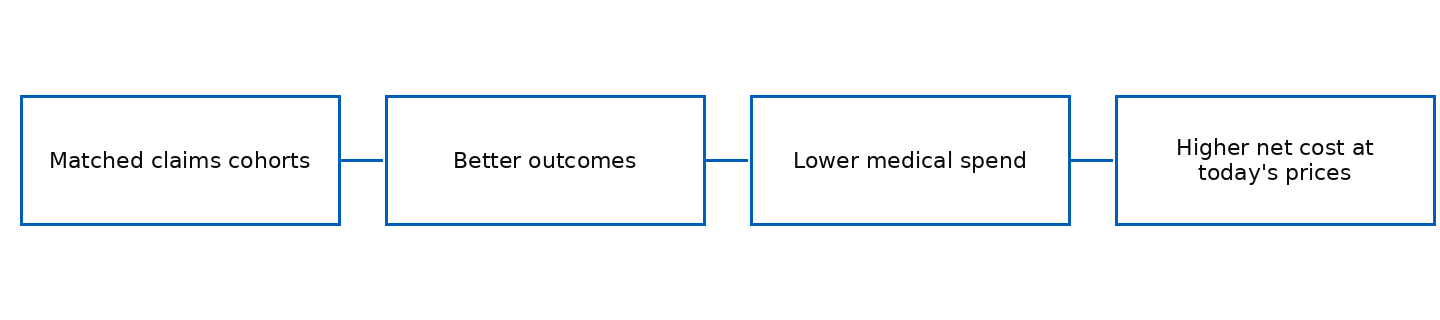
- The comparison. GLP-1 users were propensity matched with similar non-users on age, existing conditions, prior health care use, and medical and pharmacy spending. Year 1, year 2 and year 3 populations were matched and analyzed separately, so they are not one cohort followed over time.
- The adherence split. The team compared all initiators with adherent members, defined as prescriptions covering at least 80% of days during follow-up (proportion of days covered of 0.8 or more).
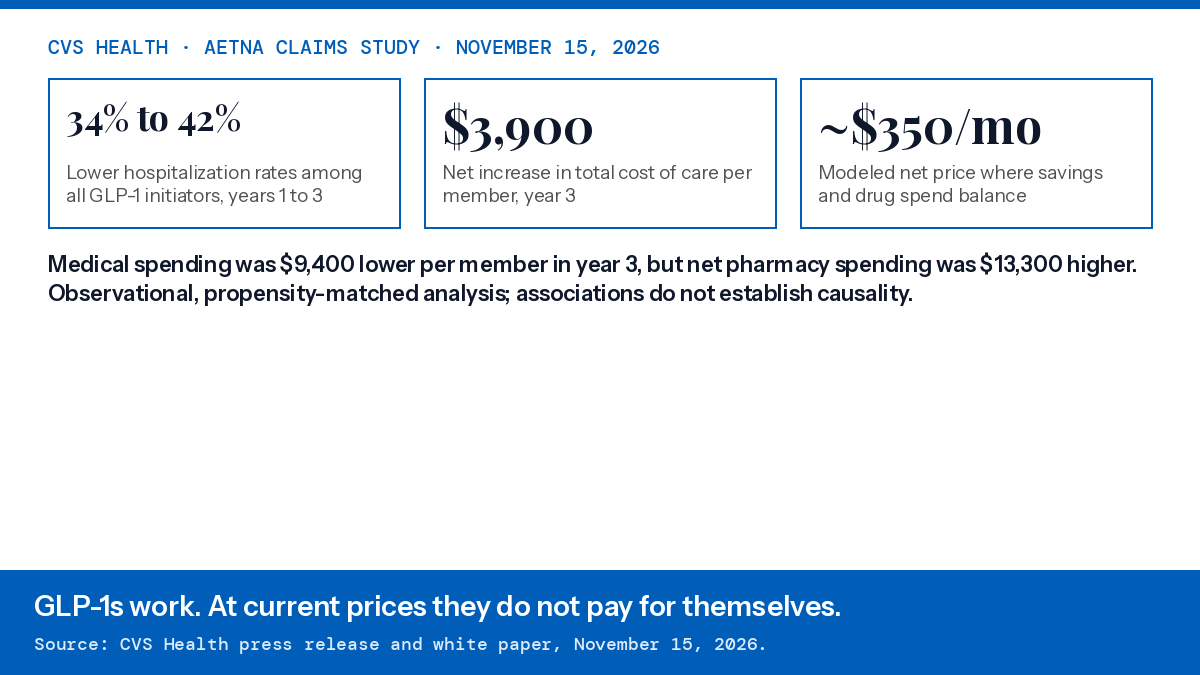
- The clinical outcomes. All initiators had 34% to 42% lower hospitalization rates, 10% to 12% lower emergency visit rates in years 1 and 2, 14% lower odds of major adverse cardiovascular events, 18% to 24% lower odds of heart attack, 15% to 19% lower odds of heart failure, and 17% to 18% lower odds of a composite renal failure outcome in the earlier analyses.
- The economics. Medical spending was $1,300 lower per member in the year 1 analysis and $9,400 lower in year 3, but net pharmacy spending was $13,300 higher in year 3, a net increase in total cost of care of about $3,900 per member.
- The benchmark. Internal modeling suggests a net price of approximately $350 per month over three years would bring pharmacy spending and observed medical savings into balance across the study population.
Certainty: (A) every figure in this section is from the
The obvious read versus the deeper signal
The obvious read: A big insurer says GLP-1s cost too much, which is what insurers always say about expensive drugs.
The deeper signal: The deeper signal is that CVS conceded the clinical argument in full and moved the fight to price and persistence. By publishing outcomes that favor the drugs, including 53% to 66% lower hospitalization rates for adherent members, CVS took away the easy objection that GLP-1s do not deliver. What remains is a number, roughly $350 a month net, and a demand that manufacturers give plans net prices at least comparable to what they now charge cash-pay consumers. That reframes coverage from a yes or no decision into a pricing and adherence management problem, which is exactly the problem PBMs and care management companies sell solutions for.
Certainty: (A) the outcomes, the $350 figure and the cash-price recommendation are from the white paper; (B) the reading that CVS is repositioning the debate toward price and persistence is ours.
Historical playbook
Payers have fought this battle before with high-value, high-cost therapies. When curative hepatitis C drugs launched in the mid-2010s, plans first restricted access by disease severity, then used formulary exclusivity deals to drive net prices down sharply once competing products arrived. The clinical value was never in doubt; the question was what plans would pay and for whom. GLP-1s follow the same arc with one critical difference: hepatitis C is cured in weeks, while obesity is a chronic disease that, as the white paper puts it, often requires treatment that is not short-term.
That chronic nature is what makes the CVS adherence finding so important. In a cure model, a one-time cost buys lifetime savings. In a chronic model, every month of therapy adds cost, and savings depend on how long people stay on treatment and how well they respond. The members who did best in the CVS data, the adherent ones, were also the most expensive, because they used more of the drug. Medical savings grew from $9,400 to $13,000 per member in year 3, but pharmacy spending grew faster, from $13,300 to $20,300.
The other historical parallel is the cash market. CVS notes that