Inside Eko's CORE 300: The Economics of AI-Enabled Physical Examination

Dr. Dereck Mush, MD, MBAThe Daily SignalOctober 23, 2026
PLUS: BioStack Launches 100M+ Record Multimodal Network with $9.5M Seed

Good morning, HealthTech insiders. For years, clinical technology followed an expensive iron law: advanced medical intelligence required specialized hardware towers, dedicated imaging suites, and multi-thousand-dollar capital budgets. That assumption is collapsing across multiple specialties simultaneously. When point-of-care disease detection arrives in standard stethoscopes priced at parity with analog tools, when multi-country training data unifies 100 million records across four continents, and when targeted RNA degradation replaces lifetime viral suppression with a 24-week functional cure, the core unit economics of healthcare delivery transform.
This morning we are tracking three landmark developments that illustrate this structural shift across bedside diagnostics, bio-compute infrastructure, and precision pharmacology. In point-of-care hardware, Eko Health has achieved FDA clearance and launched the CORE 300 AI stethoscope. In biomedical data infrastructure, BioStack secured $9.5 million to launch a 100-million-record global multimodal network. And in biotech, the FDA has approved GSK and Ionis's Hibsago, establishing the first antisense oligonucleotide functional cure regimen for chronic hepatitis B.
In today's Signal:
Hardware parity at the bedside: Eko Health launches its FDA-cleared CORE 300 AI stethoscope, embedding structural murmur detection into routine exams at standard analog pricing.
Multi-continental bio-compute: BioStack unifies 100M+ multimodal clinical records across the U.S., India, Brazil, and Argentina with $9.5M in backing led by Peak XV and DCVC.
Landmark RNA functional cure: FDA approves GSK and Ionis's Hibsago (bepirovirsen) for chronic hepatitis B following 19% functional cure rates in Phase 3 B-Well trials.
Follow the Money & Investor Signal: Capital concentrates in low-friction clinical enablement layers and scalable multi-country data assets.
People assume that real businesses get built by other people with more resources. It's how great ideas get stuck in notes apps and conversations.
But you don't need six months and a developer's salary to validate your concept. You just need a weekend. Describe what you want to exist and Lovable builds it: a real site, a real product, ready to accept real payments from real customers. Not a mockup to show people. An actual thing they can use.
You don't need anyone's sign-off to get started. Take $5 off your first month.
Discount of $5 applies to first month of any paid plan. You need to sign up via this webpage in order to claim the discount. The discount applies to new and returning users without an active paid plan. Terms apply.
LATEST DEVELOPMENTS

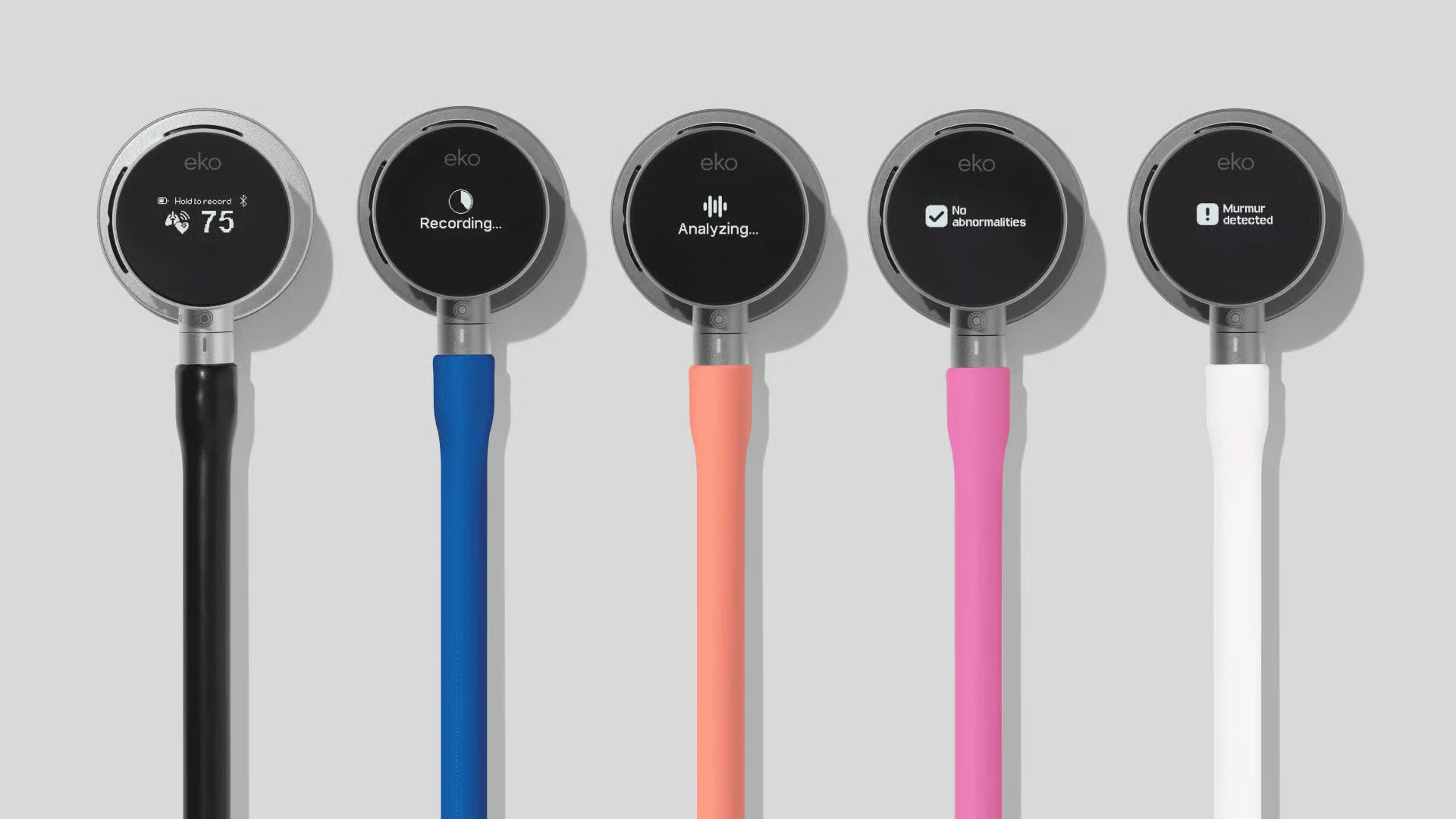
Eko Health’s CORE 300 combines traditional and digital listening, with access to AI-assisted structural murmur detection through the Eko App. Credit: Eko Health.
Eko Health has received FDA 510(k) clearance (K261694) and officially launched the CORE 300, a hybrid digital-analog stethoscope that embeds structural murmur AI detection into routine physical examinations at pricing parity with premium traditional stethoscopes.
The details:
Delivers 35x analog/digital acoustic amplification with active noise cancellation and an integrated OLED display presenting real-time heart rates directly on the chestpiece.
Integrates seamlessly with the Eko App and Eko's FDA-cleared structural murmur detection algorithm (K251494) without requiring changes to standard bedside clinical workflows.
Over 750,000 clinicians globally have deployed Eko devices; the CORE 300 targets universal frontline primary care, emergency medicine, and rural clinical adoption by eliminating the hardware cost premium.
The Signal: Frontline clinical AI adoption has historically stalled on high hardware acquisition costs and auxiliary cart workflows. By packaging FDA-cleared structural murmur algorithms into a standard-form stethoscope at analog pricing, Eko converts every routine physical exam into an automated cardiac triage point, unlocking mass point-of-care screening without health system capital expenditure hurdles.

BioStack co-founders Sanat Mishra, CEO, left, and Parth Patwa, CTO. Credit: BioStack Platforms, Inc.
BioStack has launched a global de-identified multimodal clinical data network spanning over 100 million patient records across the U.S., India, Brazil, and Argentina, closing a $9.5M Seed round led by Peak XV, DCVC, and Y Combinator.
The details:
Unifies fragmented electronic medical records (EMRs), histopathology imaging, multi-omics assays, and longitudinal treatment outcomes across hospital systems in four major health economies.
Backed by $9.5M Seed co-led by Peak XV, Afore Capital, DCVC, Emerson Collective, SV Angel, Verdict Capital, Streamlined Ventures, and Y Combinator.
Provides foundational multi-country training infrastructure for biomedical foundation models, clinical trial simulation, and automated drug discovery engines.
The Signal: The bottleneck in clinical foundation models has shifted from algorithmic architecture to multi-country, multimodal data diversity. By aggregating 100M+ longitudinal records across diverse global healthcare systems with standardized phenotypic-to-genotypic pipelines, BioStack creates the essential training substrate required to eliminate geographic and demographic bias in biomedical AI.

Scientists at GSK’s Upper Merion research site in the United States. Illustrative image accompanying the FDA approval of Hibsago for eligible adults with chronic hepatitis B.
Credit: © Olivier Hess / GSK.
The U.S. FDA has approved Hibsago (bepirovirsen; GSK / Ionis Pharmaceuticals), a first-in-class antisense oligonucleotide (ASO) for adult patients with non-cirrhotic chronic hepatitis B, establishing the first fixed-duration regimen capable of delivering functional cures.
The details:
Indicated for non-cirrhotic adults on stable nucleos(t)ide analogue (NrtI) therapy for ≥6 months with suppressed HBV DNA and baseline HBsAg ≤3000 IU/ml via an FDA-authorized companion test.
Phase 3 B-Well 1 (NCT05630807) and B-Well 2 (NCT05630820) trials (published in NEJM, n=1,220 vs 614 placebo) demonstrated a 19% functional cure rate (233/1,220) at 24 weeks post-treatment cessation vs 0% on placebo.
Granted FDA Breakthrough Therapy and Priority Review, shifting the chronic hepatitis B treatment paradigm from indefinite lifelong suppression to finite 24-week targeted RNA degradation.
The Signal: Hibsago represents a pivotal inflection in chronic virology, demonstrating that targeted RNA degradation via antisense oligonucleotides can dismantle viral antigen tolerance and restore host immune surveillance. Achieving a 19% functional cure rate in a disease with a historical <1% annual clearance rate establishes a commercial and clinical blueprint for finite curative therapeutics across chronic viral and liver pathologies.
QUICK HITS
Eko Primary Care Detection Rates & Payer Economics: Whether universal primary care deployment of the CORE 300 accelerates early echocardiogram referrals, and how Medicare Advantage plans structure value-based quality incentives around acoustic AI screening.
BioStack Biopharma Enterprise Contracts & Data Sovereignty: Commercial adoption of BioStack's multimodal datasets by tier-one pharmaceutical AI divisions, alongside regulatory compliance with evolving cross-border health data sovereignty frameworks across Latin America and India.
Hibsago Real-World Durability & Combination Regimens: Long-term off-treatment durability data beyond 24 weeks in real-world clinical practice, as well as ongoing Phase 2/3 trials evaluating bepirovirsen in combination with therapeutic vaccines and pegylated interferons to push functional cure rates toward 30%+.
The deals:
Suki: $90M Series E led by Healthier Capital, Crosslink Capital, Hercules Capital, Venrock, Flare Capital, Hedosophia, Philips Ventures, Zoom Ventures - Ambient clinical intelligence OS and multi-agent clinical workflow platform with Wolters Kluwer UpToDate integration.
Sunlight AI: $17.4M Seed led by Basis Set Ventures (Lan Xuezhao), Overlook Ventures, Early Light Ventures, Frank Williams (Evolent Health) - Autonomous practice operating layer, claims denial recovery, and revenue cycle orchestration for independent physician groups.
BioStack: $9.5M Seed led by Peak XV, Afore Capital, DCVC, Emerson Collective, SV Angel, Verdict Capital, Streamlined Ventures, Y Combinator - Global multimodal clinical data infrastructure network spanning 100M+ patient records across 4 continents.
The pattern: Venture capital is aggressively funding infrastructure layers that either directly monetize high-friction administrative choke points (Sunlight AI's independent physician operating system) or solve foundational data bottlenecks for bio-compute (BioStack's 100M-record multi-continental network). At the later stage, growth rounds like Suki's $90M Series E confirm that ambient AI scribing is evolving rapidly from point documentation tools into enterprise-wide interactive clinical operating systems.
Transcatheter Cardiovascular Therapeutics (TCT 2026) (October 31 - November 1, 2026 | San Diego, California): The world's premier interventional cardiology conference, showcasing pivotal validation data for non-invasive AI fractional flow reserve (FFR-CT) and next-generation intravascular diagnostics.
HLTH 2026 (November 15-18, 2026 | Las Vegas, Nevada): The flagship healthcare innovation summit convening 12,000+ C-suite leaders, health system executives, payers, and top venture funds defining 2027 enterprise health tech procurement.
RSNA 2026 (Radiological Society of North America) (November 29 - December 3, 2026 | Chicago, Illinois): The definitive global radiological assembly featuring breakthrough clinical trials in multimodal diagnostic foundation models, autonomous reporting, and AI image reconstruction.
Elucid FFR-IQ: FDA 510(k)-cleared BioIntegrated AI software estimating fractional flow reserve from coronary CT angiography (FFR-CT) with 92.2% sensitivity and 93.1% specificity, reducing unnecessary invasive cardiac catheterizations. Combines tissue plaque composition with coronary anatomy to deliver non-invasive hemodynamic assessments without invasive pressure wires.
Google DeepMind AlphaGenome Atlas: A 1-petabyte searchable AI database mapping predicted molecular effects across all 9 billion possible single-nucleotide DNA variants in the human genome with the AlphaGenome Variant Impact (AVI) score. Provides free zero-code genomic variant prioritization for academic researchers, bridging non-coding genetic dark matter to disease pathophysiology.
Suki Ask (UpToDate Integration): An interactive clinical reasoning assistant embedded in Suki's ambient clinical OS, powered by Wolters Kluwer's UpToDate Expert AI. Enables physicians to query point-of-care evidence and clinical guidelines in natural language directly during patient encounters without leaving their EHR chart.
Elucid: AI cardiovascular diagnostics and tissue characterization - Secured FDA clearance for FFR-IQ and Plaque-IQ, leading the transition toward non-invasive, plaque-specific coronary artery disease staging.
Sunlight AI: Autonomous operating system for independent medical practices - Secured $17.4M Seed led by Basis Set Ventures to automate clinical scheduling, prior authorizations, and claims denial recoveries for independent physicians.
Brellium: AI-powered clinical documentation compliance and pre-bill auditing - Launched CortexLM with $23M Series A to audit 100% of provider clinical charts before claim submission, insulating health systems from post-payment RAC audits.
Hardware Parity and Frontline Cardiac Triage: The Economics of AI-Enabled Physical Examination
An executive analysis of Eko Health's CORE 300 strategy, evaluating how price parity with analog stethoscopes unlocks ubiquitous primary care screening, changes ACO valvular disease economics, and pressures traditional diagnostic device business models.
Multimodal Bio-Compute Infrastructure: Solving the Global Data Scarcity Bottleneck in Medical AI
A comprehensive breakdown of BioStack's multi-continental network across the US, India, and Latin America, analyzing data sovereignty, multimodal federated pipelines, and the commercial valuation of longitudinal training assets.
A strategic assessment of GSK and Ionis's Hibsago FDA approval in chronic hepatitis B, examining functional cure economics, companion diagnostic integration, payer cost-offset modeling, and the future of RNA therapeutics.
Which category of clinical AI deployment will deliver the highest measurable health system ROI over the next 24 months? |
Healthcare innovation in late October 2026 is coalescing around a single operational truth: the most powerful technologies are those that dissolve deployment friction. Whether by putting cardiac murmur detection into an everyday stethoscope at analog prices, organizing 100 million multimodal patient records across four continents into clean training assets, or replacing lifetime chronic disease pill regimens with a 24-week targeted RNA functional cure, technology is removing barriers to clinical execution.
For health system executives, life sciences leaders, and investors, the key imperative is recognizing where friction is falling fastest. The winning platforms will not be those that require extensive hospital retraining or multi-year implementation cycles, but those that deliver immediate clinical precision within existing care delivery models.
How did we do today? |
See you tomorrow,
Dr. Dereck Mush, MD, MBA
The HealthTech Signal is independently funded. Sponsorships help us invest in better reporting, research, and a stronger newsletter for our readers. Want to reach HealthTech founders & executives while supporting the Signal? Get in touch.
Was this email forwarded to you? Sign up here.
Until tomorrow,
The HealthTech Signal

Dr. Dereck Mush, MD, MBA

Dr. Dereck Mush, MD, MBAKeep exploring