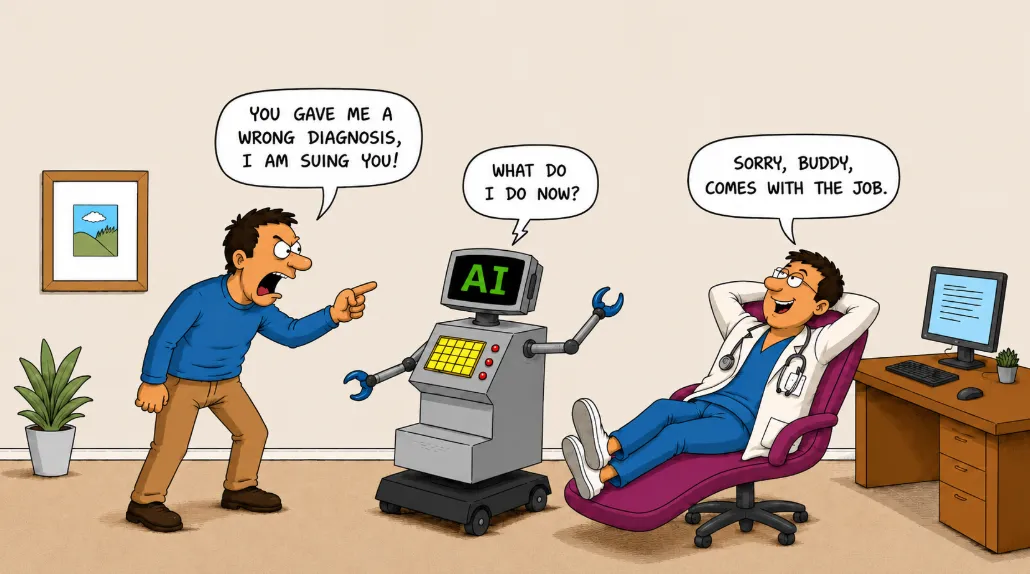
Agentic AI, systems that plan and execute multi-step tasks rather than just answer a single question, is real and shipping in hospital administration today, and the best independent benchmark available shows current agents still fail the majority of realistic, complex healthcare administrative tasks. Both facts matter for anyone deciding how much of this year's roadmap to bet on it.
What "agentic AI" means in a hospital context, concretely
Unlike a chatbot that answers a question, an agent is given a goal, such as "resolve this denied claim" or "schedule this patient's follow-up across three departments," and it independently navigates software interfaces, calls other systems, and takes a sequence of actions to get there, checking in with a human only at defined points or not at all. This is a meaningfully different technical bet than the documentation and chatbot tools that dominated 2024 and 2025.
How well do these agents actually perform?
Stanford's HealthAdminBench, built with Stanford Healthcare and described in a companion arXiv paper, is the most rigorous public evaluation available. It tests computer-use agents, meaning agents that operate real graphical software interfaces rather than clean APIs, across 135 tasks and 1,698 subtasks spanning four realistic administrative environments. That scale and realism is deliberate: hospital administrative work happens inside legacy EHR and scheduling software with inconsistent interfaces, not tidy APIs, and prior agent benchmarks in other industries had not captured that friction.

The results, consistent with agentic AI benchmarks in other complex, high-stakes domains, show current leading agents completing only a minority of full end-to-end tasks successfully, with performance dropping sharply as task length and required navigation steps increase. Multi-step tasks that require the agent to recover from an unexpected interface state, a pop-up, a session timeout, an unfamiliar field layout, are where failure concentrates most heavily.
A parallel research effort: simulating the workflow itself
A separate approach, H-AdminSim, built by researchers at KAIST and Samsung Medical Center, takes a different but complementary tack: a multi-agent simulator that models realistic hospital administrative workflows with FHIR data integration, allowing researchers to test agent behavior against synthetic but structurally realistic hospital data flows before ever touching a production system. The existence of two independent, serious benchmarking efforts in the same year is itself a signal that the field recognizes agentic AI needs rigorous evaluation infrastructure before deployment claims can be trusted, the same lesson clinical AI learned the hard way with reader studies versus prospective trials.
Where agentic AI is genuinely useful right now
A broader evidence map in npj Digital Medicine synthesizes where agentic deployments are concentrated today, and the honest answer is administrative and care-adjacent operations rather than direct clinical decision-making:

- Insurance eligibility verification and prior authorization submission, where the task is well-structured and repetitive, and errors are recoverable through existing appeal processes.
- Appointment scheduling and referral routing across departments with defined rules.
- Claims status checking and follow-up, chasing information across payer portals that would otherwise consume staff time.
A separate review in npj Artificial Intelligence traces the broader evolution of AI agents into clinical decision support, report generation and patient-facing applications, but notes evaluation methodology across the field remains immature relative to the pace of deployment claims, echoing the exact gap HealthAdminBench was built to close.
What responsible deployment looks like in 2026
- Scope the agent to short, well-defined task chains rather than open-ended goals. The benchmark data is clear that failure risk compounds with task length.
- Require human confirmation at financially or clinically consequential steps, such as submitting a claim or scheduling a procedure, even if the agent handles the navigation autonomously.
- Log every action the agent takes, not just its final output. When something goes wrong, and current benchmarks suggest it will on a meaningful share of complex tasks, you need to know which step failed to fix the process rather than just the individual case.
- Pilot against a benchmark like HealthAdminBench's task categories before a live rollout, so failure modes surface in a test environment rather than in a patient's actual claim or appointment.
The takeaway
Agentic AI is not a chatbot with better marketing, it is a genuinely new capability, and hospitals are right to be excited about the administrative labor it could eventually absorb. The 2026 benchmark data says "eventually" is doing real work in that sentence. Deploy it now on short, recoverable, well-bounded tasks, and treat any vendor pitching full end-to-end autonomous handling of complex multi-system workflows as ahead of the published evidence.
Key Signals
Stanford's HealthAdminBench shows leading AI agents still fail most complex, multi-step hospital administrative tasks. Failure concentrates in long task chains and unexpected interface states like pop-ups or session timeouts, not simple lookups. Current evidence supports agents for well-bounded tasks like eligibility checks and claims status, not open-ended goals. Log every action an agent takes, not just its final output, so failures can be diagnosed rather than just discovered.