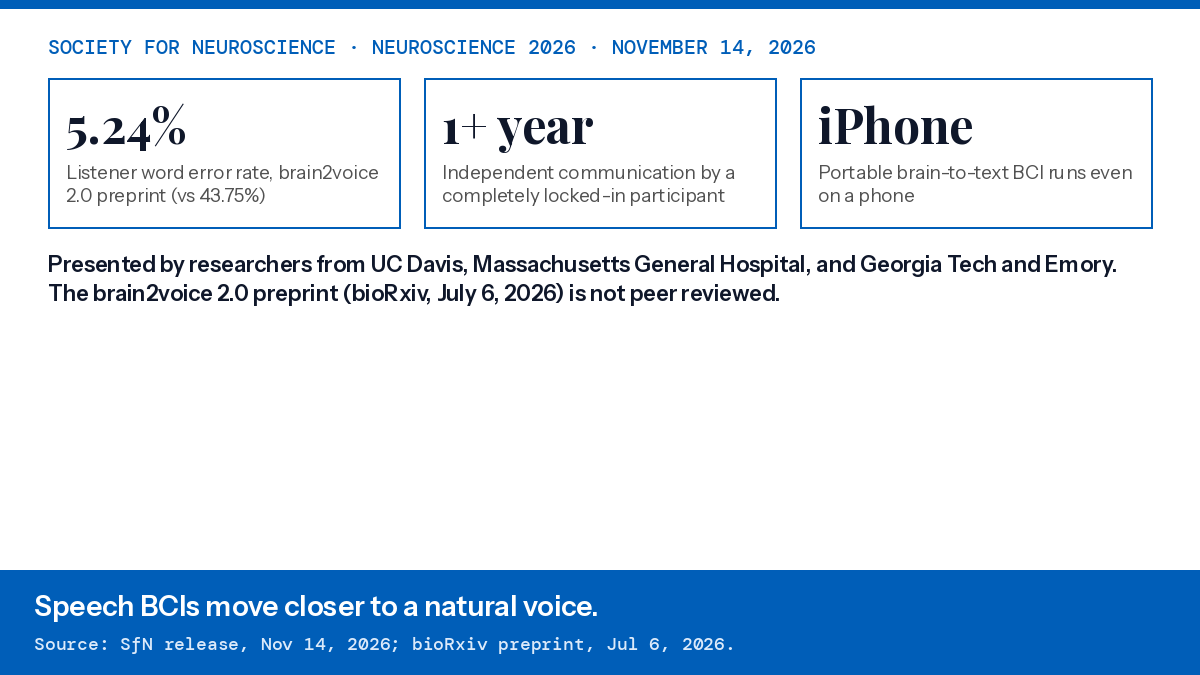
Losing the ability to speak is one of the cruelest effects of ALS, brainstem stroke and other neurological disorders. On November 14, the Society for Neuroscience used its annual meeting in Washington, D.C. to spotlight how close speech brain-computer interfaces have come to giving that ability back: not just text on a screen, but a voice with pitch and expression, independent use over more than a year, and decoding that runs on a phone.
Speech decoding is advancing in research. Reliable long-term implants remain a separate clinical development challenge. Building an implant that works for a decade is not.
In This Deep Dive
- Why this matters now
- What actually happened
- The obvious read versus the deeper signal
- Category map and taxonomy
- Evidence Ladder
- Regulation, reimbursement and the path outside trials
- Capital flows and bottom-up economics
- The HealthTech Investor's Signal
- Counter-thesis
- Forward Intelligence
- The Bottom Line for Neurotech Builders and Investors
Why this matters now
Speech BCIs have a clearer path to clinical value than almost any other neurotech application. The patients are well defined, the unmet need is severe, and the outcomes are measurable: how intelligible the output is, how fast people can communicate, and whether they use the system on their own in daily life. The SfN session showed progress on all three.
The money is following. The SfN release cites a projected global BCI market rising from $1.7 billion in 2022 to $6.2 billion by 2030. WIRED reports 


Cynthia Chestek, the University of Michigan biomedical engineer who moderated the session, said the work brings brain-to-voice and brain-to-text technologies closer to reaching people outside clinical trials. That phrase, outside clinical trials, is the commercial question for the whole field.
Certainty: (A) research findings, the market projection and the Chestek quote are from the SfN release;
What actually happened
- Expressive voice. Maitreyee Wairagkar of UC Davis presented a BCI that uses a synthetic voice capable of capturing pitch variations, which improved listener comprehension and allowed a participant to sing.
- Long-term independent use. Daniel Rubin of Massachusetts General Hospital reported that a person in a completely locked-in state communicated independently for more than a year with a BCI that decodes intended movement from brain activity.
- Portable decoding. Chethan Pandarinath of Georgia Tech and Emory showed a portable brain-to-text BCI offering accurate, efficient and reliable decoding into written words, even on an iPhone.
- The benchmark. In a bioRxiv preprint first posted July 6, Wairagkar and colleagues described brain2voice 2.0, a multimodal Transformer decoder. Naive listeners transcribed its synthesized voice at a 5.24% word error rate, an eightfold intelligibility improvement over the previous best result of 43.75%, on the team's earlier intracortical benchmark dataset.
The obvious read versus the deeper signal
The obvious read: BCIs keep getting better, and a voice that can sing is a striking demo.
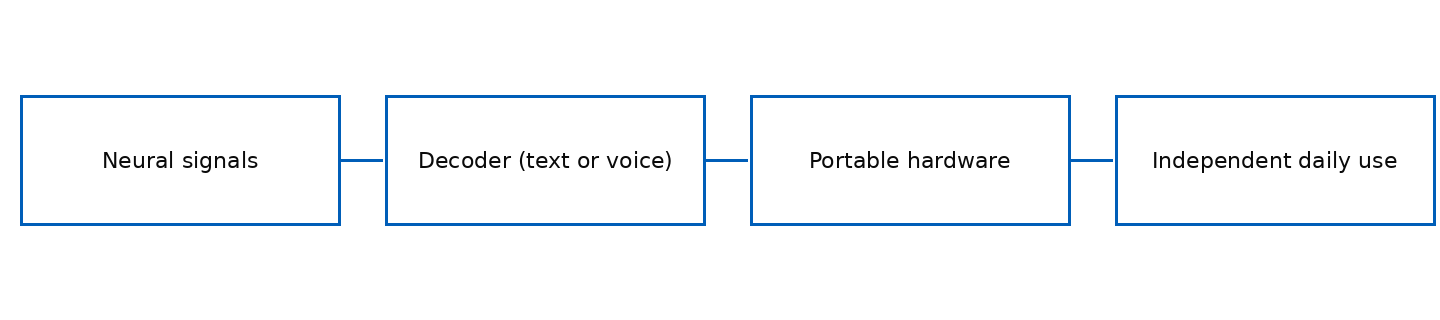
The deeper signal: The three results map onto quality of output, durability of use and practical hardware. Expressive voice addresses quality. Independent communication over more than a year addresses sustained use. Decoding on a phone addresses practicality. Each remains a research result, not evidence that an approved speech BCI is available outside trials.
Historical playbook
BCI research has moved through recognizable stages. Early intracortical work showed that people with paralysis could move a cursor or robotic arm by thought. Speech decoding came later and advanced quickly as researchers applied modern machine learning to recordings from speech motor areas, moving from slow letter-by-letter spelling to word and sentence decoding, and then to synthesized voice.
The brain2voice 2.0 preprint is a clear marker of that shift. The team trained a Transformer-based decoder on continuous and tokenized acoustic targets along with phoneme targets, outputting features every 10 ms for real-time synthesis, and reported a 7% raw phoneme error rate, which the authors describe as comparable to the latest brain-to-text models. The authors say it is the first time real-time voice synthesis from neural signals has crossed the intelligibility threshold they consider necessary for clinically viable brain-to-voice BCIs.