Heart failure is a disease of slow warnings. Fluid builds for days or weeks before a patient feels breathless enough to call, and by then the choice is often an emergency admission rather than a diuretic adjustment. Most remote monitoring tries to catch that window with weight scales, implanted pressure sensors or symptom questionnaires. DETECT-HF tested something quieter: the sound of a patient reading six sentences to a phone.
The result, published in JACC: Heart Failure and presented at the American Heart Association Scientific Sessions on November 8, is simultaneously more promising and more cautious than the headline suggests. We unpack what the numbers support, what they do not, and how to think about voice biomarkers as a category rather than a single trial.
Detection is not prevention. DETECT-HF shows a voice system can raise early flags at a livable alert rate; it does not show that acting on those flags changes outcomes.
In This Deep Dive
- Why this matters now
- What actually happened
- The obvious read versus the deeper signal
- Category map and taxonomy
- Evidence Ladder
- Regulation and the path to FDA
- Capital flows and bottom-up economics
- The HealthTech Investor's Signal
- Evidence boundaries
- Forward Intelligence
- The Bottom Line for Cardiology Operators and Remote Monitoring Vendors
Why this matters now
Heart failure is among the most expensive chronic conditions to manage, and hospitalization is the event everyone wants to avoid. Remote monitoring has promised earlier intervention for years, but adoption has been limited by hardware, patient burden and mixed trial evidence. A method that needs only a smartphone and a few seconds of speech lowers the burden side of that trade.
The study arrives alongside a competing voice program. Noah Labs presented TIM-HF3 at Heart Failure 2026 reporting that its voice-based AI detected 84% of evaluable heart failure hospitalizations (21 of 25) versus 36% for daily weight monitoring, with alerts a median 29 days ahead versus 13 days for weight, according to the company and the ESC 365 listing. The designs and populations differ, and TIM-HF3's evaluable-event count is small, so the numbers are not interchangeable with DETECT-HF. Still, two independent voice programs reporting weeks of lead time inside one year is a category signal.
The policy backdrop matters too. CMS finalized rules on November 4 that keep remote monitoring payable in 2027 while tightening initiating visit and established-patient requirements, and the CMS ACCESS model adds a heart failure track starting April 1, 2027. A monitoring technology that works is only valuable if some payer pays for the response, and the 2027 rules shape that response.
For HealthTech operators the practical question is narrower than the scientific one. If a vendor arrives next year with a voice product and a 24-day lead-time claim, what should a heart failure program ask? The DETECT-HF design supplies a checklist: how many events were first events, what was the alert rate per patient-year, how was the sensitivity target set, was the analysis blinded, and did clinicians act on it. Those five questions separate a validated detection tool from a marketing claim.
Certainty: (A) trial design, headline numbers and the November 8 presentation date from the ACC summary of the JACC: Heart Failure paper and the registry; (B) TIM-HF3 numbers come from company and conference listings and were not independently reviewed; (C) our reading of category significance is analysis.
What actually happened
- Presentation date: November 8, 2026, at the AHA Scientific Sessions in Chicago, with simultaneous publication in JACC: Heart Failure.
- Design: Prospective, international, multicenter, single-arm, blinded, noninterventional. The registry (NCT06378632) lists Cordio Medical as sponsor, 563 actual participants, sites in Israel, Spain and the United States, and study completion on August 3, 2025.
- What patients did: Recorded six prespecified sentences in their native language on a smartphone each day. HearO analyzed the recordings, but the analysis did not influence clinical care.
- Population: 563 patients with symptomatic chronic heart failure, mean age 68, 29% women.
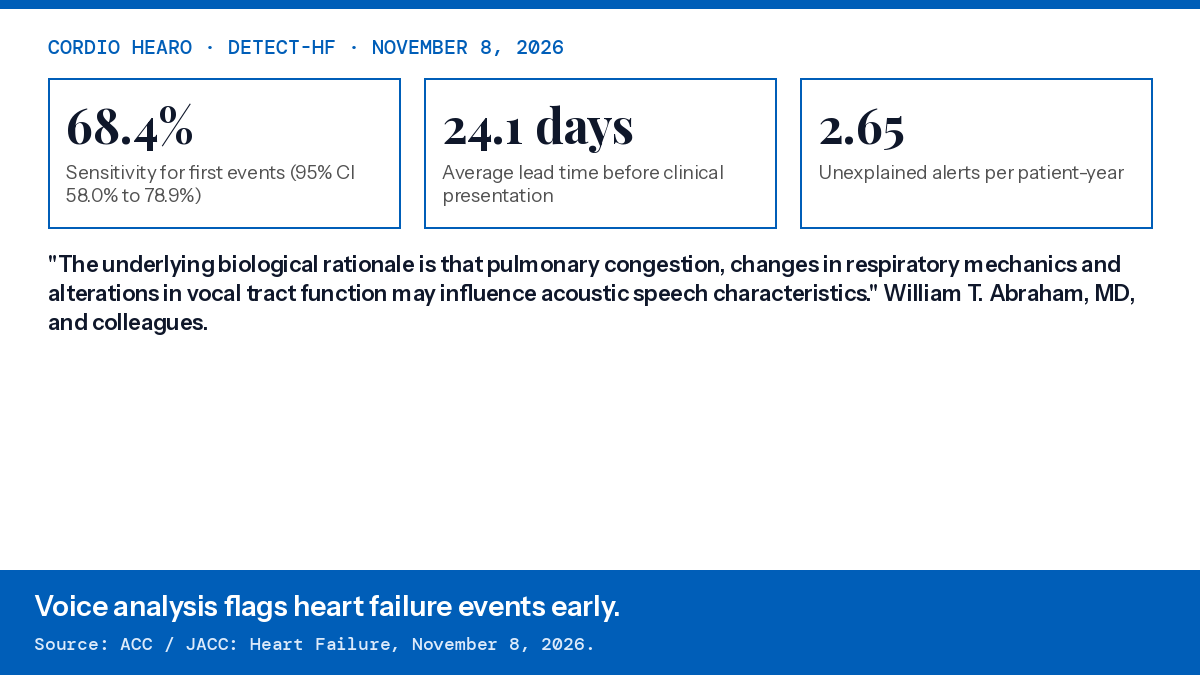
- Primary detection result: 52 of 76 first heart failure events were detected, a sensitivity of 68.4% (95% CI 58.0% to 78.9%; p=0.0573). ACC notes the lower bound was slightly below the prespecified performance target of 60%.
- Including recurrent events: 80 of 112 events detected (71.4%; model-adjusted sensitivity 70.5%).
- Lead time: First events were detected on average 24.1 days before clinical presentation.
- Alert burden: 1,981 unexplained priority notifications, 2.65 per patient-year for first events and 2.59 for all events. This met the prespecified performance criterion.
- Consistency: Sensitivity and alert rate estimates were consistent across prespecified subgroups.
- Usability and safety: Daily recording adherence was 85%; usability scores averaged 4.7 to 4.9 on a five-point scale; no device-related adverse events occurred.
- Authors and sponsor: William T. Abraham, MD, FACC, and colleagues. Abraham is a professor at The Ohio State University College of Medicine. Tamir Tal is CEO of Cordio Medical (company team page).
- What this is not: It is not an FDA authorization, not a randomized outcomes trial and not evidence that voice-triggered care reduces hospitalization. HearO holds an FDA Breakthrough Device Designation (February 2022, per investor Peregrine), which is a development pathway status.
Certainty: (A) all numbers and design details above from the ACC summary of the paper and the ClinicalTrials.gov record; (A) Breakthrough designation date from the investor's page; (C) the final box is our framing of what DETECT-HF deliberately did not test.
The obvious read versus the deeper signal
The obvious read: voice AI works: it caught nearly 70% of first heart failure events weeks early with a low false alarm rate, so remote monitoring should adopt it.
The deeper signal: the study's pass-fail structure is more informative than its headline. The alert-burden criterion passed; the sensitivity criterion was judged against a 60% target and the interval's lower bound landed at 58.0%. That is a near miss on a performance target the sponsor chose, in a study that deliberately did not let clinicians act. The scientifically honest summary is 'promising and reasonably specific, with evidence of benefit still to be generated.'
Certainty: (A) the numeric pass and miss from the ACC summary; (B) the interpretation of a near miss as meaningful rather than noise; (C) the commercial implications.
Historical playbook
Remote monitoring in heart failure has a long record of promising signals followed by disappointing randomized trials. Telemonitoring programs built on weight and symptom transmission produced mixed outcomes in the 2010s, while implanted pulmonary artery pressure sensors, with a stronger mechanistic link to congestion, produced the clearest hospitalization benefit and the regulatory approvals that followed. Detection accuracy has never been the whole story; the response protocol and who staffs it have been decisive.
Voice is the newest entrant. The biological rationale described by the DETECT-HF investigators is that pulmonary congestion, changes in respiratory mechanics and vocal tract function can alter acoustic speech characteristics. Earlier COMMUNITY-HF voice analysis work covered by TCTMD and Noah Labs' TIM-HF3 build the same logical line. The open question is whether early detection translates into fewer hospitalizations when a clinic has to respond to every flag.
A second lesson from monitoring history is about thresholds. A system tuned for sensitivity floods clinics with alerts; one tuned for low alert burden misses events. DETECT-HF reports both numbers together, 68.4% sensitivity at 2.65 unexplained alerts per patient-year, which is exactly the trade-off buyers should demand from any monitoring vendor. A single accuracy figure without the alert rate is incomplete.

A laptop displays a virtual care consultation in a bright home setting. Existing editorial illustration, not the Cordio device or a DETECT-HF participant.