Watch a prior authorization coordinator work for an hour and you see the real shape of healthcare administration. One window holds the EHR. Another holds the payer's portal. A third has the plan's medical policy as a PDF. Somewhere there is a fax queue. The coordinator's job is not to make a clinical decision; it is to assemble evidence from five systems into a packet that a reviewer at the health plan, who is doing the same assembly in reverse, will accept. Clinicians do a version of this before every visit, rebuilding a patient's story from records that never quite connect.
Google Cloud's bet, announced November 10, is that this assembly work is the most valuable place to put an AI agent, and that the agent should sit above every system rather than inside any one of them. Gemini for healthcare is in U.S. preview with a long list of connectors, seven named launch customers and an unusual feature for a Google product: customers can choose models from Anthropic and OpenAI as well as Google. Below we look at what launched, why read-only is the strategic tell, the implications for buyers and partners, and what would prove it works.
Google did not build a better EHR. It built a layer that reads all of them and does the paperwork in between.
In This Deep Dive
- Why this matters now
- What actually happened
- The obvious read versus the deeper signal
- Category map and taxonomy
- Evidence Ladder
- Regulation and international divergence: administrative agents, clinical edges and the 2027 API deadline
- Capital flows and bottom-up economics
- The HealthTech Investor's Signal
- Evidence boundaries
- Forward Intelligence
- The Bottom Line for Health System CIOs, Revenue Cycle Leaders and Enterprise AI Investors
Why this matters now
The administrative burden is the context Google leans on. Its release cites a Harris Poll and Google Cloud study finding clinicians lose nearly 28 hours a week to documentation and administrative requirements, a 2025 American Medical Association report of burnout in 41.9% of physicians, and an American Hospital Association estimate that administrative costs are 25% to 35% of total U.S. healthcare spending. Even if one discounts vendor-sponsored survey numbers, the direction is not in dispute.
The policy timing matters too. CMS's Interoperability and Prior Authorization Final Rule (CMS-0057-F) requires impacted payers, including Medicare Advantage organizations, Medicaid and CHIP programs and federal exchange plans, to meet new API requirements on compliance dates generally beginning January 1, 2027, including a Prior Authorization API, with certain operational provisions starting January 1, 2026. As payer data becomes reachable by standard interfaces, the bottleneck shifts from getting data to assembling and acting on it. An agent layer is built for that second problem.
Finally, model capability has stopped being scarce. When three frontier labs offer strong models and a cloud vendor lets customers route between them, the differentiation moves to connectors, governance and distribution. That is the market Google is now competing in.
Certainty: (A) burden statistics as cited in Google's release (vendor-cited; the Harris Poll study was commissioned with Google Cloud); (A) CMS-0057-F dates from the CMS fact sheet; (B) our view that model scarcity is ending.
What actually happened
- Launch: Gemini for healthcare, built on Google's universal Gemini agent, available in U.S. preview from November 10 for Gemini Enterprise Standard and Plus customers, with per-user seat or pay-as-you-go pricing.
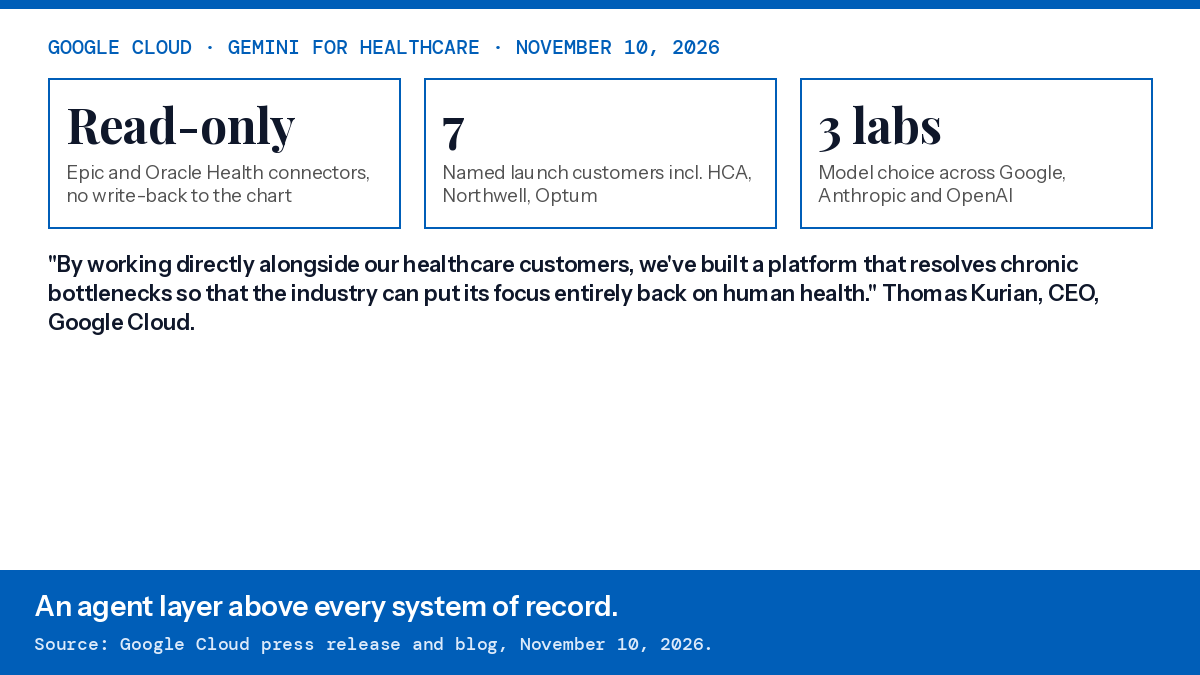
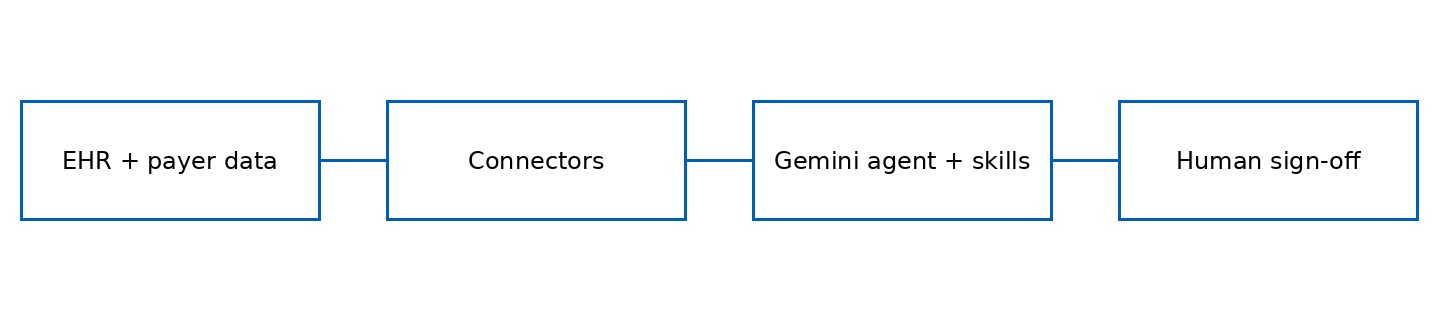
- EHR access: direct, read-only integrations with Epic via open.epic APIs and Oracle Health via Ignite APIs for FHIR, pulling active conditions, medications, labs and notes with no write-back to the chart. NextGen Healthcare connectivity is in development; InterSystems FHIR Server, Keragon (400+ applications) and Verato (identity matching) extend reach.
- Coverage and payment: CMS Coverage data including NCDs and LCDs, the NPPES NPI registry, ICD-10, RxNorm and IMO Health; Optum Network Eligibility and Coordination of Benefits in limited release; TriZetto, Waystar, GoodRx and Infinitus Relay for eligibility, pricing and benefit verification calls.
- Skills: longitudinal patient timelines, pre-visit chart prep, prior authorization packets and appeal drafts grounded in the record and the plan's policy, payer-side review against medical policy and member out-of-pocket estimates; for Medicare Advantage members it applies Medicare coverage criteria where a plan's internal rule is stricter.
- Governance and models: single governance framework with access controls, audit logging and verifiable citations; model choice across Google, Anthropic and OpenAI with routing of routine work to cheaper models; Google says customer data is not used to train its foundation models.
- Customers and partners: Blue Cross Blue Shield of Massachusetts, Hartford HealthCare, HCA Healthcare, Highmark Health, Northwell Health, Optum and Stanford School of Medicine at launch; ASCO adding its Guidelines Assistant; Suki, UiPath, Salesforce, Synthpop and others as application partners; sixteen systems integrators.
- People: Thomas Kurian, CEO of Google Cloud, who joined Google in November 2018 and took over leadership of Google Cloud in early 2019.
Certainty: (A) all items from Google's press release, blog and press corner page, cross-checked with Fierce Healthcare; (A) Kurian's start from Google Cloud's November 2018 blog.
The obvious read versus the deeper signal
The obvious read: Google launches another healthcare AI product, joining a crowded field of copilots and scribes. Health systems get one more vendor to evaluate.
The deeper signal: Read-only is the tell. Google is explicitly not touching the system of record, which avoids a direct fight with Epic and Oracle Health and makes security reviews easier. Instead it is positioning to own the assembly layer between systems: the place where a prior auth packet, a benefits answer or a pre-visit summary is built from several sources. That layer has been filled by dozens of single-purpose tools, each with its own integration, contract and security review. A governed agent with a connector marketplace offers a health system one contract for many tasks. Open model choice reinforces the point. Google is telling buyers the model is replaceable and the connectors, governance and distribution are what they are paying for.
Certainty: (A) read-only design and model choice from Google's materials; (B) our interpretation of the competitive positioning.
Historical playbook
Google has tried healthcare before. Its consumer Google Health personal record was retired more than a decade ago, and later clinical efforts were reorganized. The difference now is the channel. Earlier attempts asked patients or clinicians to adopt a Google product. Gemini for healthcare rides on enterprise cloud contracts and plugs into systems hospitals already run, which is closer to how enterprise software has historically won in healthcare.
There is also a broader enterprise software pattern. Systems of record (ERP, CRM, EHR) tend to stay put once installed, and value moves to the layers that integrate across them: middleware, then analytics, now agents. Integration platforms have become valuable exactly because nobody replaces the system of record. Google's playbook mirrors its own recent sequence: packaged Gemini solutions for government, financial services and legal came first, and healthcare is the next vertical on the same agent.