
A good startup list shouldn't pretend that every interesting product is already clinically proven. Web Summit 2026 offered an unusually broad mix of health technology, from hospital workflows and prevention to movement, data and women's health. Here are 15 companies worth understanding, not a ranking of the “best” fifteen.
The headline competition winners are covered separately: Carevision won Web Summit's official PITCH; AURIMOD won KPMG's storm-moved global final, with TissueLabs second. Humanity, MindFriend, umo health, NeuroXense and the separate Brazilian Lisbon-incubation cohort also have their own stories. This selection focuses on companies that actually appeared in Lisbon and the questions their products raise.
1. Lampsy Health, Portugal
The Portuguese KPMG global finalist is a reminder that award recognition and CE marking are separate milestones. The key question is what evidence supports its intended medical use, not whether it impressed a pitch jury.
2. Olá Doutor, Brazil
Anderson Zilli's company describes asynchronous, chat-first primary care and an interest in a European pilot. The opportunity is easier access; the test is how well the service escalates urgent problems and meets local clinical rules.
3. Zoundream, Switzerland and Spain
Zoundream is studying infant cries as potential developmental signals. Its preliminary 93-infant work is intriguing, but not, by itself, evidence of an autism diagnostic tool. Validation must lead the next chapter.
4. INOVACUBO / CareWear Sénior, Brazil
The Paraíba company's sensor-enabled shirt focuses on monitoring older people. It's easy to imagine the application. It is much harder, and more important, to demonstrate reliable alerts and better real-world follow-up.
5. BloodFlow, Portugal
BloodFlow appeared in KPMG Portugal's innovation pipeline. It deserves attention as part of the country's medical-technology field, but reported hospital rollouts still need their own supporting announcements.
6. Reconquering Medicine, Portugal
Public-hospital physicians behind the Lisbon company are building software for operations and emergency-department workflows. Its WardControl product tracks beds and workflow states, according to the company, not individual patients. WardControl remains in beta.
7. RTBEAMTECH / FLASHGuard, Portugal
A team from Instituto Superior Técnico and LIP is developing real-time beam monitoring for ultra-high-dose-rate FLASH radiotherapy. The concept addresses a real technical problem in radiation treatment, but a finished commercial product or clinical result was not announced at Web Summit.
8. BM Diagnostics / SubVenio, Italy
Matteo Boldreghini's company describes rapid finger-prick tests for cardiac biomarkers. UpNext cited early commercial activity, pharmacy connections and validation work underway. Those figures are founder-reported, not independently verified clinical results.
9. Igloo Health, Germany
Igloo brings finger-prick testing to pharmacy counters. Its company site said 106 German pharmacies were using it, while an official Web Summit blurb claimed 300 pharmacies in ten countries. Those are separately reported figures, not a single comparable total.
10. Allbionics, Ukraine
The Kyiv-based company builds 3D-printed bionic arms. A pre-event profile named Volodymyr Bandura as co-founder and Nika Kudrytska as CEO. Its focus on affordable prosthetics puts cost and access at the centre of its proposition.
11. Ynone, Germany
Ynone works on lymphoedema self-management. UpNext named Mara Sorrentino as founder and CEO and reported early commercial and clinical relationships. The company's own site, meanwhile, describes a platform still in development and MDR certification as a future goal.
12. EaseTalk, Ireland
The University College Cork-associated project helps speech and language therapists support home practice. Marco Faggiani described a Web Summit showcase pitch and an Enterprise Ireland proof-of-concept project. A promising workflow idea still needs evaluation with therapists and families.
13. Caju, Portugal
Bruno Gomes' app provides gamified communication aids and illustrated routines for autistic children, with a free family offering and paid tools for professionals. Supporting families is the goal; claims of clinical efficacy would need their own evidence.
14. NamaBaby, Portugal
Founder Regina Pinto pitched a screen-free ankle band intended to support infant sleep and wellbeing in an official group round. The company's reported letters of intent from childcare centres represent early interest, rather than a clinical outcome.
15. BRAINING, Portugal
The Porto company describes an AI and VR platform for stroke rehabilitation. It appeared in the Road 2 Web Summit health booklet, as part of its conference-week presence. Zura Health, a separate participant exploring an earring-format wearable, is another name to watch without turning the reported pilot into proven clinical performance.
What else was on the floor?
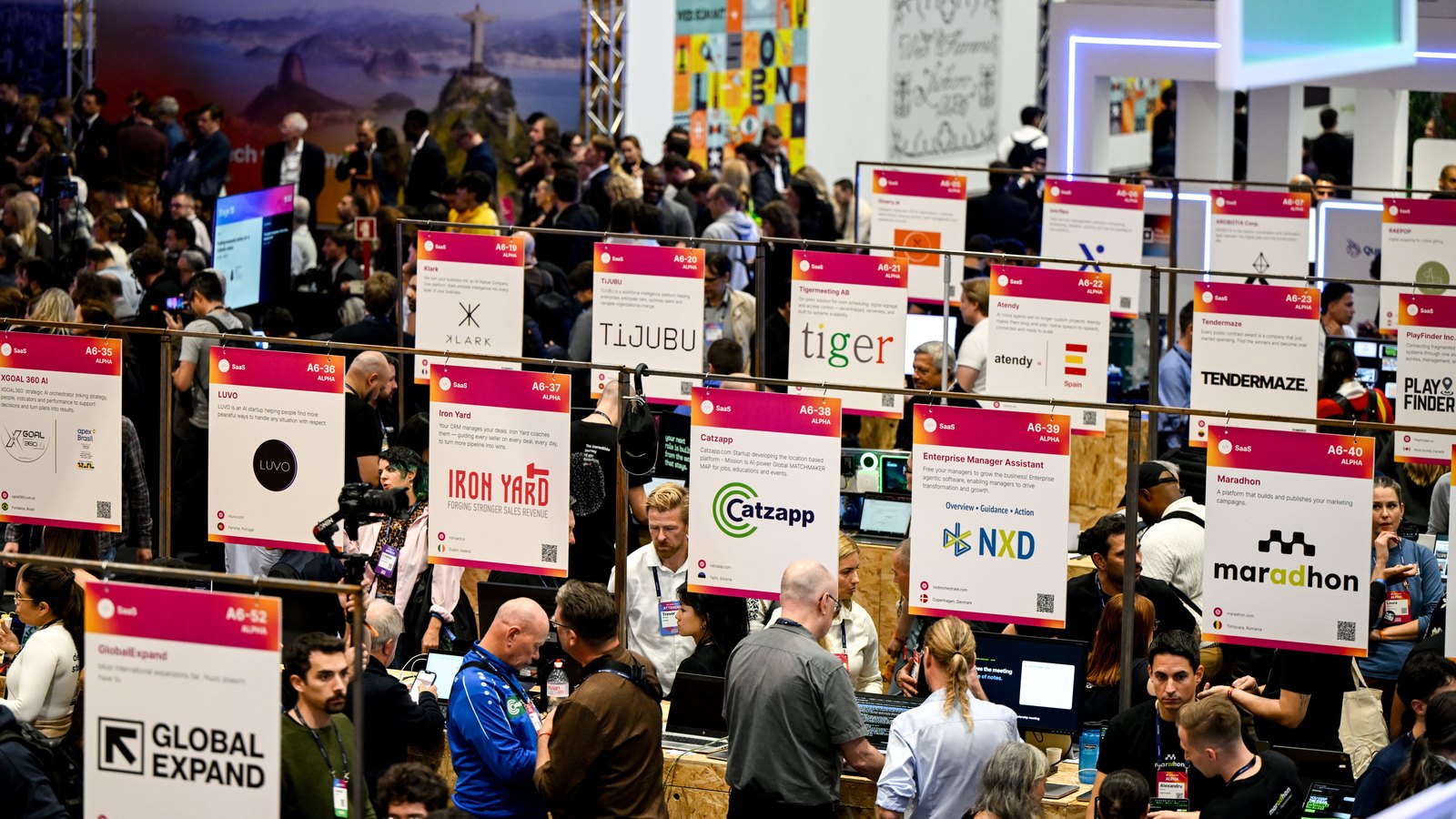
The wider event materials also included Portuguese names such as Octo Health and showcase or booklet names including MindMatch, PAPAYYA, Revitacharge, The Family Door, Twinfactory, UpSpeech, ZeloCare and Nuree AI. A listing does not prove a live presentation, launch or commercial result, particularly where the storm altered Wednesday's programme.
The most interesting thread across these fifteen is how quickly startups can describe a powerful benefit and how much longer it takes to prove that benefit. The right response isn't cynicism. It's curiosity with standards: ask what works, what has been tested, and what still needs to be shown.
What makes a startup worth watching?
A list like this can easily become a series of enthusiastic product descriptions. That would miss the most useful part of Web Summit: the opportunity to compare companies tackling different problems and ask what their next genuine milestones should be.
The startups here are not ranked by clinical evidence, funding, revenue or the likelihood of commercial success. Their inclusion reflects documented participation and a proposition relevant to healthcare. Some are working on tools for clinicians. Others are trying to improve access, rehabilitation, monitoring or support in everyday life. Those differences are why treating them all as interchangeable AI health startups would make the list less informative.
For each company, the immediate question is what is available today. A functioning product used by customers is different from a prototype, a proposed device or a research project. There can be good reasons to include all of them in a watchlist, but their stages should remain clear. An early team that acknowledges the work ahead may be more credible than a more polished pitch that blurs it.
There is also a distinction between technology that provides information and technology intended to influence clinical decisions. A device measuring movement may generate useful observations; claiming that it prevents injury would require evidence of a further outcome. A rehabilitation platform may offer an engaging experience; claiming that it improves recovery requires appropriate evaluation. An access platform may help people book consultations; claiming improved health outcomes is another step.
The point is not to demand the same type of clinical trial from every startup. It is to demand claims proportionate to what the product is actually designed to do.
Portugal's advantage is not just proximity to Web Summit
The Portuguese companies in the list demonstrate how varied a local healthcare-innovation ecosystem can be. A startup working on hospital operations faces a different market from one building a wearable for babies or designing technology for radiotherapy. They may share talent pools and a conference address, but they do not share one route to market.
Research-intensive teams can benefit from access to universities and technical institutions. Clinical founders may bring first-hand understanding of workflow problems. Consumer products may test initial demand with families or individual users. Yet these advantages do not remove the need to find a paying customer, demonstrate reliability and navigate the requirements relevant to the product's use.
For hospital-facing software, procurement can be the most important commercial obstacle. A tool may save time in principle but still fail if it cannot integrate with existing records or requires staff to duplicate work. For a wearable or monitoring device, users need a form factor they will tolerate consistently and measurements they can trust. For a research or therapeutic technology, evidence and regulatory work can determine the pace of adoption.
Investors evaluating companies from Portugal should therefore look beyond the generic attraction of a fast-growing health-tech sector. Each startup needs a plausible customer, an adoption pathway and a milestone that would materially reduce uncertainty about its proposition.
The difficult questions for software founders
Software often reaches the market faster than hardware, which can make early progress look impressive. A startup may demonstrate an attractive interface and sign up initial users before it has gathered evidence of long-term benefits. That is normal for many consumer products. In healthcare, however, the claims must remain carefully scoped.
A scheduling tool can be evaluated on appointment completion, administrative workload and the user experience. A clinical documentation platform may be assessed on accuracy, staff burden and whether errors are identified before entering the medical record. A communication aid might be evaluated on accessibility and practical usefulness in the settings where families or professionals actually use it.
These outcomes can be meaningful without being framed as diagnoses or treatments. The trouble begins when ordinary software metrics are presented as proof of clinical effectiveness. The most valuable founders are often those who understand that a narrow, measurable improvement is a stronger commercial foundation than an expansive promise that cannot yet be assessed.
Another issue is whether the company can keep supporting its product after the publicity fades. Hospitals and clinical professionals need reliable service, clear accountability and manageable workflows. A great demo helps a startup get a meeting. Documentation, support and a realistic business model help it win and retain customers.
The difficult questions for devices and research teams
Hardware introduces complications that a slide deck cannot fully explain. Devices must work outside the development laboratory, tolerate the way people actually use them and deliver consistent performance across realistic conditions. If a product depends on a sensor, its measurement method and limits deserve attention. If it involves AI interpretation, the validation should address both the raw signal and the generated conclusion.
For products related to infants, neurological conditions or seizures, the consequences of false reassurance are particularly important. A device that produces a compelling early result still needs to show how it handles uncertain measurements, missing data and situations where professional care is necessary.
Research-led teams may face a longer commercial journey. A radiotherapy monitoring technology, for example, depends on demanding technical integration and specialist evaluation. A bionic prosthesis must fit the practical and individual needs of users. A rehabilitation platform may need to demonstrate useful performance in real care settings rather than only in controlled experiments.
There is no single stopwatch by which all these companies should be judged. The meaningful question is whether the next milestone addresses the biggest uncertainty holding the product back.
Milestones beyond the conference
The strongest follow-up announcements would be specific. An identified hospital pilot with its scope clearly defined. A published evaluation with understandable methods. A documented regulatory milestone. A product becoming available to an identifiable user group. A paying customer that confirms a deployment. A repeatable outcome measured against an appropriate baseline.
Those are more interesting than another description of how AI will transform healthcare. They show whether a company is moving from a promising idea toward something people can rely on.
The companies on this list deserve attention for different reasons. Some may develop into substantial businesses. Others may discover that their first product or market is not the right one. That is part of startup development, and it is exactly why a watchlist is different from a prediction of winners.
Web Summit offers a useful snapshot. The real signal will emerge in the months after the conference, when product claims meet clinical environments, real customers and the difficult economics of health technology.