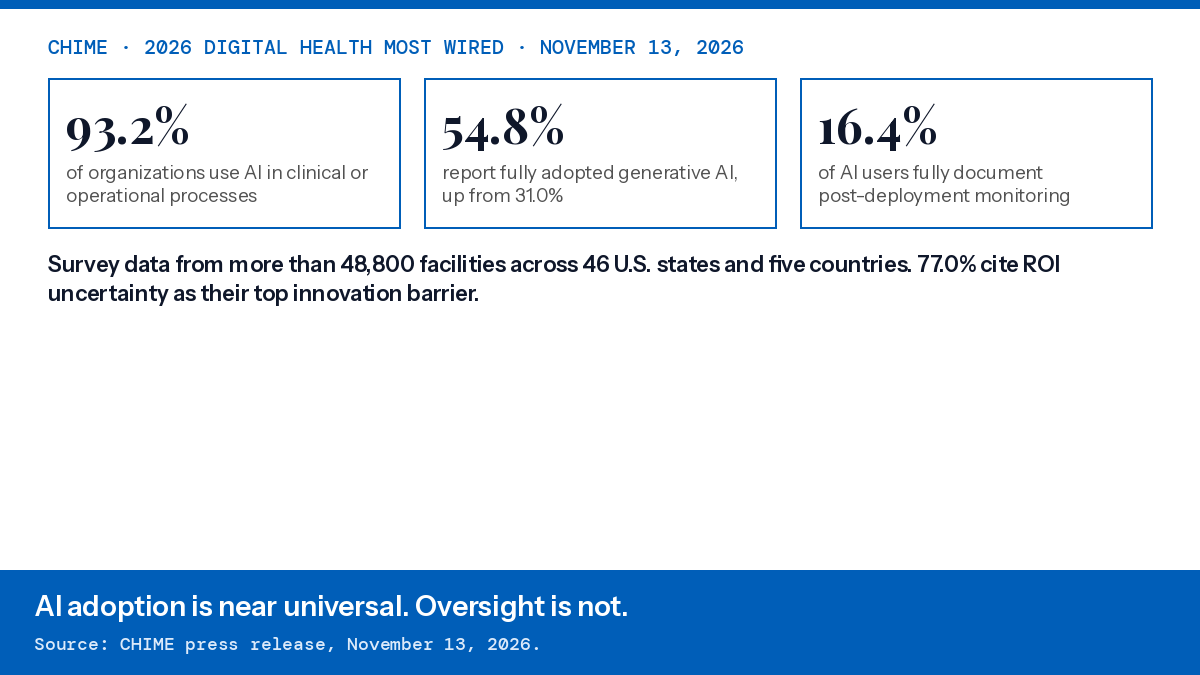
For most of the last decade, the question about AI in hospitals was whether anyone was using it. That question is settled. On November 13, CHIME reported that 93.2% of organizations in its 2026 Digital Health Most Wired survey use AI in clinical or operational processes, and that fully adopted generative AI jumped from 31.0% to 54.8% in a single year.
The more important number sits a line lower. Only 16.4% of organizations using AI have fully documented processes for monitoring models after deployment. In this deep dive we look at why that gap matters, what the rest of the survey says about value, resilience and workforce, how state laws and CMS rules taking effect in January 2027 raise the stakes, and where the money in health system AI is likely to move next.
Adoption is now universal. Supervision is the new frontier, and almost nobody has finished building it.
In This Deep Dive
- Why this matters now
- What actually happened
- The obvious read versus the deeper signal
- Category map and taxonomy
- Evidence Ladder
- The 2027 regulatory calendar for health system AI
- Capital flows and bottom-up economics
- The HealthTech Investor's Signal
- Counter-thesis
- Forward Intelligence
- The Bottom Line for Health System Leaders and Healthcare AI Investors
Why this matters now
The Most Wired survey is one of the broadest annual views of digital maturity in U.S. healthcare. This year's report draws on data covering more than 48,800 facilities across 46 states and five countries. When a dataset that broad says AI use has crossed 90%, the conversation for boards, CIOs and vendors shifts from whether to adopt to how to govern.
Governance is no longer optional either. Pacific AI's November 9 announcement, citing Manatt's Health AI Tracker, says more than 280 state AI bills were introduced in 2026 and 40 were enacted across 24 states as of October. Three laws taking effect on January 1, 2027 reach different parts of the industry: California SB 503 on bias risk in AI clinical decision support, California AB 1979 on independent clinical judgment when AI informs care, and Colorado HB 26-1139 on insurer denials based solely on AI output.
Russ Branzell, president and CEO of CHIME, framed the moment as an inflection point where adoption is giving way to a focus on how effectively organizations put technology to use. In our view, the next twelve months will be defined by which systems can show what their AI is doing after go-live, and which cannot.
Certainty: (A) survey figures and the Branzell quote are from CHIME's November 13 release; state law details and the Manatt counts are as stated in Pacific AI's November 9 release. (B) The forward view is our interpretation.
What actually happened
- The report. CHIME released its 2026 Digital Health Most Wired National Trends Report, derived from the 2026 DHMW survey powered by Digital Health Analytics.
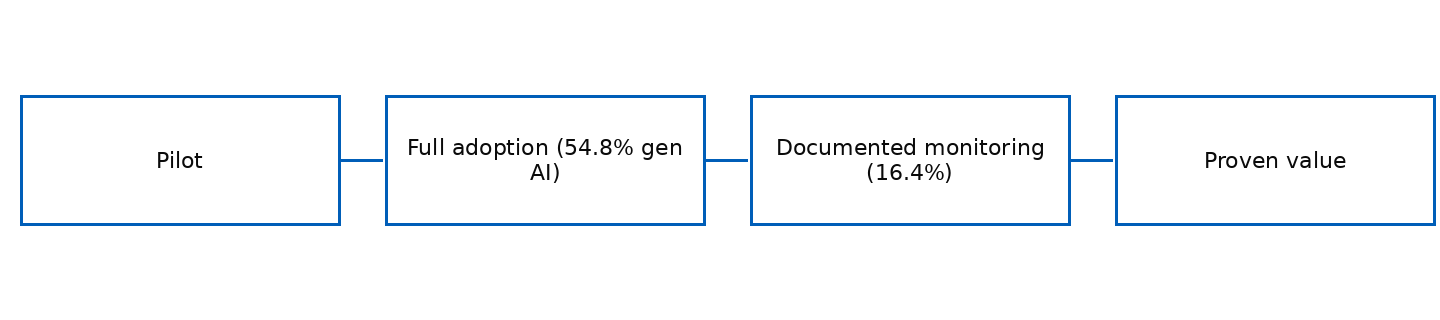
- AI adoption. 93.2% of participating organizations use AI in clinical or operational processes, and fully adopted generative AI rose from 31.0% to 54.8% in one year.
- AI oversight. 16.4% of AI users have fully documented processes for monitoring models after deployment, which CHIME calls a clear opportunity to strengthen governance and oversight.
- Value. 77.0% of organizations cite ROI uncertainty as their top innovation barrier. The most digitally advanced organizations are more than twice as likely to monitor cost savings from digital engagement, at 80.0% vs. 37.1%.
- Resilience. Only 39.1% can restore all critical systems within four hours. Organizations that test failover are about twice as likely to meet that bar, 45.7% vs. 23.5%.
- Workforce, payers and climate. 15.7% have a comprehensive role-based data literacy program; ambient listening is fully adopted for physicians at 60.8% and nurses at 9.5%; 49.4% have automated prior authorization, falling to 28.9% among smaller organizations; 5.6% have fully adopted heat index data.
Certainty: (A) all figures are from CHIME's November 13 release. The survey is self-reported by participating organizations, and the release does not state the number of responding organizations alongside the facility count.
The obvious read versus the deeper signal
The obvious read: AI has gone mainstream in hospitals, and the laggards are catching up.
The deeper signal: The deeper signal is the distance between the first number and the third. Health systems have deployed AI much faster than they have built the machinery to watch it: who checks a model after an EHR upgrade, a vendor update or a shift in patient mix, and how that check is recorded. That is not an academic gap. It is the exact question new state laws, accreditation reviewers and plaintiffs' lawyers will ask, and it maps onto the ROI problem too, because a system that does not monitor a model cannot show what it is worth. Monitoring is where governance and value meet.
Certainty: (A) the adoption and monitoring figures are facts from the report; (B) the link between monitoring, legal exposure and ROI measurement is our interpretation.
Historical playbook
Healthcare has lived through a version of this before. In the early 2010s, federal incentives drove electronic health record adoption from a minority of hospitals to near universal use within a few years. The adoption numbers looked like success. The harder work, usability, interoperability, safety and clinician burden, took much longer and is still being fixed. Adoption first, oversight later, was the pattern then, and the Most Wired data suggests it is the pattern again.
The difference is speed and opacity. EHRs were large, slow-moving systems with clear vendors and versions. AI models change more often and in less visible ways. Pacific AI's David Talby put it plainly in the company's November 9 release: a risk assessment starts diminishing the day it is approved, because models are retrained, vendors update documentation, teams add use cases and states pass laws. Pacific AI also cites research on more than 20 leading health systems finding that AI project submissions outpaced governance committee decisions nearly 3 to 2, and that more than 60% of leaders called their governance resources insufficient, particularly for ongoing monitoring.
Ambient documentation shows how fast the cycle can run. CHIME finds ambient listening fully adopted for physicians at 60.8%, a level that would have seemed implausible a few years ago. Nurses, at 9.5%, are where physicians were at the start of that curve. The next wave of deployments will hit the largest clinical workforce in the hospital, and it will hit while most systems are still building their monitoring discipline.