While the sector argues about large language models, the most consequential change in frontline diagnostics has been happening with almost no attention. Ultrasound has left the imaging department.
A probe that plugs into a phone, costs a fraction of a cart-based system, and increasingly ships with AI acquisition guidance that tells a novice how to tilt the transducer, changes something structural: it decouples image acquisition from the specialist who used to be required to perform it.
Why this matters clinically, in concrete terms
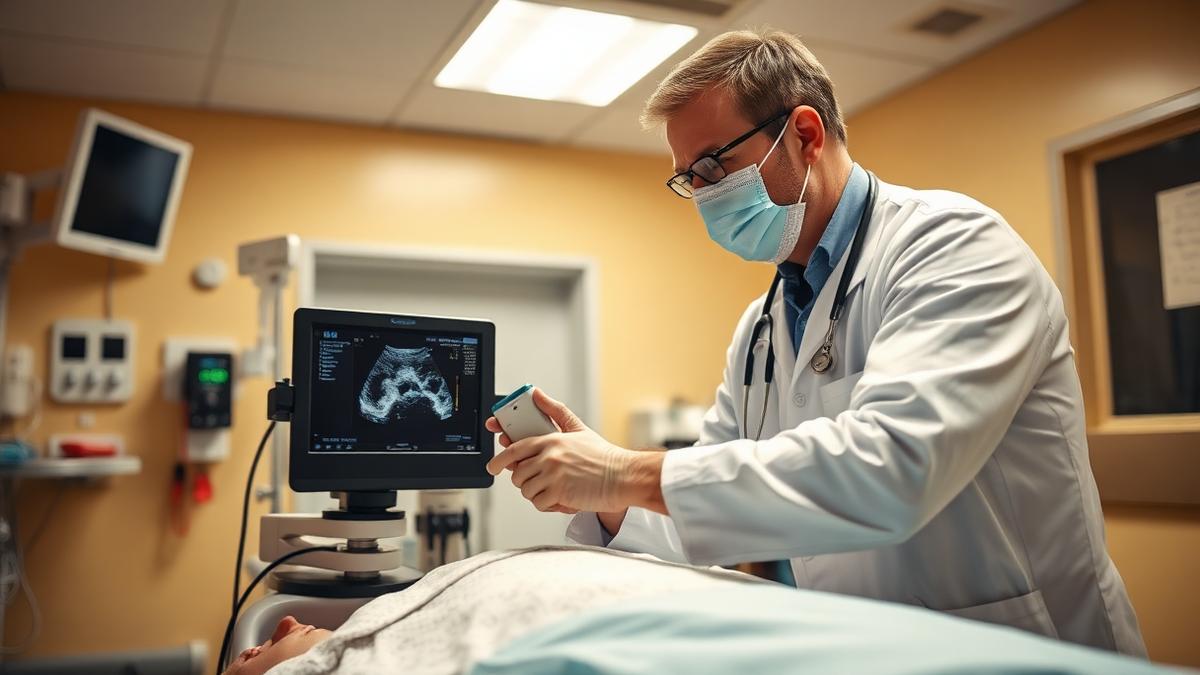
In emergency medicine, bedside ultrasound has been standard for years, and its value is not subtle. Determining whether hypotension is cardiogenic, hypovolaemic or obstructive at the bedside, in ninety seconds, changes the next intervention rather than the next order.
The expansion now is into settings that never had imaging at all. Primary care clinicians assessing breathlessness can distinguish pulmonary oedema from other causes at the point of the complaint rather than after a chest film and a wait. Antenatal care in low-resource settings is being transformed by AI-guided probes that let a midwife with days of training establish gestational age and detect malpresentation, both of which drive concrete decisions about where a woman should deliver. Nephrology, rheumatology, anaesthesia and critical care have each quietly built their own protocol sets.
The common thread is that these are not incremental accuracy gains. They are decisions made hours or weeks earlier, by the person already in the room.
The bottleneck is not hardware
Devices are good enough and getting cheaper. Three other things constrain the category.
Training and competence. Ultrasound is famously operator-dependent, and the failure mode is a confidently misinterpreted image, not a blank screen. AI acquisition guidance addresses part of this by helping novices obtain a diagnostic-quality view, and it is genuinely impressive. Interpretation is harder. The programmes that work pair the device with structured curricula, image review by a qualified supervisor, and a defined scope: this clinician is credentialled for these specific questions and no others. Scope discipline is what makes the difference between a safety improvement and a liability.
Documentation and governance. A scan performed and not stored is a medico-legal problem. Images need to reach the record, be reviewable, and be auditable. Most handheld deployments in community settings still do not solve this well, and it is the first thing a risk manager asks about.
Reimbursement. In many systems, a bedside scan performed by a non-radiologist to answer a focused clinical question is not separately funded, even though it removes a formal study downstream. Where the incentives are misaligned, adoption is driven by individual clinician enthusiasm, which does not scale and does not survive staff turnover.
Where the technology opportunity actually is
The probes will commoditise, as every piece of imaging hardware eventually does. The software layer will not.
Three specific gaps are wide open. Automated quality assurance, software that flags when a stored study is non-diagnostic and prompts a repeat before the patient leaves, which is the single largest safety gain available. Structured reporting that writes back into the record in a form that a downstream clinician and a coder can both use. And longitudinal comparison, because the clinical power of serial bedside imaging, watching an effusion or a bladder or a joint change across visits, is almost entirely untapped when every scan is stored as a disconnected clip.
The strategic read
Diagnostics is decentralising, and ultrasound is furthest along because the physics is safe, the hardware is cheap and the AI assistance is genuinely competent at the acquisition step.
That has second-order consequences worth thinking about. Radiology volumes shift rather than disappear, moving toward complex studies and away from confirmatory ones. Primary care becomes a diagnostic setting rather than a referral desk, which changes what a primary care visit is worth. And the training infrastructure, which is currently ad hoc and specialty-siloed, becomes a market of its own.
None of this will produce a billion-dollar round announcement. It will change more patient pathways than most of the things that do.
Key Signals
Handheld point of care ultrasound is decoupling image acquisition from the specialist radiologist or sonographer who traditionally had to perform it, extending imaging into primary care, antenatal care and other settings that never had it before. The technology's bottleneck is no longer the hardware, which is inexpensive and improving, but training, documentation governance and reimbursement for the clinician performing the scan. Scope discipline, credentialling a clinician for a narrow, defined set of clinical questions, is what separates a genuine safety improvement from a liability. The open opportunity is in the software layer: automated quality assurance, structured reporting that writes back into the record, and longitudinal comparison of serial scans over time.