A patient with geographic atrophy usually loses the centre of their vision slowly, then completely. The peripheral world stays, but faces, letters and the line on a medicine label go. For most of these people there has been nothing to give back, only drugs that may slow the spread of the damage. In a small European trial, a chip thinner than a sheet of paper and smaller than a grain of rice has been giving some of that central vision back, and on November 17 the company that makes it raised $400 million.
That company is Science Corporation, and the round matters beyond ophthalmology. It is one of the first large financings in brain-computer interfaces built around a product that is already on sale, not a first-in-human study. Below we set out what was announced, what PRIMA's evidence does and does not show, why the U.S. route Science has chosen shapes the economics, and what the round tells investors about where neurotech revenue may arrive first.
The round is a test of whether neurotech can earn money in the eye before it earns it in the brain.
In This Deep Dive
- Why this matters now
- What actually happened
- The obvious read versus the deeper signal
- Category map and taxonomy
- Evidence Ladder
- Regulation: CE marking in Europe and the Humanitarian Device Exemption in the U.S.
- Capital flows and bottom-up economics
- The HealthTech Investor's Signal
- Counter-thesis
- Forward Intelligence
- The Bottom Line for Health System Leaders and Neurotech Investors
Why this matters now
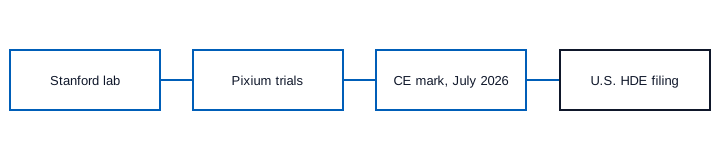
Most of the public attention in brain-computer interfaces has gone to motor and speech implants in the cortex, which remain in feasibility studies. PRIMA is different on three counts: it carries a CE mark in Europe, it is being implanted in paying patients, and it has three years of follow-up data from a multi-centre pivotal trial. Science says PRIMA's European commercial launch came in July 2026, and Inside BCI, citing Bloomberg, reports that two commercial patients in Germany have received it.
The timing also matters for the U.S. Science says it is pursuing approval through FDA's Humanitarian Device Exemption, and Hodak told Bloomberg he expects U.S. availability in the first half of 2027. If that holds, PRIMA could become one of the first implanted neural interfaces sold in both Europe and the U.S. for vision restoration since Second Sight's Argus II.
Finally, the cap table is unusual. Tenet Healthcare, which runs hospitals and outpatient surgery centres in the U.S., is listed among the investors, alongside Khosla Ventures, the Ackman Oxman Institute and Y Combinator. Science has not said what role, if any, Tenet will play, but a provider on the cap table of an implant company is worth noting.
What actually happened
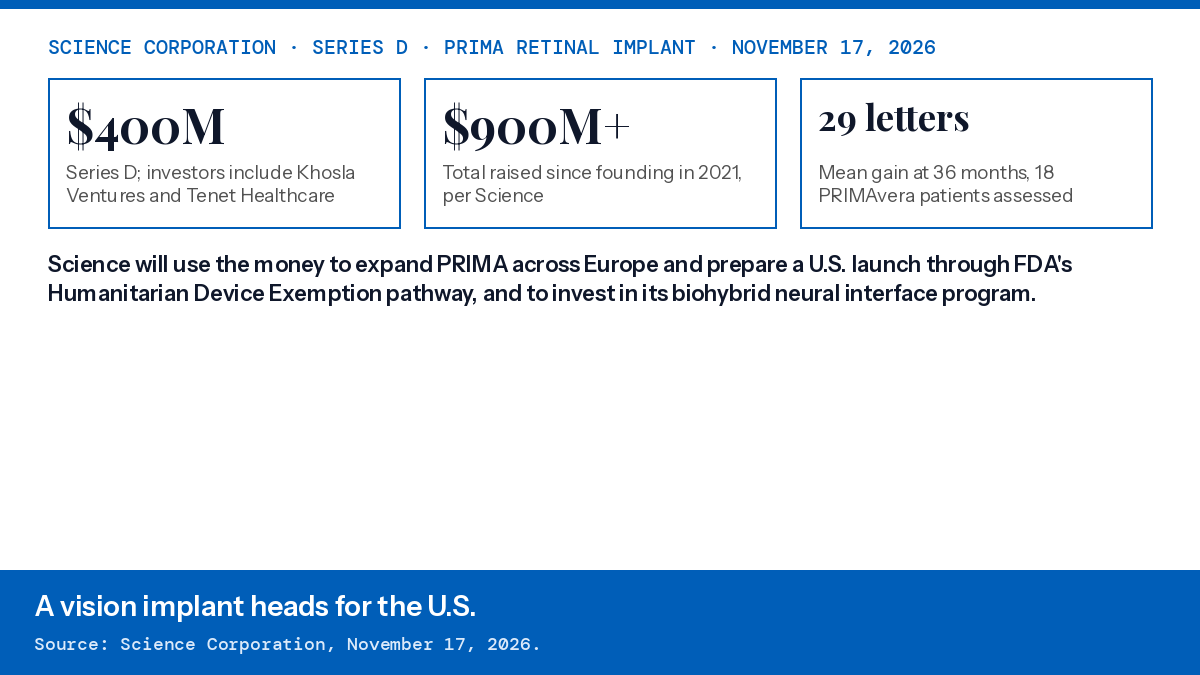
- The round. On November 17, Science announced a $400 million Series D with participation from Khosla Ventures, the Ackman Oxman Institute, Tenet Healthcare, 885 Capital, Y Combinator and PLC Neurotech, among others. Total capital raised since its 2021 founding is more than $900 million. Science did not name a lead or a valuation; TechCrunch, citing a person familiar with the deal, and Bloomberg report $3.5 billion.
- The product. PRIMA is a wireless subretinal photovoltaic implant measuring 2 mm by 2 mm by 30 microns, paired with glasses that project near-infrared light. It works as an array of artificial photoreceptors that stimulate the remaining retinal cells. A zoom feature lets patients magnify letters. It is indicated in Europe for geographic atrophy due to age-related macular degeneration.
- The evidence. In PRIMAvera (NCT04676854), 38 patients were implanted at 17 sites in five European countries. At 36 months, 27 were evaluable for safety and 18 for efficacy. Mean improvement was 29 letters on the ETDRS chart, up from 24.5 at 12 months; 14 of 18 (78%) gained at least 15 letters. No new safety signal emerged between months 12 and 36; three serious adverse events occurred after month 12, and none were attributed to the device alone.
- The people. Max Hodak, co-founder and CEO, said "PRIMA is working better at month 36 than it did at month six." Mahi Muqit, MD, PhD, consultant vitreoretinal surgeon at Moorfields Eye Hospital, presented the data at EURETINA in Vienna. The device originated in Professor Daniel Palanker's lab at Stanford; Inside BCI reports Science bought the technology in 2024.
- The plan. The money goes to European expansion, U.S. launch preparation under the Humanitarian Device Exemption, research, manufacturing and operations, and the biohybrid program, a neural interface that integrates engineered neurons with the brain's own circuits. TechCrunch reports Science is designing initial human trials of the biohybrid device with Yale neurosurgery professor Murat Günel.
The obvious read versus the deeper signal
The obvious read: A well-funded neurotech company raised a large round to launch a product. Bigger number, more countries.
The deeper signal: The deeper signal is about sequencing. Science has put a narrow, restorative indication with a measurable endpoint (letters read on a chart) ahead of its broader ambition to connect to the brain with living neurons. That order matters because reading gains are easy for a regulator, a surgeon and a patient to understand. It also means the company is exposed to the economics of a small, older patient group in a specialty where drugs that slow the disease already exist. The U.S. route amplifies that: a Humanitarian Device Exemption avoids a full effectiveness standard, but it was designed for small populations and restricts profit, so PRIMA's U.S. launch may be more important as proof of adoption than as a profit engine.