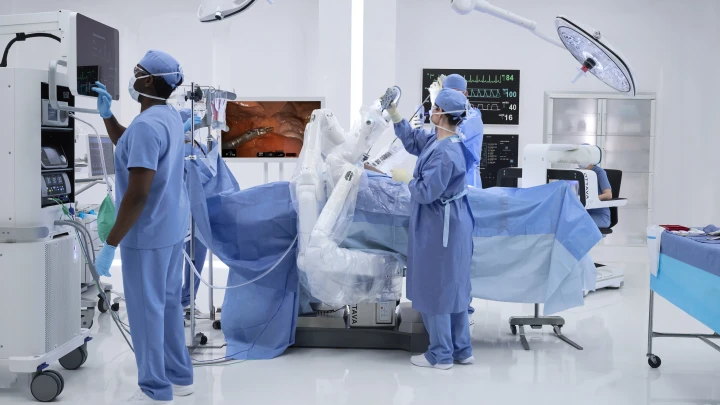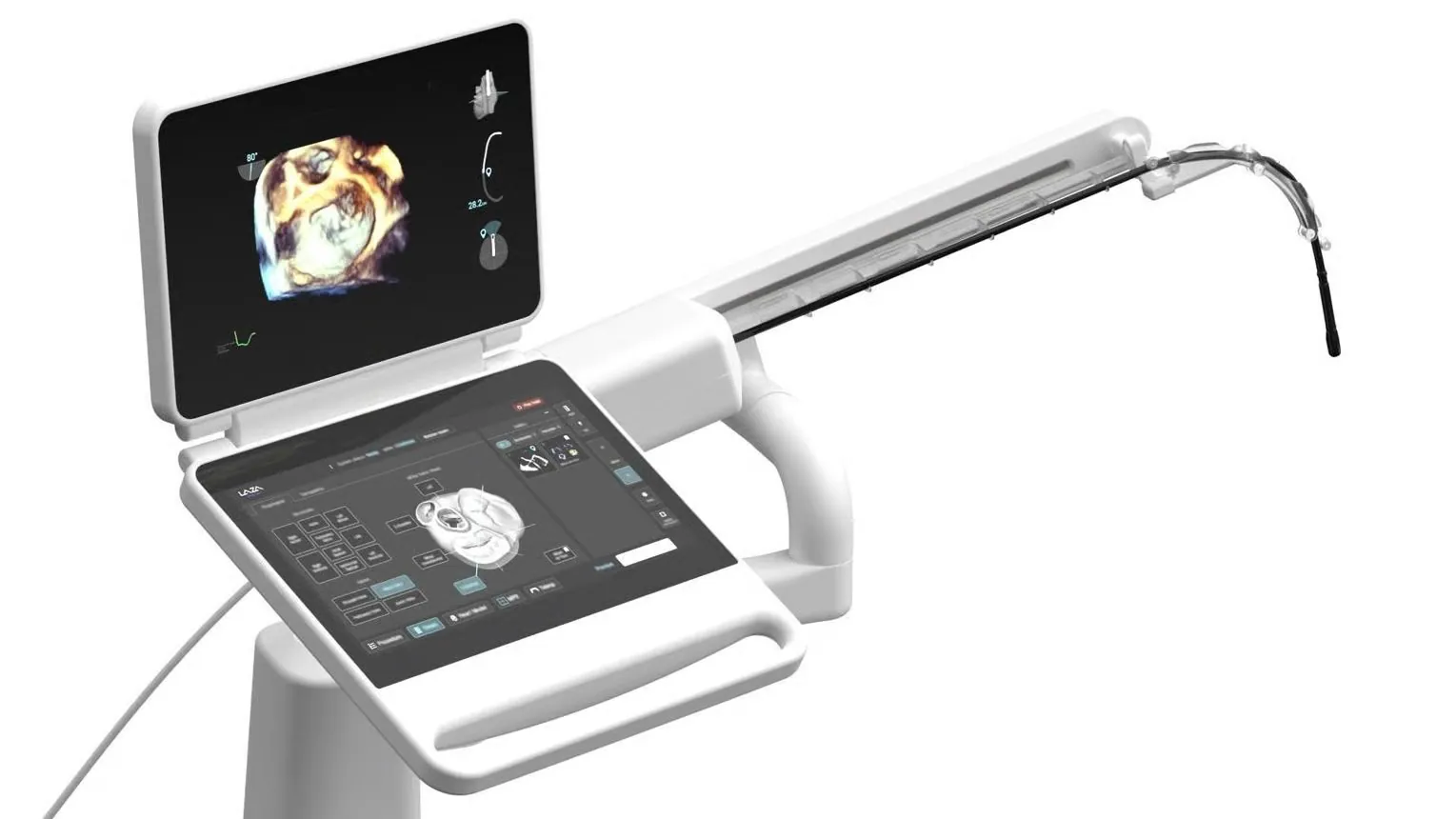
Ask a hospital's chief of surgery about robots and the conversation usually turns to scheduling. The hospital owns a few systems, the urologists and gynecologists booked them first, and the general surgeons who now want robotic time for gallbladders and hernias are waiting. Adding a robot means a multimillion-dollar capital request, a service contract, new instruments, and training for nurses and surgeons. For two decades, there was essentially one vendor to ask.
On November 17, Medtronic announced that its Hugo system is now cleared for general surgery in the U.S. In this deep dive we look at what the clearance covers, how the four soft-tissue systems now in or entering the U.S. differ, what a mixed fleet means for hospital economics, how regulation differs in the U.S., UK and EU, and the indicators that will show whether competition actually changes prices.
General surgery is where the volume is. It is also where hospitals will first find out whether a second robot vendor lowers the bill or just adds one.
In This Deep Dive
- Why this matters now
- What actually happened
- The obvious read versus the deeper signal
- Category map and taxonomy
- Evidence Ladder
- Regulation in the U.S., UK and EU
- Capital flows and bottom-up economics
- The HealthTech Investor's Signal
- Counter-thesis
- Forward Intelligence
- The Bottom Line for Hospital Surgical Leaders, Supply Chain Teams and MedTech Investors
Why this matters now
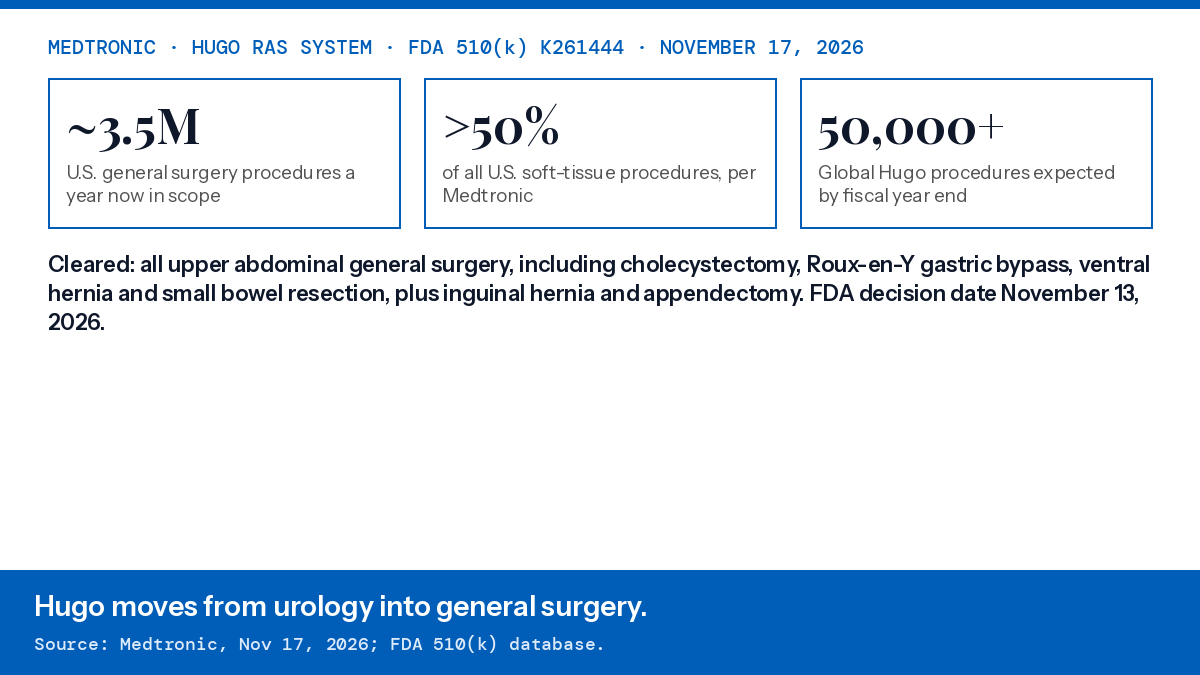
General surgery is the largest soft-tissue category. Medtronic says the procedures in this clearance account for about 3.5 million U.S. surgeries a year, more than half of all soft-tissue procedures. Until now, Hugo's U.S. label covered urology, which limited it to a small part of a hospital's robotic schedule. With general surgery added, Hugo can compete for the cases that drive most robot utilization.
The timing matters because competition is arriving at once. MedTech Dive reports that Johnson & Johnson received FDA authorization for its Ottava system in general surgery in July, and that Stryker agreed last month to distribute
CMR Surgical's Versius in the U.S. For the first time, U.S. hospitals planning 2027 capital budgets can compare several soft-tissue robots for the same procedures.
Third, Medtronic brings an installed base of a different kind. It does not have a large U.S. robot fleet, but its staplers, energy devices and laparoscopic instruments are used by general surgeons in most hospitals. Its pitch is continuity: the LigaSure RAS Maryland instrument, cleared for Hugo in September, brings a vessel-sealing technology
Medtronic says has been used in more than 45 million open and laparoscopic procedures into robotic cases.
Certainty: (A) procedure figures and LigaSure details from Medtronic; (A) competitor milestones as reported by MedTech Dive; (B) interpretation is ours.
What actually happened
- The clearance: FDA 510(k) K261444 for the Hugo RAS System, filed by Covidien LLC (a
Medtronic company), classified as a modular electromechanical surgical system under product code SCV. The FDA database shows it was received May 1, 2026 and decided November 13, 2026 as substantially equivalent, through a traditional 510(k) reviewed by the General and Plastic Surgery panel.
- The procedures: All upper abdominal general surgical procedures, including but not limited to cholecystectomy, Roux-en-Y gastric bypass, ventral hernia and small bowel resection, plus the lower abdominal procedures of inguinal hernia repair and appendectomy.
- The system: Hugo uses a modular design, letting teams use only the robotic arms a procedure needs and position them for the technique and anatomy, and an open console that keeps the surgeon connected with the operating room team.
- The people: Matt Anderson, senior vice president and president of
- Outside the U.S.:
Urology clearance
Instrument additions
General surgery 510(k)
Hospital contracts
Certainty: (A) from the Medtronic release and FDA database entry; urology clearance timing from MedTech Dive.
The obvious read versus the deeper signal
The obvious read: Medtronic finally has a robot that can compete with da Vinci where it counts, and Intuitive faces its first serious threat.
The deeper signal: The deeper change is in the buyer's leverage. Intuitive has a large installed base, a long clinical record and surgeons trained on its systems, and none of that disappears with one clearance. What changes is that hospital supply chain and surgical leaders can now run competitive processes for general surgery robots, with at least Medtronic and J&J able to bid and CMR's Versius arriving through
Stryker. Even hospitals that stay with Intuitive may use the alternatives to negotiate instrument pricing, service terms and capital financing. The first effect of competition is often on the incumbent's contracts rather than on market share.
Certainty: (B) evidence-based interpretation; no pricing data from any vendor has been disclosed.
Historical playbook
Intuitive's da Vinci received FDA clearance in 2000 and spent most of the next two decades as the only widely used soft-tissue robot in the U.S. Its business model, selling the system and then earning recurring revenue from instruments, accessories and service, became the template for the category. Competitors that tried to enter earlier mostly struggled with clinical evidence, surgeon training and the switching costs of hospitals that had already built programs around one system.
The lesson from other device categories, such as joint replacement robotics and endoscopy towers, is that second entrants rarely win on technology alone. They win where they already have a commercial relationship with the surgeons and the hospital, and where they can bundle the robot with products the hospital already buys. That is Medtronic's strategy in general surgery, and it explains why the company emphasizes its decades with general surgeons and instruments like LigaSure.