Colonoscopy days do not fail in the operating room as often as they fail in the living room. A patient who did not finish the prep, did not hold the right medicine or never answered the nurse's third call becomes an empty slot. The surgeon is ready. The room is ready. The prep phone tree was not.
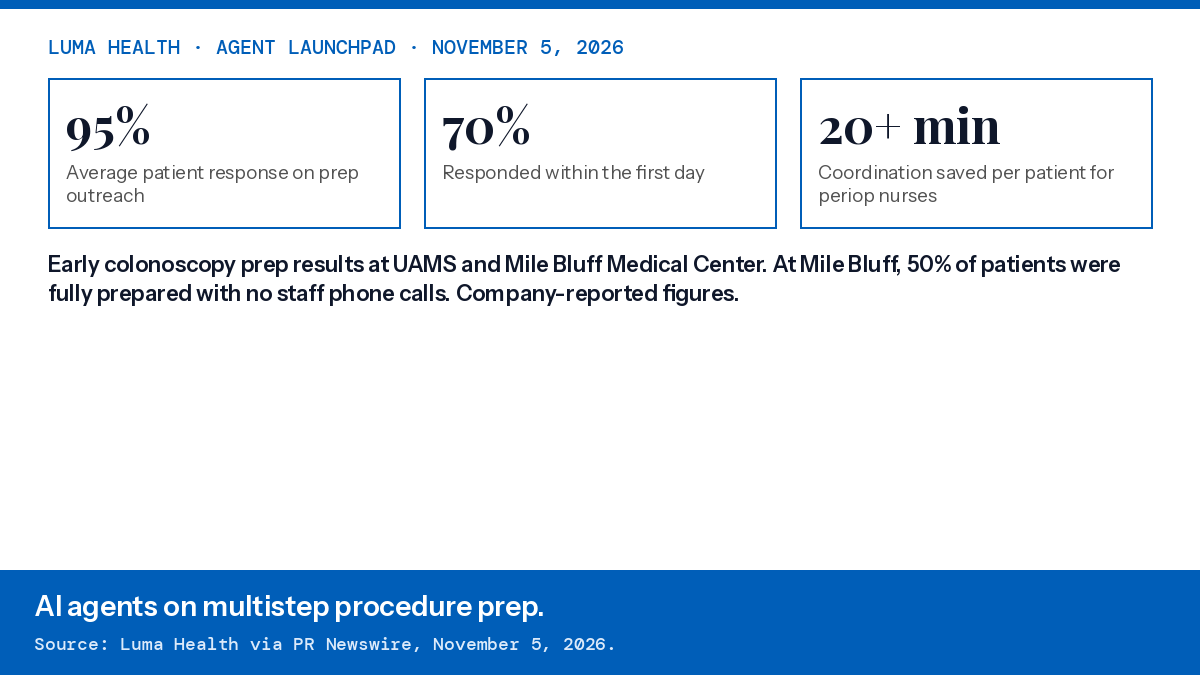
On November 5, Luma Health launched Agent Launchpad to put AI agents on those multistep prep journeys. Early numbers from UAMS and Mile Bluff Medical Center are striking if they hold: 95% patient response, more than 20 minutes of nurse time saved per patient. Below we look at what was launched, why prep is a capacity problem disguised as a customer-service problem, how Agent Launchpad compares with adjacent operational AI, and what still has to be proven before health systems treat this as infrastructure rather than a pilot.
The scarce asset in perioperative care is not another reminder. It is a completed protocol that a nurse does not have to chase by phone.
In This Deep Dive
- Why this matters now
- What actually happened
- The obvious read versus the deeper signal
- Category map and taxonomy
- Evidence Ladder
- Regulation and international divergence
- Capital flows and bottom-up economics
- The HealthTech Investor's Signal
- Counter-thesis
- Forward Intelligence
- The Bottom Line for Health System COOs and Digital Leaders
Why this matters now
Health systems have spent a decade buying patient engagement platforms that send reminders, collect forms and fill open slots. Those tools help. They do not finish a seven-day colonoscopy prep, answer anesthesia questions at 10 p.m., or escalate a clinical concern with the full conversation attached. That work still falls on perioperative nurses, who live inside a phone tree.
Luma's own customer quotes make the cost visible. Paige Anderson, Assistant Clinical Service Manager at UAMS, said nurses historically spent a large part of their day walking patients through prep, medication holds and general questions. Many UAMS patients travel long distances, so arriving unprepared is both a clinical and an operational failure. Tamara Coughlin, Director of Surgery at Mile Bluff, framed it as a volume problem: getting patients through the door for preventive care while complex prep still needs human guidance.
At the same time, the market is filling with agentic claims. Ellipsis Health is buying Kouper to put care-management calls onto EHR maps. Health iPASS is opening MCP servers so outside agents can act on balances and payments. The buyers are no longer asking whether AI can draft a message. They are asking whether AI can complete a job against a protocol and hand off cleanly when it cannot.
That shift matters for anyone who owns endoscopy or OR utilization. Empty rooms caused by incomplete prep do not show up as a technology problem in most dashboards. They show up as wasted block time. An agent that recovers even a fraction of those slots changes the economics of a service line without adding staff.
Certainty: (A) Luma launch details and quoted customer titles from Luma's November 5 release and blog; (B) our framing of prep as an OR capacity constraint based on those operational descriptions; (C) how widely these early response rates will generalize.
What actually happened
- Product: Agent Launchpad, part of Luma's Fall 2026 release, gives health systems one place to run AI agents on multistep workflows from start to finish.
- First jobs: procedure prep and post-procedure check-ins. Agents call or text, follow the health system's approved instructions, FAQs and screening questions, track readiness and escalate clinical issues to staff with context.
- Templates in the first release: colonoscopy prep, colonoscopy follow-up, knee replacement prep, cataract surgery prep, bariatric surgery prep, endoscopy prep and pain management guidance.
- Early sites: UAMS and Mile Bluff Medical Center on colonoscopy prep.
- Reported results: 95% average response rate; 70% within the first day; 20+ minutes of periop nurse coordination saved per patient on average; 50% of Mile Bluff patients completely prepared with no staff phone calls.
- Roadmap: Luma says that this winter its AI will be able to read a procedure referral, reach out to schedule it and enroll the patient in prep outreach.
- Leadership: Adnan Iqbal (Co-Founder and CEO), Aditya Bansod (Co-Founder and President) and Tashfeen Ekram, MD (Co-Founder and Chief Medical Officer), per Luma's About page.
Luma describes itself as serving more than 1,000 healthcare organizations with 100+ million patients across the U.S., UK and the Caribbean. Those footprint figures are company-stated. The company also published a simple operating loop for Launchpad: start from a template or goal, upload approved guidance, then decide what agents can handle versus when staff step in.
Certainty: (A) all product, template, site and result figures as published by Luma on November 5; (A) leadership titles from lumahealth.io/company/about; (C) winter roadmap features that have not shipped.
The obvious read versus the deeper signal
The obvious read: another chatbot that texts patients about prep. Engagement vendors have shipped reminders for years. Sustained response rates will need longitudinal measurement.
The deeper signal: Luma is selling orchestration against a health system's own protocol, with explicit escalation rules, not a generic LLM conversation. Reporting around the launch describes check-ins at 14, seven, three and one day before colonoscopy, channel switching from call to text, retries after missed calls using engagement data, and moving the outreach timeline when an appointment is rescheduled. That is workflow software with an agent inside it.
The second deeper signal is where the minutes come from. Twenty minutes of nurse coordination per patient is not delight. It is labor. If half of Mile Bluff patients need no staff phone calls to be fully prepared, the nursing hours return to clinical work Anderson described as only they can do. That is a different ROI story from open-slot fill rates.
The third signal is competitive. The same week, Ellipsis bought Kouper to connect voice outreach to EHR booking, and Health iPASS opened an agent ecosystem around financial interactions. Procedure prep, care management and patient finance are all becoming agent jobs with human exception handling. Protocol completion gives buyers a further measure beyond message delivery.
Certainty: (A) workflow details from Luma's blog and Unite.AI reporting of the launch; (B) competitive framing across same-week announcements; (C) durability of early response rates.
Historical playbook
Patient engagement software learned a hard lesson between 2018 and 2024: reminders raise response rates, but they do not finish clinical prep. Health systems that bought SMS platforms still staffed nurse phone lines for colonoscopy and surgical prep. The next product generation is defined by whether software can run a protocol, branch on answers, reschedule timelines and escalate with context.
Agent Launchpad sits in that generation. The comparable pattern outside healthcare is field-service software that moved from "notify the technician" to "complete the work order." Healthcare is late to that shift because clinical risk raises the escalation bar. Vendors that clear that bar with nursing leaders will look less like chat apps and more like operating infrastructure.