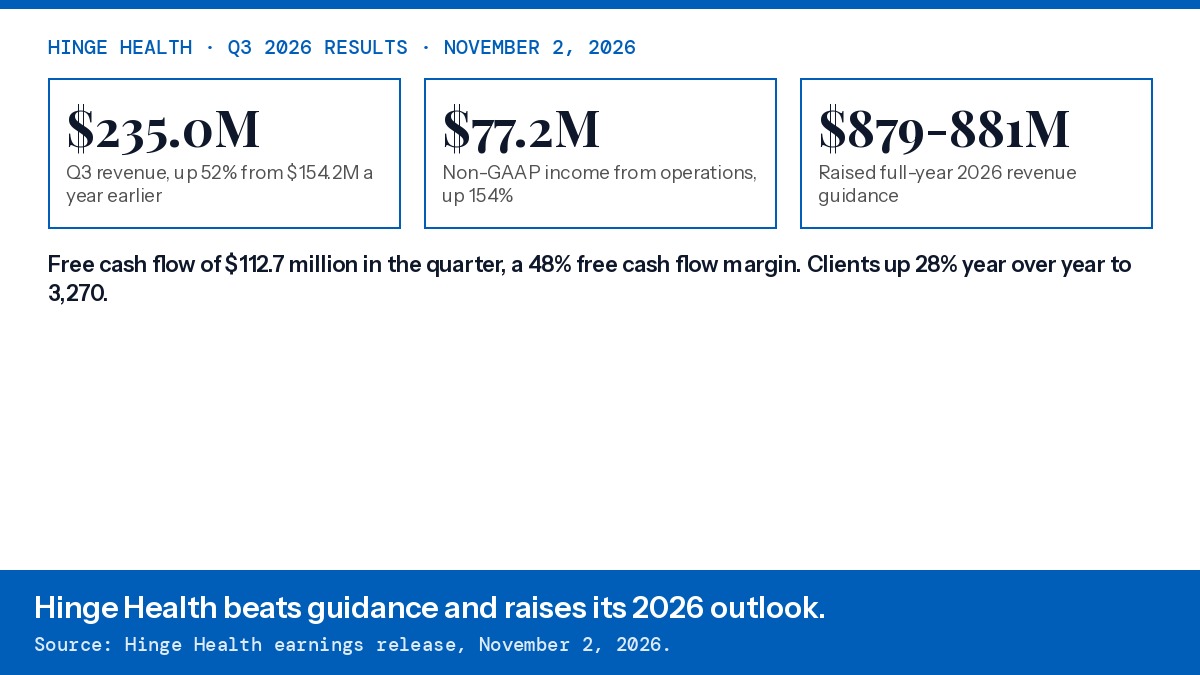
Two numbers from Hinge Health's third quarter tell most of the story. Revenue grew 52%. Free cash flow was 48% of revenue. Growth and cash generation are separate measures. Fewer have reported fast growth while turning nearly half of every revenue dollar into free cash flow. Hinge did both in the same quarter, beat its own guidance, and raised its outlook for the year.
That changes the question investors and buyers ask about the category. For years the question was whether virtual musculoskeletal care could be a profitable business. Hinge's results answer that for itself. The new question is what a profitable digital care platform does with its cash, and Hinge's answer is clear: expand into adjacent conditions, sell them to the same employers and health plans, and invest in hardware. Below we look at the numbers, the strategy, how Hinge compares with other approaches, the payer and regulatory context, and what would prove the expansion works.
Hinge no longer has to prove virtual MSK can make money. It has to prove MSK was a platform and not just a product.
In This Deep Dive
- Why this matters now
- What actually happened
- The obvious read versus the deeper signal
- Category map and taxonomy
- Evidence Ladder
- Regulation, reimbursement and international divergence
- Capital flows and bottom-up economics
- The HealthTech Investor's Signal
- Implementation priorities
- Forward Intelligence
- The Bottom Line
Why this matters now
Employers and health plans are under pressure to control specialty costs, and they have grown wary of buying a separate digital program for every condition. Each new point solution brings its own contract, its own member engagement campaign and its own claims about savings. Benefits leaders increasingly want fewer vendors that cover more conditions, with clear outcomes reporting.
Hinge is well placed for that shift because MSK is one of the largest and most common cost categories for employers, and Hinge already sits in thousands of benefits programs. The company says it has 3,270 clients, up 28% from 2,560 a year earlier. Its release counts entities with at least one active agreement, with clients reached through partners counted individually. That is distribution that a single-condition startup in migraine or GI would take years to build.
Public markets matter here too. Hinge listed on the New York Stock Exchange in 2025, and its quarterly reporting is now one of the clearest public windows into digital care economics. When Hinge reports, buyers, competitors and private investors recalibrate what good looks like for the category.
Certainty: (A) client numbers and definitions from Hinge's release; (B) the buyer trend toward vendor consolidation is our summary of a widely discussed market shift.
What actually happened
Hinge reported results for the quarter ended September 30, 2026 on November 2, and Fierce Healthcare reported on the earnings call on November 3.
Third quarter results
- Revenue: $235.0 million, up 52% from $154.2 million in Q3 2025, above guidance of $223 million to $225 million.
- Gross margin: 87% GAAP, up from 82%; 88% non-GAAP, up from 83%.
- Operating income: GAAP income from operations of $50.3 million, compared with a GAAP loss of $6.1 million a year earlier, a 21% GAAP operating margin. Non-GAAP income from operations rose 154% to $77.2 million, a 33% non-GAAP operating margin, up from 20%.
- Cash generation: operating cash flow of $114.6 million and free cash flow of $112.7 million, compared with $81.3 million a year earlier. Hinge reports a 48% free cash flow margin.
- Balance sheet: cash, cash equivalents, marketable securities and restricted cash of $358.5 million.
- Leading indicators: LTM calculated billings up 54% to $960.3 million; clients up 28% to 3,270.
Outlook and leadership
- Q4 2026: revenue of $249 million to $251 million, 46% growth at the midpoint, and non-GAAP income from operations of $81 million to $83 million.
- Full year 2026: revenue guidance raised to $879 million to $881 million, 50% growth at the midpoint; non-GAAP income from operations of $266 million to $268 million, about a 30% margin at the midpoint.
- Commercial organization: Aaryn Pure will lead the commercial organization as Chief Commercial Officer following the January 2027 transition.
The expansion
CEO Daniel Perez said in the release that the client base is up almost 30% year over year for the MSK Care Program, roughly 40% for the GI Care Program since the Cylinder Health acquisition announcement in August, and has nearly doubled for the Migraine Care Program since last quarter. Hinge bought Cylinder Health for $105 million in cash, and Fierce reports that the company targets summer 2027 for its fully integrated GI product. Early results from the migraine program cited on the call showed a 23% reduction in monthly migraine days. On hardware, Perez told analysts: "I absolutely firmly believe you will not automate care delivery without also investing in hardware."
Certainty: (A) financial figures, guidance and leadership changes from Hinge's release; (A) call details as reported by Fierce Healthcare; (B) the migraine figure is an early company-reported result, not a peer-reviewed study.
The obvious read versus the deeper signal
The obvious read: a digital health company had a strong quarter. Revenue beat guidance, margins rose and the outlook went up. That is accurate, and on its own it is good news for the category.
The deeper signal: Hinge describes itself as "focused on scaling and automating the delivery of health care," using an AI-powered care model, connected hardware and access to expert clinicians. Read the quarter through that lens. An 87% GAAP gross margin describes aggregate revenue less cost of revenue for the quarter; it does not establish marginal cost per additional member or margins in new programs. That makes adjacent conditions unusually attractive: if the same platform, clinical team structure and member engagement engine can deliver migraine or GI care, the margin on that new revenue could look similar, and the sales cost is low because the buyer already has a Hinge contract.
Three implications follow. First, the competitive set widens. Hinge is no longer competing only with other virtual MSK providers. It now competes with single-condition specialists in migraine and GI, and with multi-condition platforms that sell to the same benefits leaders. Second, the bar for point solutions rises. A startup offering one condition must now argue it is better enough to justify a separate contract when an incumbent offers the condition as an add-on. Third, cash generation provides strategic flexibility. With $358.5 million in cash, cash equivalents, marketable securities and restricted cash and more than $100 million of free cash flow in a quarter, Hinge can acquire capability, as it did with Cylinder, rather than build it slowly.
The hardware comment matters. Perez's view that automation requires hardware suggests Hinge sees connected devices as part of how it lowers the cost of care and gathers data. That points to more acquisitions, and to a model closer to a device-plus-software care company than a pure app.
Certainty: (A) Hinge's self-description and stated strategy; (B) the margin logic for adjacent conditions and the implications for competitors are our analysis; (C) whether non-MSK programs will match MSK economics.