If a vendor tells you its clinical AI scored 88.6% on a safety benchmark, what have you learned? That the model did well on a specific test set, scored a specific way, at a specific moment. You have not learned how it will behave with your clinicians, your patients, your formulary and your documentation habits. Yet benchmark numbers are increasingly what clinical AI vendors lead with, and they are often what reaches a health system's buying committee first.
On November 4, two very different organizations published how they judge clinical AI. Medscape reported scores for its Clarus model on two clinical benchmarks and described, for the first time, its internal ClinVal framework. Google published a whitepaper laying out a multi-method framework for evaluating AI in health, written with health quality experts Dr. Elizabeth McGlynn and Dr. Dana Gelb Safran. Below we look at what each one measures, where they converge, what they leave out, how regulators are approaching the same problem, and what a chief medical information officer should ask a vendor before trusting any score.
A benchmark tells you how a model did on someone else's test. Your hospital needs to know how it does on your patients.
In This Deep Dive
- Why this matters now
- What actually happened
- The obvious read versus the deeper signal
- Category map and taxonomy
- Evidence Ladder
- Regulation and international divergence
- Capital flows and bottom-up economics
- The HealthTech Investor's Signal
- Counter-thesis
- Forward Intelligence
- The Bottom Line
Why this matters now
Generative AI answer engines are now part of everyday clinical information seeking. Clinicians ask them about dosing, differential diagnoses and guideline recommendations, and patients ask consumer chatbots about symptoms. Google's post frames the stakes directly: "The adoption of technology for health is accelerating and impacts billions of people every day. But how can we assess if these tools are safe and helpful?"
The traditional ways of evaluating clinical tools do not fit general-purpose models well. A diagnostic device is tested for one task in one population. A large language model answers open-ended questions across all of medicine, and its answers can change whenever the model or its retrieval system is updated. The Google whitepaper's abstract says general-purpose generative AI models "are challenging to assess with traditional evaluation frameworks," and that these challenges "parallel decades of work in evaluating clinician and health system quality and safety."
That gap has produced a wave of public benchmarks for medical AI, with names like NOHARM and HealthBench, and a growing number of vendors publishing scores on them. Benchmarks are useful because they are comparable. They are limited because they are fixed, can be optimized against, and rarely capture a specific organization's workflow. As vendors start to compete on scores, health systems need a way to interpret them.
Certainty: (A) quotes from Google's post and whitepaper abstract; (B) our description of clinician and patient use of AI answer engines and of benchmark strengths and limits, which reflects general industry experience.
What actually happened
Medscape: scores plus a framework
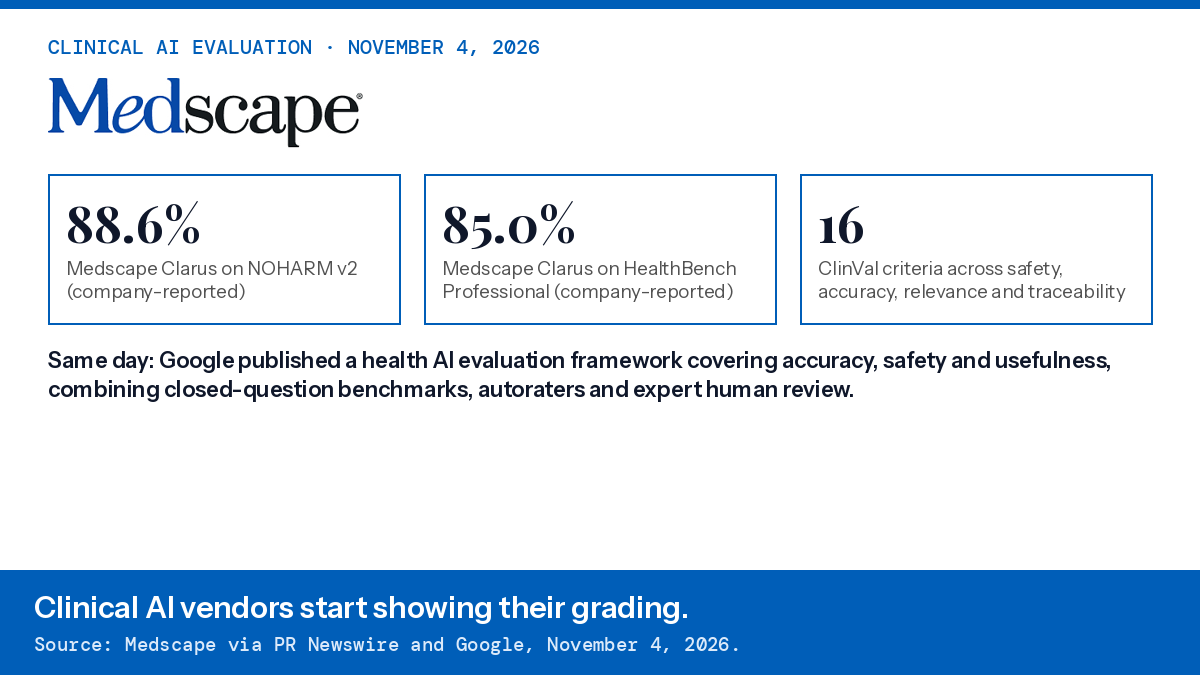
- NOHARM v2: Medscape's Clarus model scored 88.6%. Medscape describes NOHARM v2 as "a safety benchmark that examines the frequency and severity of potentially harmful errors in AI-generated medical recommendations." It says its score exceeds the three highest reported competitor scores of 86.2%, 84.5% and 80.0%.
- HealthBench Professional: Clarus scored 85.0%. Medscape says this benchmark "assesses AI responses to a range of health-related scenarios against physician-defined standards for answer quality," and that its score surpasses the three highest published competitor scores of 69.2%, 65.6% and 65.3%.
- ClinVal: a proprietary, clinician-developed framework that evaluates AI answers against "an evidence-based set of 16 criteria across dimensions including safety, accuracy, relevance, and traceability." It combines automated AI assessments with clinician review. Answers are re-evaluated after product changes. Medscape says it has shared ClinVal with external physicians for feedback.
Joshua Conrad, PharmD, Group VP Editorial & Content Strategy at Medscape, said: "Strong benchmark results demonstrate what our AI can achieve today, but clinical AI quality requires an ongoing commitment to improvement."
Google: a multi-method framework
- Google's blog post, dated November 4, says the framework "evaluates models across three areas: accuracy, safety, and usefulness" and "combines closed-question benchmarks, autoraters, and expert human review to assess common and high-risk health scenarios."
- The whitepaper, posted to arXiv on November 3 with Sarah Montgomery-Taylor as first author, anchors evaluation to Critical User Journeys and maps them to a phased lifecycle: base model development, product development and post-deployment monitoring.
- Google says it built and continues to use this framework for its own models, and that it is sharing the methodology "to promote transparency" and support developers, researchers and clinicians.
Certainty: (A) all scores, definitions and quotes as published by Medscape and Google; (A) the benchmark scores are company-reported and we have not independently verified them.
The obvious read versus the deeper signal
The obvious read: two companies say their AI is safe. One publishes high scores; the other publishes a methodology. Both are marketing their credibility.
The deeper signal: the two announcements describe the same evaluation architecture from different sides. Both combine three ingredients: standardized benchmarks, AI-based automated grading, and expert clinician review. Both emphasize that evaluation is continuous rather than a one-time test. Medscape re-evaluates answers after changes; Google maps evaluation across the lifecycle, including post-deployment monitoring. That convergence suggests an emerging industry pattern for evaluating clinical generative AI, even without a formal standard.
The second signal is that evaluation itself is becoming proprietary and competitive. ClinVal is described as proprietary. Google's framework is public, but the internal datasets and rater pools behind it are not. Vendors are starting to treat evaluation as a moat: the better your evaluation process, the faster you can improve and the more credible your claims.
The third signal is about who holds the pen. Today, vendors largely choose which benchmarks to report and how to describe them. A health system reading "88.6%" needs to know which version of the benchmark was used, how it was scored, whether the model was tuned on related data, and how competitor scores were collected. Neither announcement gives buyers a ready-made way to verify that on their own.
Certainty: (A) the structure of each framework as described; (B) the convergence and moat arguments are our analysis.