A care-management call that goes well still fails if nobody books the follow-up. That is the quiet failure mode of voice AI in healthcare: the conversation ends, the transcript looks empathetic, and the chart never moves.
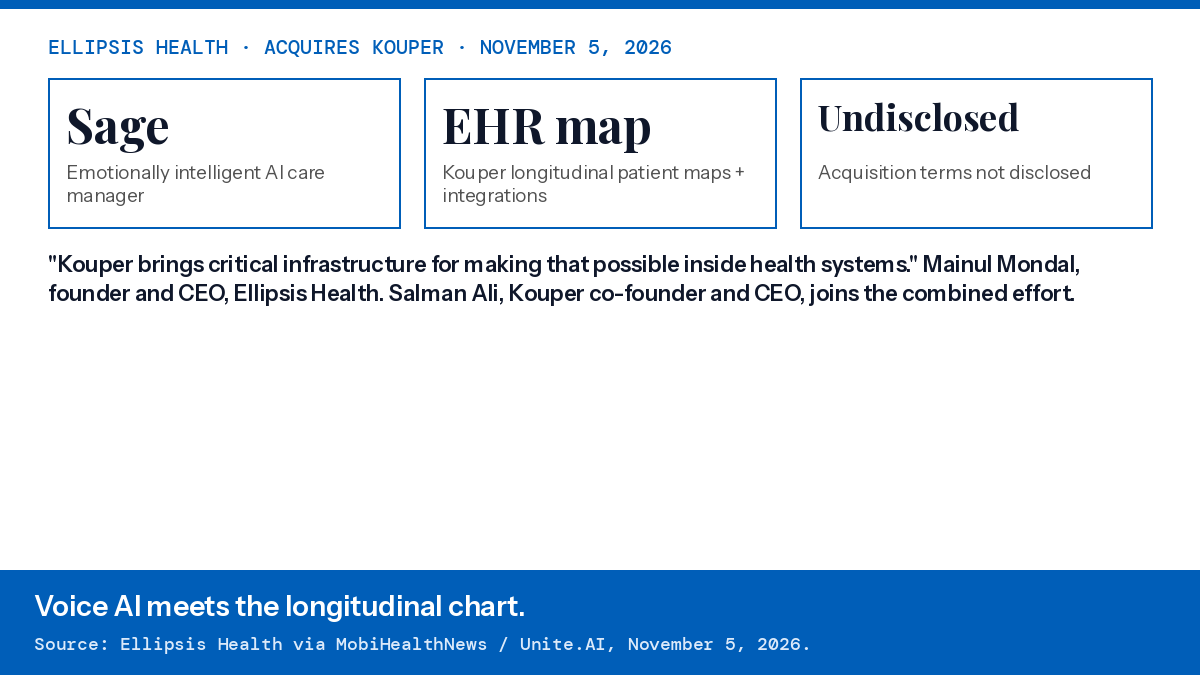
On November 5, Ellipsis Health said it is buying Kouper Health to close that gap. Sage, Ellipsis's emotionally intelligent AI care manager, will sit on Kouper's EHR integrations and longitudinal patient maps. Below we look at what each company brings, why context has become more valuable than conversation quality alone, how the combined stack compares with adjacent care-coordination AI, and what still has to work in production EHRs before the thesis is proven.
Voice AI that can call patients is no longer scarce. An AI that can finish the next step inside the record is.
In This Deep Dive
- Why this matters now
- What actually happened
- The obvious read versus the deeper signal
- Category map and taxonomy
- Evidence Ladder
- Historical playbook
- Regulation and international divergence
- Capital flows and bottom-up economics
- The HealthTech Investor's Signal
- Counter-thesis
- Forward Intelligence
- The Bottom Line for Health Plan and Health System Leaders
Why this matters now
Payers and health systems have spent several years piloting outbound AI agents for enrollment, medication adherence, post-discharge follow-up and behavioral health screening. Ellipsis has been one of the more visible players in that lane, with Sage contacting people by phone and text and using vocal cues as part of its engagement model. The company says Sage has been trained on more than 3 million labeled clinical conversations and reports large gains in enrollment speed and task completion versus human agents in its own deployments.
Those figures, if durable, still leave a structural problem. Care management does not end when the member says yes. Someone has to match the person to a clinician, find an open slot and write the next step into the system of record. That is where many AI outreach programs stall, and where human coordinators quietly re-enter the workflow.
Kouper was built for that second half. Founded in 2022 and out of stealth in May 2025 with $10 million from General Catalyst, 25Madison and CVS Health Ventures, Kouper embeds AI agents into health-system workflows and builds longitudinal patient maps from emergency, inpatient and urgent care data. Customers named in prior coverage include LifePoint, Henry Ford Health's Mosaic Clinically Integrated Network and Ascension Saint Thomas. The acquisition thesis is blunt: put Sage's conversation layer on Kouper's chart context and booking path.
Certainty: (A) acquisition announcement details as reported November 5, 2026; (A) Kouper stealth financing and customer names from prior public coverage cited in Unite.AI; (B) our characterization of the post-call booking gap as the strategic motive.
What actually happened
- Deal: Ellipsis Health acquired Kouper Health. Terms were not disclosed.
- Buyer leadership: Mainul Mondal, founder and CEO of Ellipsis Health.
- Seller leadership: Salman Ali, co-founder and CEO of Kouper Health. Kouper's team is joining Ellipsis.
- Product intent: integrate Sage into Kouper's EHR integrations and longitudinal patient intelligence maps so the combined stack can support continuous, personalized support and appointment booking.
- Customer continuity: both companies plan to keep serving existing customers under their respective brands while building a combined roadmap. Ellipsis expects new health-system offerings in the months ahead.
- Prior capital: Ellipsis announced a $45 million Series A in 2025 led by Salesforce, Khosla Ventures and CVS Health Ventures. CVS Health Ventures was also a Kouper investor, creating a shared backer before the deal.
- Reported footprint: Ellipsis says its customers include seven of the top 20 U.S. health plans, plus academic medical centers and integrated delivery networks.
Certainty: (A) leadership names, brand-continuity plan and product intent from November 5 reporting that quotes company statements; (A) prior financing disclosures from earlier company releases as summarized in secondary coverage; (C) eventual combined product roadmap.
The obvious read versus the deeper signal
The obvious read: a voice AI vendor buys a care-navigation startup to grow into health systems after winning health plans.
The deeper signal: the scarce resource shifted. Empathetic conversation is becoming table stakes. Longitudinal context and the ability to write an appointment into an EHR are the differentiating assets. Mondal's quote in the coverage is explicit: Kouper brings infrastructure so care teams can extend reach without being asked to do more.
A second signal is the shared investor. CVS Health Ventures sitting on both sides of the table before the deal does not prove coordination, but it does show that strategic capital was already underwriting both halves of the workflow. The combined company is being assembled along a capital thesis that was visible a year earlier.
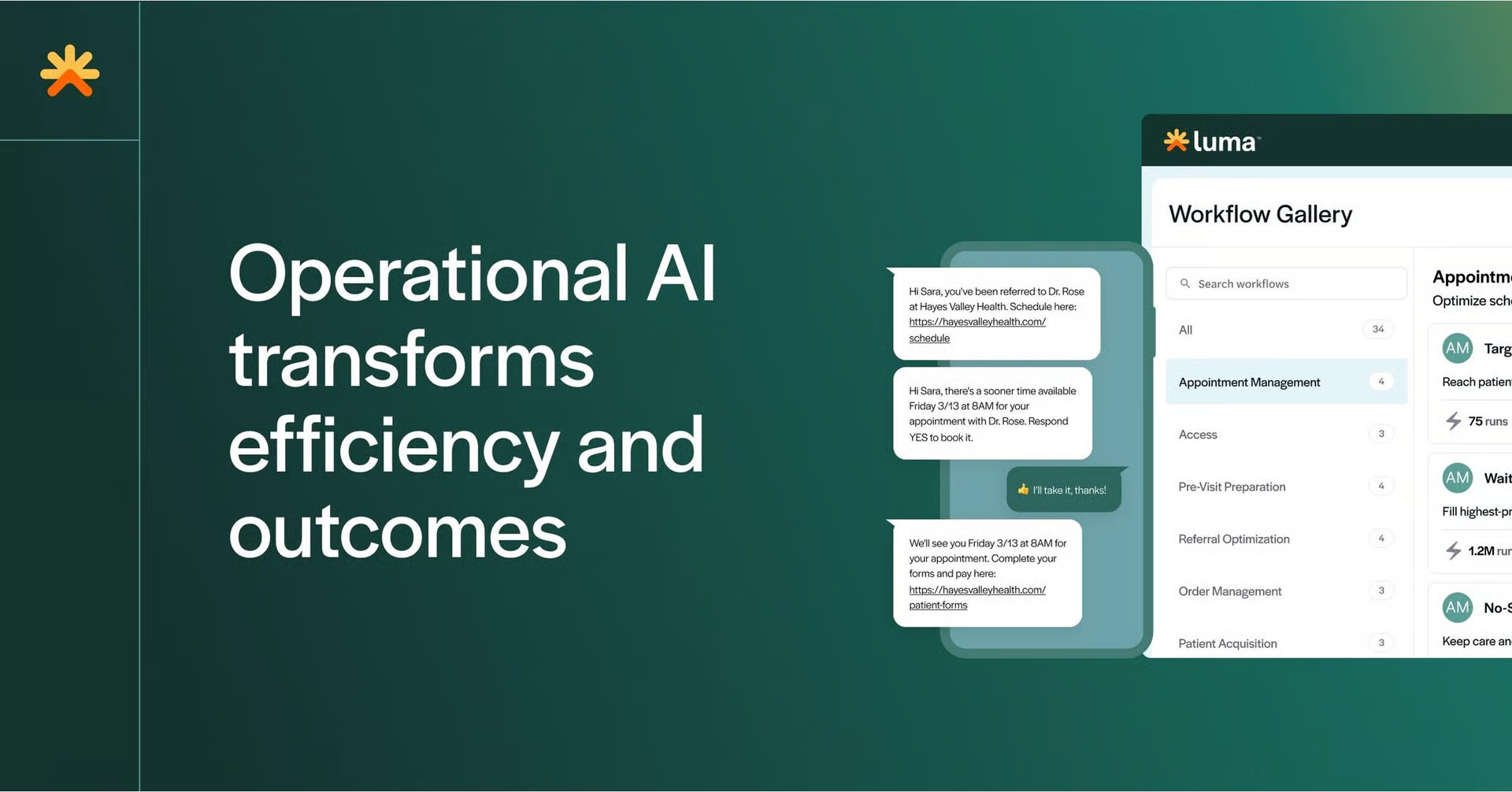
A third signal is timing relative to Luma's Agent Launchpad launch the same day. One company is automating prep protocols before a procedure. The other is trying to automate the path from outreach to booked care after a risk is identified. Together they describe a market that is no longer debating whether agents should talk to patients. It is debating who owns the handoff into clinical operations.
Certainty: (A) quoted strategic framing from company statements in coverage; (B) same-day competitive context with Luma; (C) how cleanly EHR booking will work post-integration.