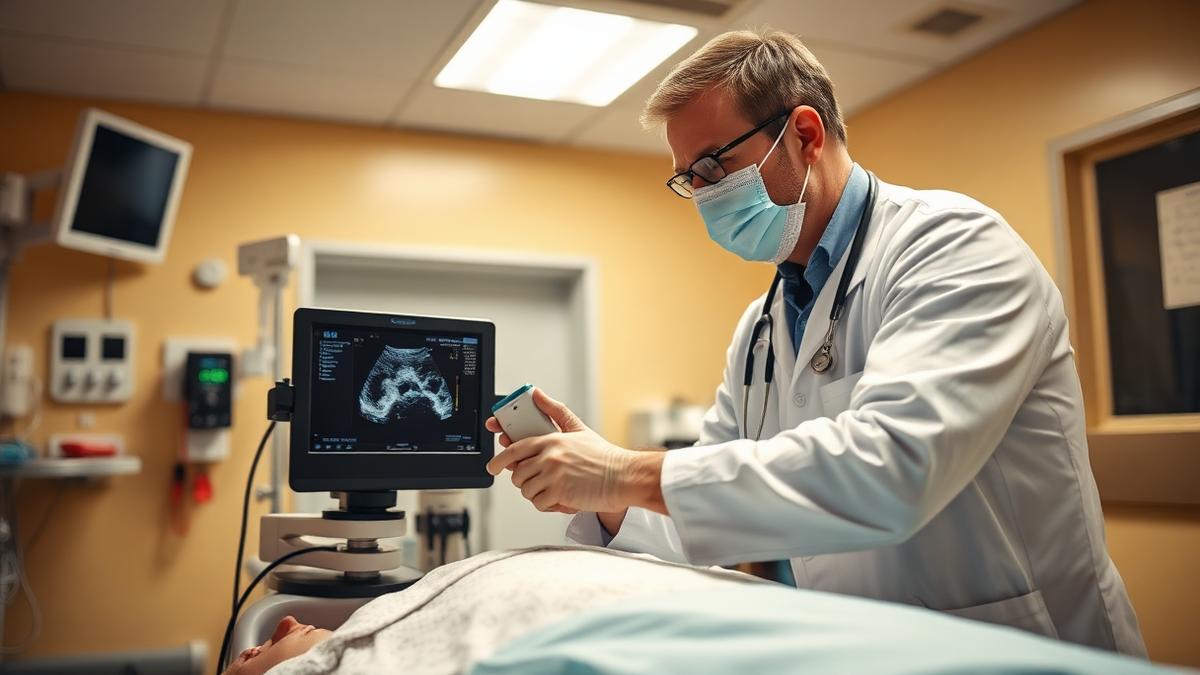
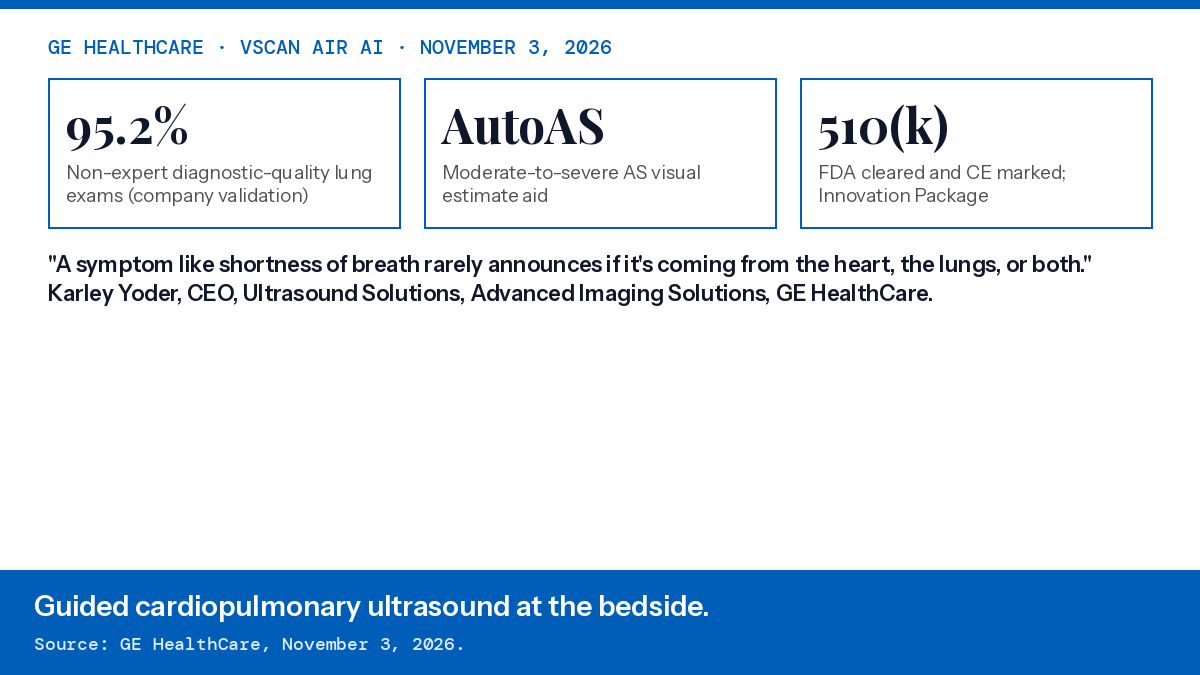
Shortness of breath is a dishonest symptom. It can be fluid in the lungs, a failing valve, both, or neither. At the bedside, the clinician often has a handheld ultrasound and very little time before the next decision: treat, image formally, escalate or send home.
On November 3, GE HealthCare put two new AI assists onto that handheld moment. Lung Guidance helps non-experts acquire consistent lung windows. AutoAS estimates whether images suggest moderate-to-severe aortic stenosis. Both are FDA 510(k) cleared and CE marked. Below we look at what shipped, why cardiopulmonary guidance on a pocket probe matters, how it sits among point-of-care ultrasound AI players, and where the evidence still has to catch the product claim.
The handheld ultrasound is becoming less of a camera and more of a guided first workup for heart and lung uncertainty.
In This Deep Dive
- Why this matters now
- What actually happened
- The obvious read versus the deeper signal
- Category map and taxonomy
- Evidence Ladder
- Historical playbook
- Regulation and international divergence
- Capital flows and bottom-up economics
- The HealthTech Investor's Signal
- Counter-thesis
- Forward Intelligence
- The Bottom Line for Clinical and Imaging Leaders
Why this matters now
Point-of-care ultrasound (POCUS) spread because the probe got smaller and cheaper. The constraint that remained was skill. A device in every pocket does not help if the operator cannot find the pleural line or recognize a calcified aortic valve. Training programs and credentialing pathways help, but they do not scale as fast as device shipments.
GE HealthCare has been pushing AI into that skill gap on Vscan Air already, including Caption AI for cardiac scan guidance and Caption Interpretation Auto EF for ejection fraction support. Lung Guidance and AutoAS extend the same idea across the cardiopulmonary boundary that bedside clinicians actually face. Karley Yoder, CEO of Ultrasound Solutions, Advanced Imaging Solutions at GE HealthCare, put the clinical scene plainly: shortness of breath rarely announces whether it is coming from the heart, the lungs or both.
That matters outside cardiology and radiology too. Emergency medicine, hospital medicine, critical care and primary care clinics are all places where a guided first look can change the next step. The strategic question is whether AI guidance makes POCUS reliable enough that health systems treat handhelds as standard workup tools rather than enthusiast devices.
Certainty: (A) product and leadership details from GE HealthCare's November 3 release; (B) general POCUS skill-gap framing as established clinical operations context.
What actually happened
- Announcement date: November 3, 2026, Chicago, from GE HealthCare.
- Products: Lung Guidance and AutoAS for Vscan Air (AutoAS on Vscan Air SL).
- Regulatory status: both FDA 510(k) cleared and CE marked; available for purchase through Vscan Air Innovation Packages in the United States and select countries.
- Lung Guidance: real-time guidance for the standard 8-zone lung protocol; detects landmarks including pleural line, A-lines, rib shadows, diaphragm and abdomen; AutoCapture when quality criteria are met; B-line detection and scoring; reporting support.
- Validation figure: in company validation, non-expert users acquired diagnostic-quality lung exams 95.2% of the time versus 96.8% for experts (descriptive assessment, GE document UM DOC3172170).
- AutoAS: AI-assisted visual estimate of presence or absence of moderate-to-severe aortic stenosis from at least two compatible views (PLAX, PSAX-AV or AP5), with a confidence score. Intended as a diagnostic aid, not a standalone diagnosis.
- Rollout: existing Vscan Air customers with a valid Innovation Package subscription or license are expected to receive the updates by the end of November 2026. Offerings vary by location and system model.
Certainty: (A) all technical and regulatory statements from the GE HealthCare release; (A) validation percentages as company-reported descriptive assessments cited in that release.
The obvious read versus the deeper signal
The obvious read: a large imaging company ships more AI features on a handheld probe.
The deeper signal: GE is productizing a cardiopulmonary differential at the first touch. Lung guidance alone would be a pulmonary assist. AutoAS alone would be a valve assist. Together they target the undifferentiated breathless patient, which is where delays and mis-sequencing of formal imaging are costly.
A second signal is the distribution model. Shipping via Innovation Packages to existing Vscan Air customers means GE can update the installed base by software rather than by forcing a new hardware cycle. That is the same software-margin logic Clarius and other handheld vendors have pursued, and it changes the competitive race from probe hardware to AI suite completeness.
A third signal sits next to GE's same-week cath lab bets. Days around this launch, GE HealthCare was also visible as a strategic backer of AI-guided procedural imaging. Handheld guidance for frontline assessment and intelligent imaging for the cath lab are different clinical rooms, but they are the same corporate thesis: own the AI layer that makes ultrasound expertise scale.
Certainty: (A) feature pairing and Innovation Package distribution from GE; (B) strategic reading across GE's imaging AI posture.