Ask an ICU nurse how delirium is found and the honest answer is: by asking questions, at set times, and hoping the patient is awake enough to answer. Screening tools based on bedside assessment are well established, but they are snapshots. A patient can be calm at 8 AM and confused by noon, and the quiet, withdrawn form of delirium is easy to miss because it looks like a patient resting.
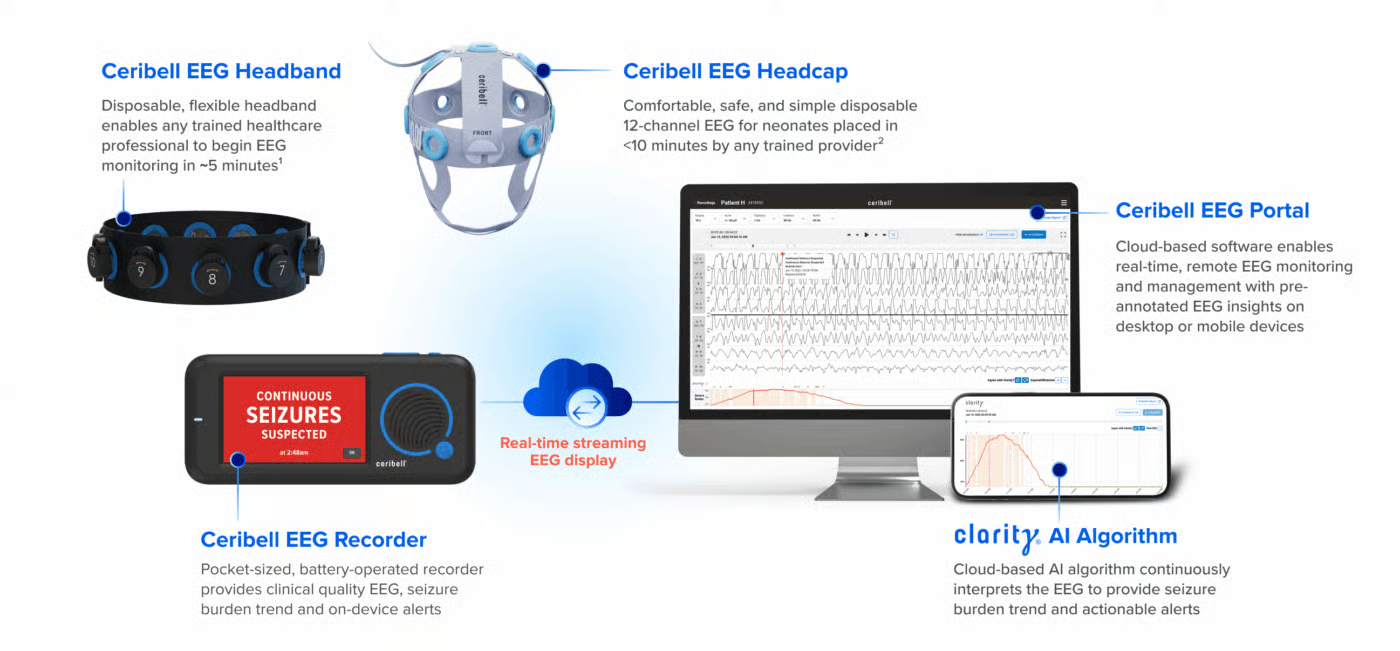
On November 2, Ceribell launched a product built around that gap. Its delirium monitoring solution reads the brain's electrical activity continuously through the same headband the company already places on ICU patients to look for seizures, and flags patterns associated with delirium. It comes with an FDA 510(k) clearance from December 2025 and, since October 1, a Medicare add-on payment of up to $2,171 per eligible case. Below we look at what the launch actually is, why a second indication on an existing device matters more than it sounds, how the payment works, and what evidence would make this a standard of care rather than a pilot.
Delirium has always been found by asking. Ceribell is betting it can be found by listening, continuously, on hardware hospitals already own.
In This Deep Dive
- Why this matters now
- What actually happened
- The obvious read versus the deeper signal
- Category map and taxonomy
- Evidence Ladder
- Regulation, payment and international divergence
- Capital flows and bottom-up economics
- The HealthTech Investor's Signal
- Implementation priorities
- Forward Intelligence
- The Bottom Line
Why this matters now
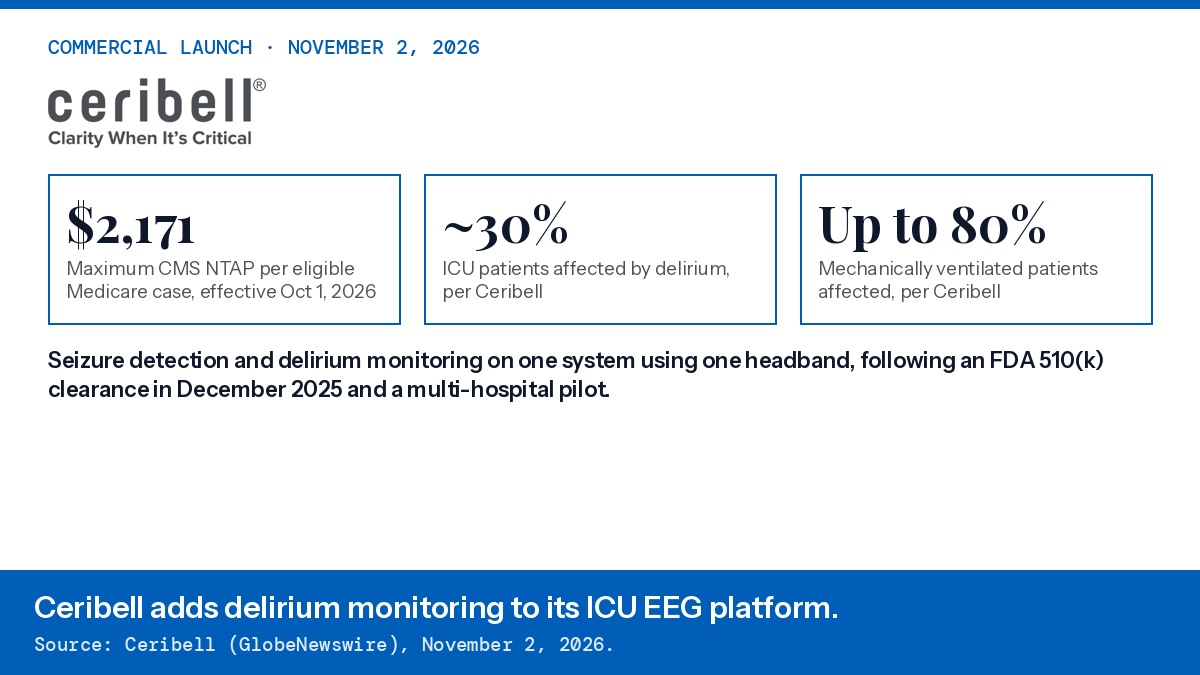
Delirium is common and costly. In its launch release, Ceribell says delirium affects about 30% of ICU patients and up to 80% of mechanically ventilated patients. It cites research associating each additional day of delirium with a 10% higher risk of death at six months, and delirium with a 60% higher risk of developing dementia after an ICU stay. Those are the company's figures from published literature, and they describe association, not cause. Even so, they explain why critical care societies have pushed for routine delirium screening for years.
The practical problem is that screening depends on staff time and patient cooperation. Bedside tools ask the patient to respond to simple tasks. Sedated, intubated or very sleepy patients can be hard to assess, and repeated checks take nursing time in units that are often short-staffed. Ceribell also makes a clinical point in its release: hypoactive delirium can look like nonconvulsive seizures, so a team trying to work out why a patient is withdrawn may need to rule out both. A device that already watches for seizures is well placed to watch for delirium too.
The timing matters for a second reason. The NTAP took effect on October 1, 2026, the start of the federal fiscal year. Hospitals planning purchases and protocols now know there is a specific Medicare payment for eligible inpatient cases. A commercial launch one month later is the obvious follow-on.
Certainty: (A) the prevalence and outcome figures as cited by Ceribell; (B) our description of bedside screening limits is general clinical knowledge; (A) NTAP effective date.
What actually happened
Ceribell, based in Sunnyvale, California, announced the commercial launch on November 2 via GlobeNewswire. The essentials:
- Product: a delirium monitoring solution that runs on Ceribell's point-of-care EEG platform. The system uses AI algorithms to analyze EEG continuously and alert clinicians to patterns associated with delirium, to aid screening and monitoring.
- Same hardware: seizure detection and delirium monitoring run on one system using one headband. Ceribell says the system is cleared for both seizures and delirium in ICUs and emergency rooms.
- Clearance: FDA 510(k) clearance in December 2025. Ceribell describes the system as "the first and only FDA-cleared device used to aid in delirium screening and monitoring."
- Pilot: the launch follows a multi-hospital pilot. The release does not give pilot size or outcome data.
- Payment: CMS granted an NTAP of up to $2,171 per eligible Medicare case, effective October 1, 2026. MassDevice's Sean Whooley reported the NTAP on August 3.
What they said
Dr. Juliana Barr of Stanford University School of Medicine said: "Continuous, objective EEG-based information gives clinicians another tool to screen for and monitor delirium in individual patients." Jane Chao, Ceribell's CEO, said: "Our pilot demonstrated that real-time data helps frontline teams intervene earlier and validate their treatment choices." She described the company's goal as "establishing a new neurological vital sign."
Note the careful wording. The clearance and the clinician quote both describe an aid to screening and monitoring. Neither claims the device diagnoses delirium or that it improves outcomes. That distinction runs through everything below.
Certainty: (A) launch facts, clearance timing, NTAP amount and quotes from Ceribell's release and MassDevice; (C) the pilot's results, which are described qualitatively only.
The obvious read versus the deeper signal
The obvious read: a MedTech company has a new AI feature and a payment code. Hospitals that already use Ceribell for seizures get another tool. That is accurate.
The deeper signal: the business model of point-of-care neuromonitoring is changing from one indication to a platform. Ceribell built its position on rapid EEG for suspected seizures, a setting where conventional EEG is often slow to arrange because it needs technologists and specialist reading. That is an episodic use: a patient is suspected of seizures, the headband goes on, the question is answered. Delirium is different. It is common, it fluctuates, and the clinical question is ongoing. Monitoring for delirium means more patients, for longer, on hardware that is already in the unit.
Three things follow. First, utilization. A device with two indications on one headband gets used more, which spreads fixed costs and raises revenue per installed system. Second, the clinical case for continuous EEG strengthens, because one setup answers two questions that clinicians often face together. Third, Chao's phrase, a "neurological vital sign", is the real ambition. Vital signs are measured on everyone, continuously, without a specific suspicion. If brain monitoring becomes routine for ventilated or high-risk ICU patients, the addressable market changes in size.
The test is whether a continuous signal changes care. A vital sign earns its place when a change in the number leads to a clear action. For delirium, the actions available, such as reviewing sedation, managing sleep, early mobility and treating underlying causes, are well known but not dramatic. The value of earlier detection depends on whether teams act on it and whether acting earlier changes outcomes.
Certainty: (A) Ceribell's stated ambition; (B) the platform and utilization interpretation is our analysis; (C) whether continuous detection will change outcomes.