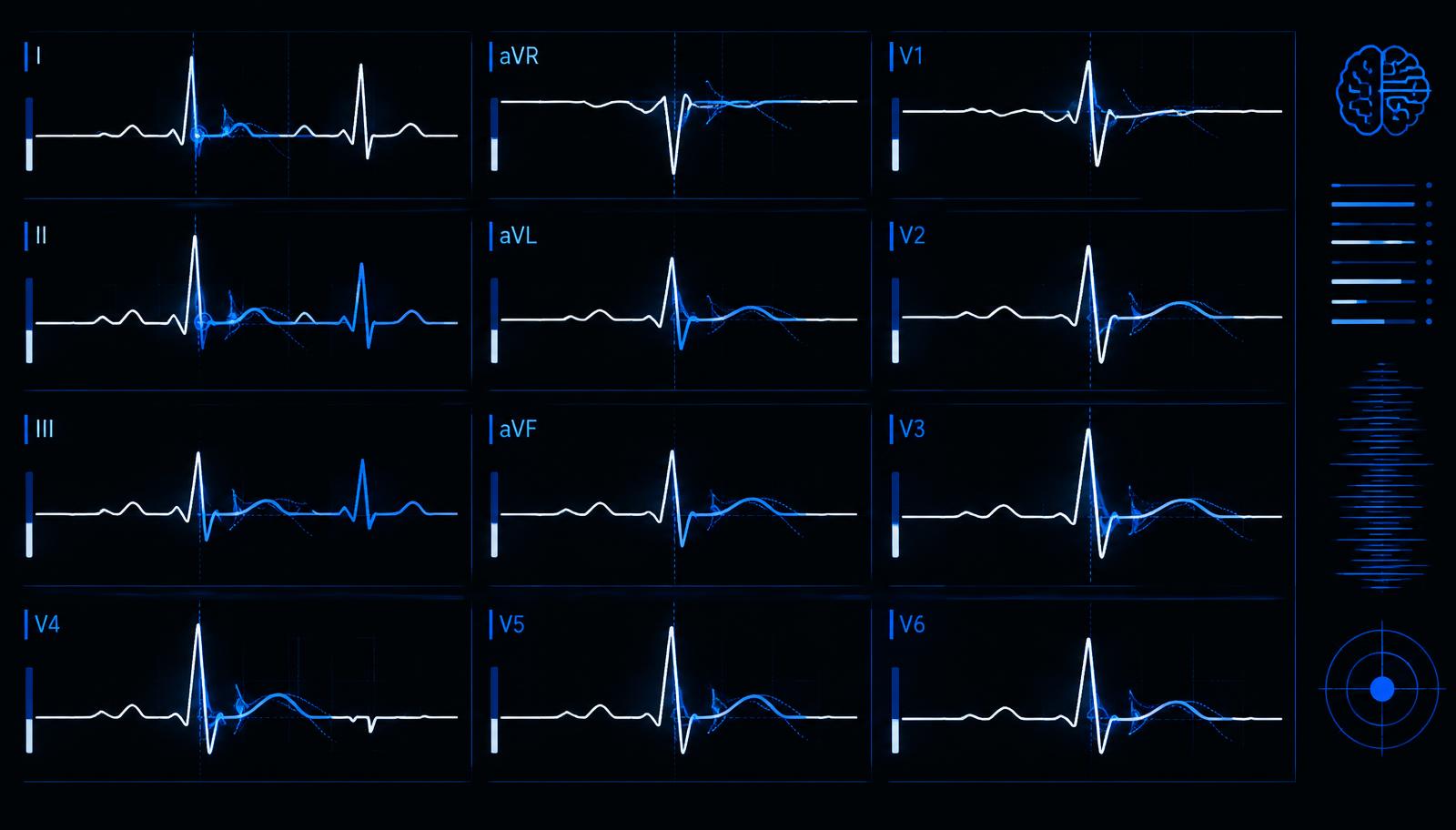
Emergency departments run 130 million visits a year in the United States. ECGs are ordered in a substantial portion of them. And by the most conservative clinical estimates, standard ST-elevation criteria miss approximately 25-50% of acute coronary occlusions requiring urgent catheterization. Heart muscle is dying during that delay. The missed cases are not random: they cluster in STEMI equivalents, hyperacute T-wave patterns, and de Winter morphologies that human emergency physicians, even experienced ones, identify inconsistently under time pressure.
That clinical gap is what Powerful Medical built Queen of Hearts to address. On September 15, 2026, the FDA granted De Novo authorization for the product, making it the first AI ECG tool cleared to detect acute coronary syndrome in a category that had no predicate device. The authorization matters beyond Powerful Medical. Here is what it changes for the AI cardiology diagnostics market, what the clinical evidence actually says, and who benefits from the regulatory category that now exists.
In this deep dive, we are going to look at:
-
Why the De Novo classification matters more than a standard 510(k) clearance
-
What the clinical evidence actually shows, with study-level detail
-
The AI ECG competitive landscape and how it repositions
-
The evidence ladder for AI cardiac diagnostics
-
International regulatory divergence: CE marking vs. FDA De Novo
-
Bottom-up hospital economics: the business case for deployment
-
The HealthTech Investor's Signal
-
Counter-thesis: why this does not automatically translate to widespread adoption
-
Observable milestones to track