
Every health system has a team whose job is to be the integration layer. They read a chart in one window, open an insurer's portal in another, and retype what the first says into the second. Prior authorizations, referrals, records requests and discharge paperwork all run through people like this, because the systems involved were never built to talk to each other. On November 16, 

In this deep dive we look at what computer use is and how it differs from APIs and older automation, what the 99% safety and 8.5-cent figures do and do not tell a buyer, how the first deployments are designed, where the regulatory and liability questions sit, and which business models gain or lose if agents become the default way work moves between healthcare systems. We close with the strongest case that this is robotic process automation with a better marketing team.
The integration layer in healthcare has always been a person with two windows open. That is the job these agents are built to do.
In This Deep Dive
- Why this matters now
- What actually happened
- The obvious read versus the deeper signal
- Category map and taxonomy
- Evidence Ladder
- Regulation, liability and the rules for agents that act
- Capital flows and bottom-up economics
- The HealthTech Investor's Signal
- Counter-thesis
- Forward Intelligence
- The Bottom Line for Health System CIOs, Payer Operations Leaders and Agent Builders
Why this matters now
Healthcare has spent two decades trying to fix interoperability with standards and mandates, and the work is real: FHIR APIs, information blocking rules and the CMS payer API requirements that take effect in January 2027 have all moved data more freely. But the last mile is stubborn. Many payer portals, scheduling tools and departmental systems still have no usable API, and the ones that do often support only part of a workflow.
The second reason this matters now is cost.
Third, the buyers named are not small pilots.
Certainty: (A) the benchmark figures, deployments and controls are from
What actually happened
- The release.
- The clinical evaluation. GPT-6 Astra completed multi-step EHR inbox tasks shaped by physician input. Reviewers judged 99% of 325 reviewed tasks clinically safe, meaning inaccuracies, omissions or actions were unlikely to lead to patient harm, and physicians selected very or extremely helpful in 93% of 646 assessments.
- The administrative benchmark. On HealthAdminBench, from Stanford researchers, Astra earned 94.3% of available rubric points and Luna 91.8% at 8.5 cents per task, both at maximum reasoning effort, across tasks such as prior authorizations, appeals and equipment orders.
- The partners.
Abridge is developing inpatient agents for discharge barriers. Ambience built approval and audit controls for prior authorization.
- The guardrails. Role-based access, configurable approval steps, allow-lists of applications and audit logs. HIPAA workflows require eligible services under a Business Associate Agreement, and
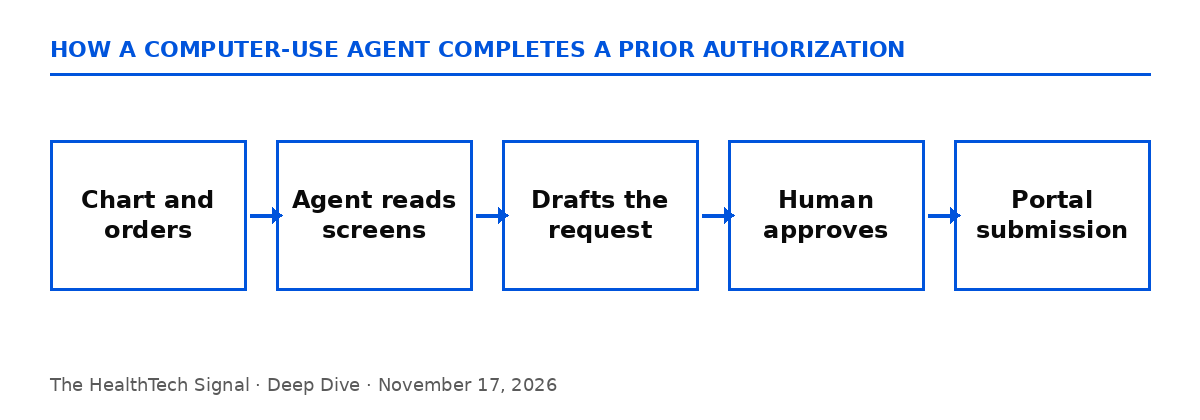
Certainty: (A) all facts in this section are from
The obvious read versus the deeper signal
The obvious read:
The deeper signal: The deeper shift is where the integration burden lives. For twenty years, connecting healthcare systems meant someone, usually the vendor or the government, had to build and mandate an interface. Computer use lets the buyer connect systems on its own terms, without waiting for anyone's API, which moves power toward organizations with strong internal engineering and governance, such as
Certainty: (C) this is our interpretation of the November 16 announcements.
Historical playbook
Healthcare has tried screen-level automation before. Robotic process automation, or RPA, spread through revenue cycle departments in the late 2010s, using scripted bots to log into portals, check claim status and copy fields. It worked well for stable, repetitive screens and broke whenever a portal changed its layout. Many programs stalled because maintaining the bots cost more than expected.
Computer-use agents differ in two ways that matter. They reason about what is on the screen rather than following a fixed script, so a moved button or a new field does not automatically break them, and they can read clinical context, such as visit notes and imaging history, to decide what the request needs. The trade-off is that a reasoning agent can also make a reasoning error, which is why
The other precedent is the shift to cloud EHRs and patient portals, which created the portal explosion in the first place. Each payer, lab and imaging network built its own web front end. Agents are, in a sense, the industry's answer to a problem it created by digitizing in silos.