Some acquisitions are bets. This one reads more like a receipt. 
In this deep dive we explain what transcarotid revascularization is and what the integrated filter adds, how strong the PERFORMANCE III evidence is, how the deal fits the way large MedTech companies are buying, which competitors and clinicians are affected, and where the risks sit. We close with the case that a zero-stroke headline from a single-arm study is not yet a reason to change practice.
Invest early, distribute exclusively, buy after the FDA says yes.
In This Deep Dive
- Why this matters now
- What actually happened
- The obvious read versus the deeper signal
- Category map and taxonomy
- Evidence Ladder
- Regulation, reimbursement and the rules shaping carotid therapy
- Capital flows and bottom-up economics
- The HealthTech Investor's Signal
- Counter-thesis
- Forward Intelligence
- The Bottom Line for MedTech Strategists, Vascular Programs and Device Investors
Why this matters now
Stroke prevention is a large and enduring market.
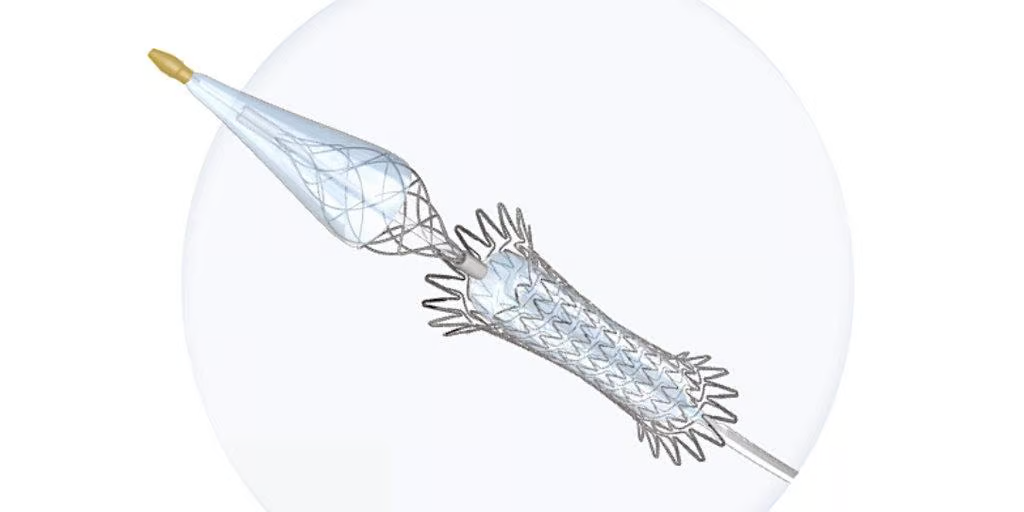
Transcarotid artery revascularization, or TCAR, accesses the carotid artery directly through a small incision in the neck and typically reverses blood flow during stenting so debris is pulled away from the brain. Contego's argument, stated by Cleveland Clinic vascular surgeon Sean Lyden, MD, in its November 10 release, is that transcranial Doppler studies show flow is not always reversed, so microemboli can still reach the brain in some patients. Its system adds a 40-micron filter to the stent delivery system to catch what flow reversal misses.
The deal also matters for the shape of the market. 
Certainty: (A) the 20% figure, device description and Lyden quote are from
What actually happened
- November 10: FDA approval. Contego announced FDA premarket approval of the Neuroguard IEP Direct System and 510(k) clearance of the Neuroguard IEP Embolic Protection System, together providing flow reversal plus an integrated filter via direct transcarotid access, a category it calls TCAR-IEP.
- The pivotal data. Contego reported that PERFORMANCE III showed a 0% stroke rate through 30 days in the intention-to-treat population, with zero heart attacks, cranial nerve injuries, neurological deaths and stent thromboses. The primary endpoint, the 30-day rate of major adverse events, was 0.69% in the intention-to-treat population and 0% per protocol.
- November 16: the acquisition.
- The guidance.
- The people. Ravish Sachar, MD, Contego's founder and CEO, called the deal an exciting next chapter. David Moeller, president of
Certainty: (A) all items are from
The obvious read versus the deeper signal
The obvious read:
The deeper signal: The deeper signal is that
Certainty: (C) this is our interpretation.
Historical playbook
Carotid revascularization has moved in waves. Open surgery, carotid endarterectomy, has long been the standard. Transfemoral carotid stenting, entering through the groin, offered a less invasive option but carried concerns about procedural stroke from debris dislodged on the way to the neck. TCAR emerged as a hybrid that avoids crossing the aortic arch and uses flow reversal to protect the brain, and it has gained ground for patients at higher surgical risk.
Coverage has followed evidence. In 2023, CMS expanded Medicare coverage of carotid stenting, which broadened the population for whom stent-based options can be reimbursed. Device makers responded with approaches aimed at reducing procedural stroke further, which is the space Contego's integrated filter targets.
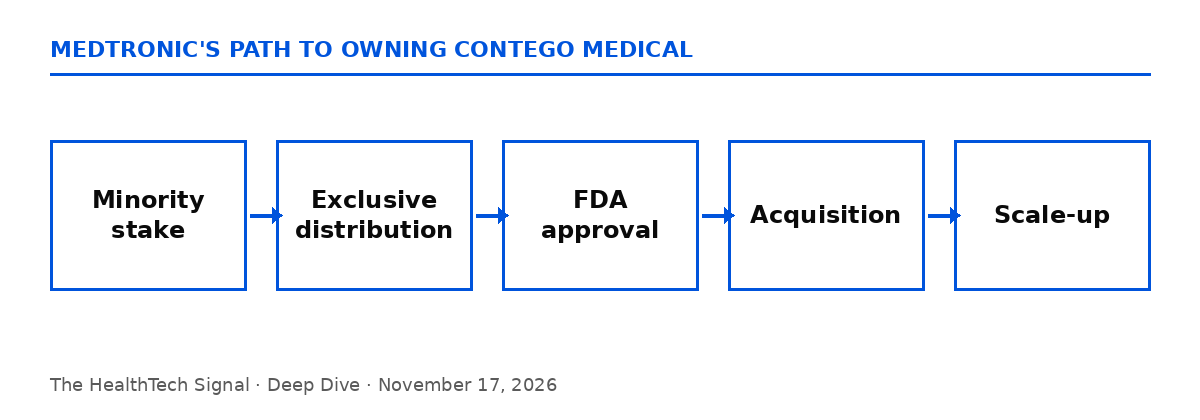
The ownership pattern is also familiar. Large MedTech companies often take minority stakes and distribution rights in promising device makers, then acquire them after a major regulatory milestone. That approach lets the buyer learn the market, test demand through its own sales force and pay once the biggest risk, FDA approval, is gone. Contego's earlier Neuroguard IEP system was approved in October 2024 for transfemoral and transradial stenting and distributed by