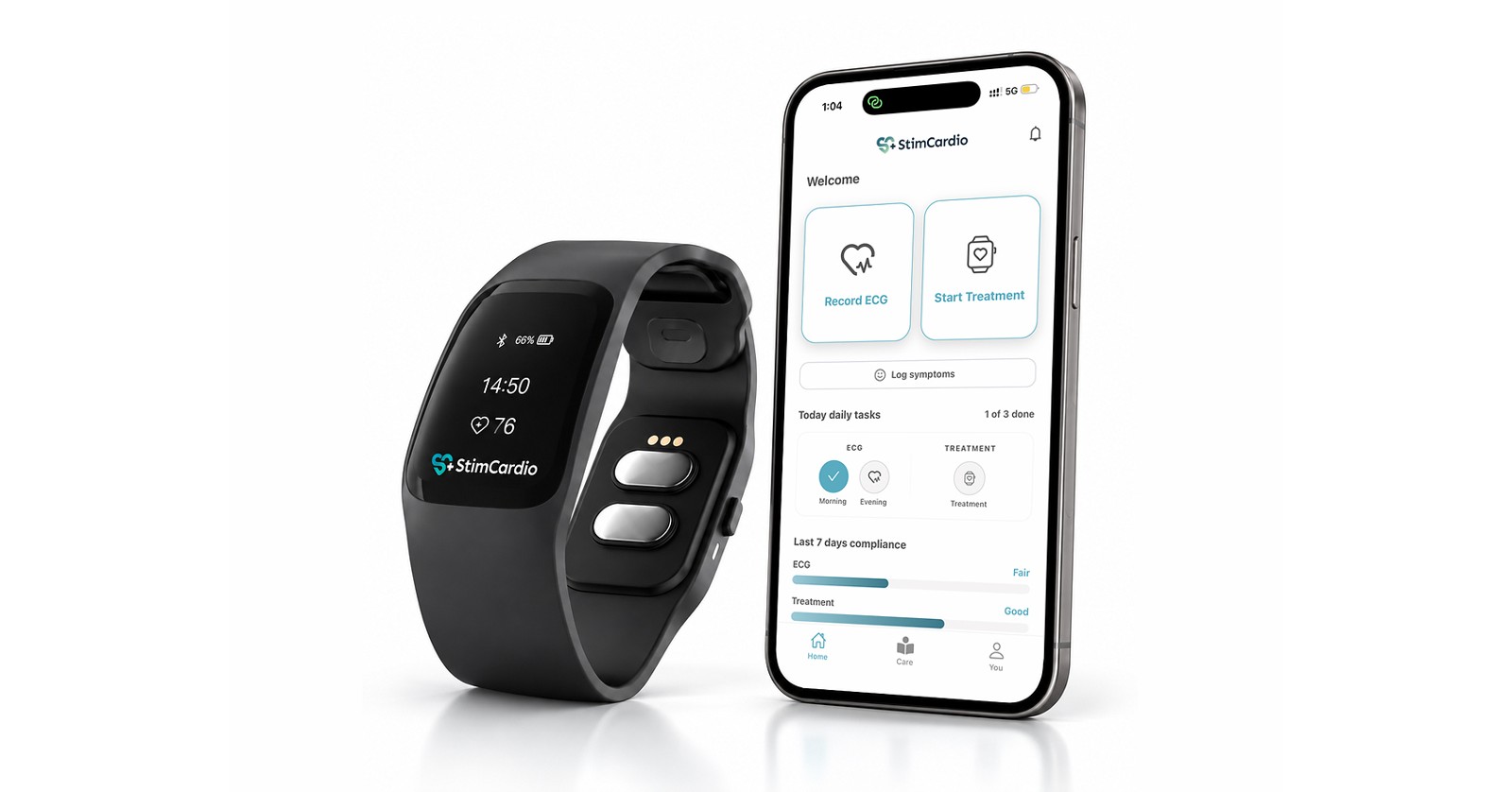
Catheter ablation has expanded the options for atrial fibrillation care. Follow-up remains an important part of that pathway, and StimCardio cites recurrent AF in roughly 30% to 40% of patients after an initial ablation. Its $30M Series A supports testing whether investigational home neuromodulation can contribute to that post-procedure period.
What follows separates the financing from the evidence, maps the adjunct AF field, compares FDA De Novo and EU MDR pathways, and sets out what the pivotal trial has to show before anyone should treat wearable neuromodulation as a category.
Rhyvive aims to extend wearable technology from rhythm monitoring into an investigational therapeutic adjunct.
Why this matters now
Atrial fibrillation care has spent the last three years in an energy-source upgrade cycle. Pulsed field ablation moved from trials to mainstream electrophysiology labs, with Boston Scientific's Farapulse, Medtronic's PulseSelect and Affera systems, and Johnson & Johnson MedTech's Varipulse all competing for share. The procedure got faster and, by most accounts, safer for surrounding tissue. What did not disappear is recurrence. StimCardio's release cites roughly 30% to 40% of patients experiencing recurrent AF after an initial ablation, and the ADVENT randomized trial, which compared pulsed field with thermal ablation, reported one-year treatment success of 73.3% versus 71.3%. A better catheter did not close the gap on its own.
That is the opening StimCardio is betting on. Its $30M Series A, closed October 29 and led by John Slump's family office Metis Medtech, funds NeuroPulse 2, a multicenter pivotal trial of Rhyvive, an investigational wrist-worn device that delivers closed-loop, non-invasive median nerve stimulation after ablation. The pitch is not to replace the procedure. It is to extend treatment beyond the procedure room and into the patient's home, during the weeks when the atrium is most electrically unstable.
Roughly 59 million people live with AF worldwide, according to a 2025 Global Burden of Disease analysis in JACC cited by the company. If even a modest share of ablation patients were prescribed a post-procedure therapy, the category would be meaningful. The question is whether the evidence will hold.
Certainty: (A) financing terms and recurrence figure as stated in the release; (A) ADVENT results as published in NEJM 2023; (B) our read on the post-procedure opportunity.
What actually happened
StimCardio, a clinical-stage company based in Los Angeles, announced the close of an oversubscribed $30M Series A. Metis Medtech led, with Catalyst Health Ventures, multiple corporate strategic investors and other new and existing investors participating. The company said the financing is expected to fund it through NeuroPulse 2 and the preparation of a De Novo submission to the FDA.
"Our vision is to establish non-invasive neuromodulation as a new therapeutic category in cardiac electrophysiology," said Amir Soltanianzadeh, CEO of StimCardio Medical. John Slump, CEO and founder of Metis MedTech and now a StimCardio board member, pointed to AF recurrence as "a significant unmet clinical challenge" despite advances in ablation. Joshua Phillips, managing partner of Catalyst Health Ventures and also a board member, described the approach as targeting a large unmet need with encouraging early evidence. Amos Ziv, MSc, is the company's founder and chief scientific officer.
The evidence base is the NeuroPulse 1 pilot, presented as a late-breaking trial at HRX Live 2026 and described by the company as published in Heart Rhythm, with Vivek Y. Reddy, MD, of Mount Sinai as lead investigator. The company reports a three-center, randomized 1:1, double-blind, sham-controlled study. Seventy-seven patients were randomized and 59 were included in the modified intention-to-treat analysis. In the post-blanking sensitivity analysis, the stimulation arm had 12 recurrent atrial arrhythmia events versus 28 in the sham arm (p = 0.025). Freedom from atrial arrhythmia at six months was 90.0% versus 80.8%, a difference that was not statistically significant. No device-related serious adverse events were reported.
Rhyvive is an investigational device, limited by US law to investigational use. The financing announcement does not establish marketing authorization.
Financing and development plans are from the company release. Trial design and results here are attributed to StimCardio's published clinical research summary; the endpoints are distinguished rather than combined.
The obvious read versus the deeper signal
Obvious read: a wearable startup raises a Series A for an AF gadget.
Deeper signal: experienced electrophysiology investors are supporting investigation of post-procedure care alongside advances in ablation. A prescribable home adjunct, if supported by pivotal evidence and regulatory authorization, could complement established EP workflows.