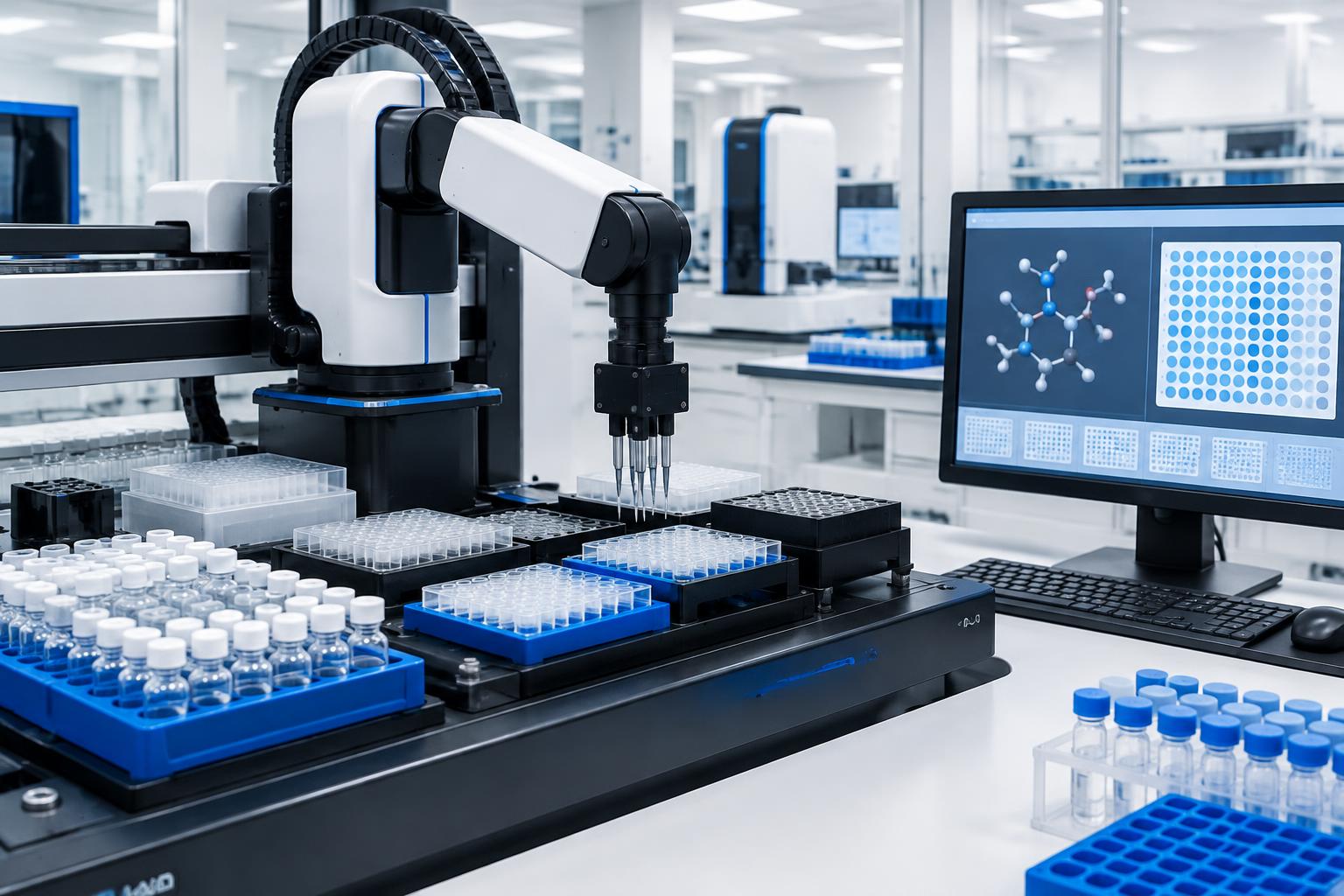
A medicinal chemist at a mid-sized biotech spends most of a year on one question: which of a few thousand possible molecules is worth making, testing and making again. Each round trip through the lab takes weeks. Most of the molecules fail for reasons nobody predicted, such as poor absorption, an unexpected off-target hit, or a liver signal that appears only in animals. The promise of AI drug design has always been to shorten that loop by predicting more of those failures before anyone touches a pipette.
On November 17, Isomorphic Labs raised $5 billion on the strength of that promise. In this deep dive we look at what the company has actually disclosed, how the round compares with the rest of AI drug discovery, why paying for its own trials changes the relationship with pharma partners, what regulators will expect, and which observable milestones will tell investors and partners whether the platform delivers.
Five billion dollars buys compute and chemists. Mostly it buys the right to carry molecules further before handing them to anyone else.
In This Deep Dive
- Why this matters now
- What actually happened
- The obvious read versus the deeper signal
- Category map and taxonomy
- Evidence Ladder
- What FDA, EMA and the MHRA will ask
- Capital flows and bottom-up economics
- The HealthTech Investor's Signal
- Counter-thesis
- Forward Intelligence
- The Bottom Line for Pharma R&D Leaders and Life Sciences Investors
Why this matters now
AI drug discovery has had a decade of strong announcements and a thinner record in the clinic. Several AI-designed molecules have entered human trials, and some have been stopped for lack of efficacy, which is what happens to most drug candidates regardless of how they were found. The field's central claim is therefore not that AI makes drugs that work, but that it makes better candidates faster and fails fewer of them late. That claim can only be tested in trials, and trials are expensive.
Isomorphic's round matters now because it moves the company from a model where pharma partners pay for access to its platform to one where it can afford to develop its own drugs. The release says proceeds will support "scalable AI-first translational and clinical development infrastructure as it advances its drug candidates to clinical trials." That is a different business from licensing molecules at the discovery stage, and it carries different risks.
There is also a market signal. Investors put $5 billion into a company with no disclosed clinical asset, months after a $2.1 billion Series B, according to TechCrunch and BioSpace. The same day, Insight Partners led a $22 million round for Mass General Brigham spinout Aevius, which builds multimodal patient models for care delivery and life sciences. Capital is flowing to AI in biomedicine at every size, but the gap between the largest platform and everyone else has never been wider.
Certainty: (A) round size, investors and use of funds from the Isomorphic release; (A) Series B timing from TechCrunch and BioSpace; (B) interpretation of the business model shift is our read.
What actually happened
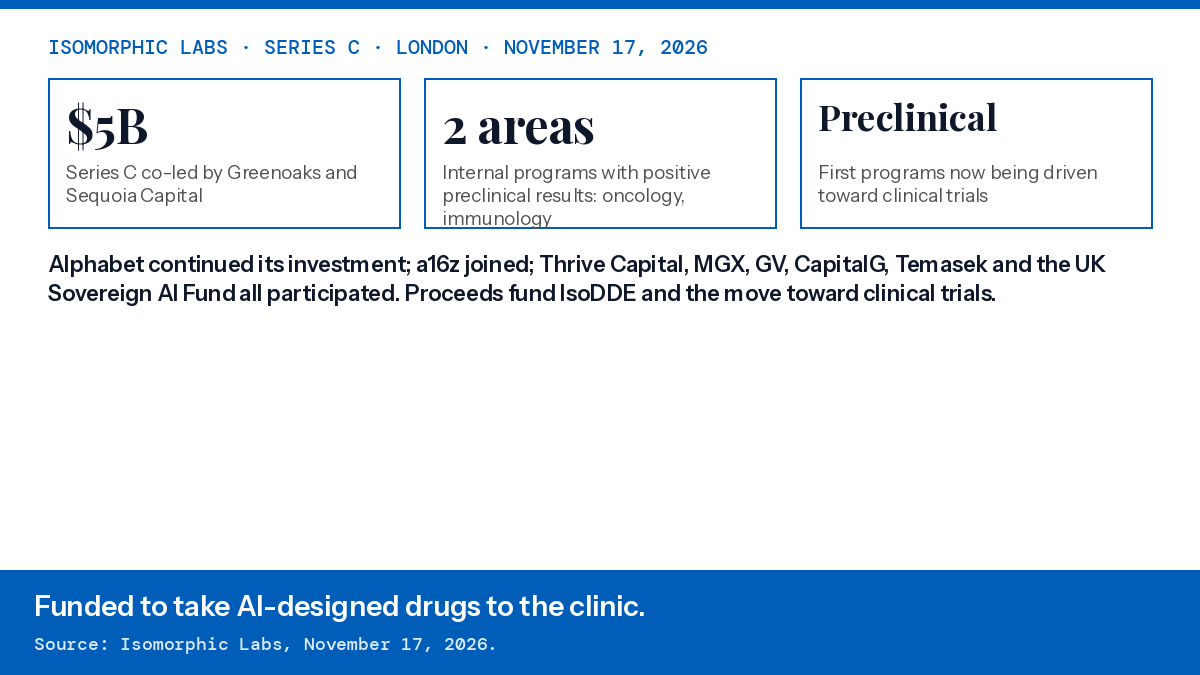
- The round: A $5 billion Series C, announced in London on November 17, co-led by Greenoaks and Sequoia Capital, alongside Andreessen Horowitz and several other new investors. Alphabet continued what the company calls significant investment, and every existing investor participated: Thrive Capital, MGX, GV, CapitalG, Temasek and the UK Sovereign AI Fund. The release calls the round oversubscribed. No valuation was disclosed.
- The engine: Isomorphic describes IsoDDE as a suite of foundational simulation AI models that work across multiple therapeutic areas and drug modalities, combined with "proprietary agents that navigate and reason over highly complex biological systems." It says the models push predictions "towards experimental accuracy."
- The pipeline: The company reports "positive preclinical results" for internal programs in oncology and immunology and with partners, "setting the stage for clinical entry." It has not named a target, a molecule or a planned trial. Publicly announced pharma partners include Eli Lilly and
Novartis, and TechCrunch reports a deal with Johnson & Johnson.
- The people: Sir Demis Hassabis, founder and CEO, said the round enables "driving our first therapeutic programs towards clinical trials to deliver tangible impact for patients." Max Jaderberg, president, said the company is making "repeatable scientific advancements" every week. Neil Mehta of Greenoaks called drug development "an optimization challenge of almost infinite scale," and Konstantine Buhler of Sequoia Capital said the team is translating AI "into a growing portfolio of drug candidates."
- The footprint: Isomorphic was founded in 2021, is headquartered in London, and has offices in Cambridge, Massachusetts and Lausanne, Switzerland, according to the release.
Simulation models
Designed molecules
Preclinical results
Clinical entry
Certainty: (A) every item above is taken from the Isomorphic release of November 17, 2026, except the Johnson & Johnson deal (TechCrunch).
The obvious read versus the deeper signal
The obvious read: AI drug discovery is hot again, a famous founder raised a record round, and the money will mostly go to compute. On this reading, the story is about valuation and hype, and the right response is to wait for the first trial.
The deeper signal: The more important change is structural. Most AI drug discovery companies have depended on upfront fees and milestones from pharma partners, which meant giving away most of the value of any molecule early. A company with $5 billion can hold its own candidates through phase 1 and possibly phase 2, where value per asset rises sharply. That makes Isomorphic less a vendor to pharma and more a competitor that also partners with it. Partners will want to know which targets Isomorphic keeps for itself, and investors will start valuing the company on its pipeline rather than its models.
Certainty: (B) evidence-based interpretation; the partnership terms of individual deals are not public beyond announced headline values.
Historical playbook
Platform biotechs have faced this choice before. Genomics and combinatorial chemistry companies in the 1990s and 2000s often began by selling access to their technology, and the ones that created lasting value were usually those that eventually took their own drugs forward. The lesson is not that platforms fail, but that the market pays for assets, and a platform without owned assets tends to be priced as a service.
The recent AI cycle shows the same pattern. Companies that raised large rounds on discovery claims in the late 2010s were later judged on trial readouts, and several consolidated or narrowed their pipelines when early programs disappointed. AlphaFold changed the field's tools, and the 2024 Nobel Prize in Chemistry recognized Hassabis and John Jumper for that work, but predicting protein structure is one step in a long chain that ends with efficacy and safety in people. Isomorphic's own language reflects that: its release talks about clinical entry, not clinical success.