A portfolio committee at a large drugmaker sits down on a Monday with three oncology programs and room to fund two Phase 2 trials. Each costs years and a large share of the year's development budget. The molecules all looked good in cell lines and mice, the translational team has a favorite, and the evidence that would settle the question only arrives after hundreds of patients have been treated. That is the moment Orakl Oncology wants to sell into.
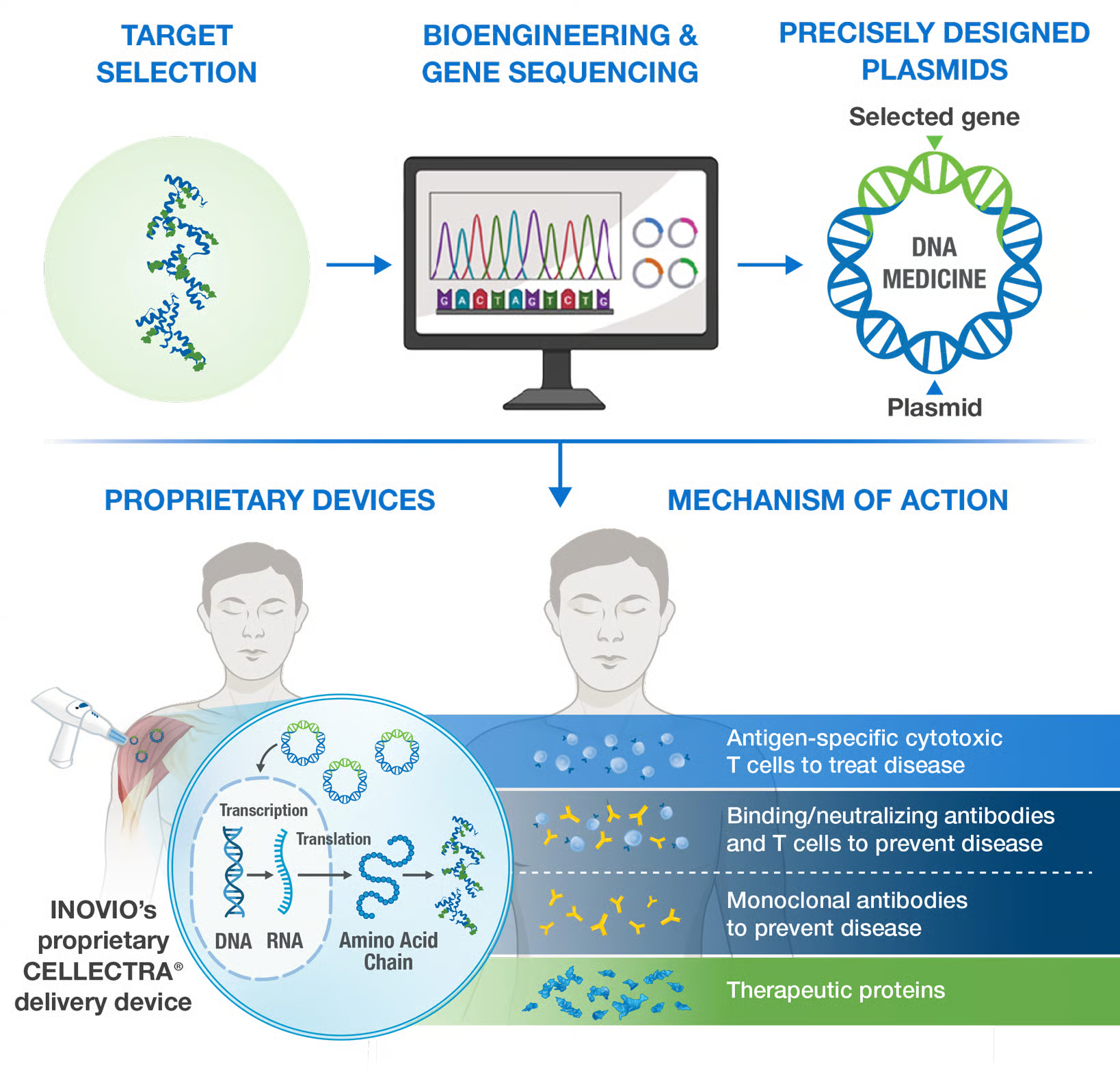
Orakl's pitch is that the missing input is not a better molecule or a bigger model, but a better proxy for the patient. It grows tumors taken from real patients as organoids, tests candidate drugs against them at scale, pairs the results with each patient's clinical history and uses machine learning to forecast how a whole trial arm would perform. On November 12 it raised $34 million to grow that dataset fivefold. What follows is what the evidence shows so far, who else is attacking the same problem, and what would have to be true for a trial forecast to become a line item in pharma budgets.
Most AI in drug discovery helps design the molecule. Orakl is trying to predict the trial. That is a different product, sold to a different buyer, and judged by a much harsher test.
In This Deep Dive
-
Why this matters now
-
What actually happened
-
The obvious read versus the deeper signal
-
Category map and taxonomy
-
Evidence Ladder
-
What regulators have opened up, and what they have not
-
Capital flows and bottom-up economics
-
The HealthTech Investor's Signal
-
Counter-thesis
-
Forward Intelligence
-
The Bottom Line for Biopharma R&D Leaders, Cancer Centers and Life Sciences Investors
Why this matters now
Start with where oncology loses its money. The industry analysis Orakl cites (BIO, Informa Pharma Intelligence and QLS Advisors, covering 2011 to 2020) puts the share of oncology candidates that fail in Phase 2 at around 75%, and Norrsken VC's investment note puts the share of oncology drugs entering clinical development that never reach approval at around 95%. Phase 2 is the first point where efficacy is tested in patients, so it is where weak biology finally shows up, after the expensive manufacturing, toxicology and Phase 1 work is already done.
Second, AI has not yet fixed that stage. Structure prediction and generative chemistry have shortened the path to a candidate molecule, but they say little about whether a tumor in a real patient, with its own mutations, microenvironment and treatment history, will respond. Orakl's own framing is blunt: AI-designed cancer drugs still stumble in Phase 2.
Third, regulators have opened the door to human-relevant models. The FDA Modernization Act 2.0, signed in December 2022, removed the statutory requirement that drugs be tested in animals before human trials and allowed alternatives such as cell-based assays and computer models. In April 2025 the FDA announced a plan to phase out animal testing requirements for monoclonal antibodies and other drugs, naming organoids and AI-based computational models among the methods it wants to encourage. That does not validate any one company's forecasts, but it moves organoid data from a research curiosity toward an accepted form of evidence.
Certainty: (A) failure-rate figures are as cited by Orakl and Norrsken; the 2022 law and the April 2025 FDA plan are matters of public record; (B) the link between these policy moves and demand for organoid-based forecasting is our interpretation.
What actually happened
-
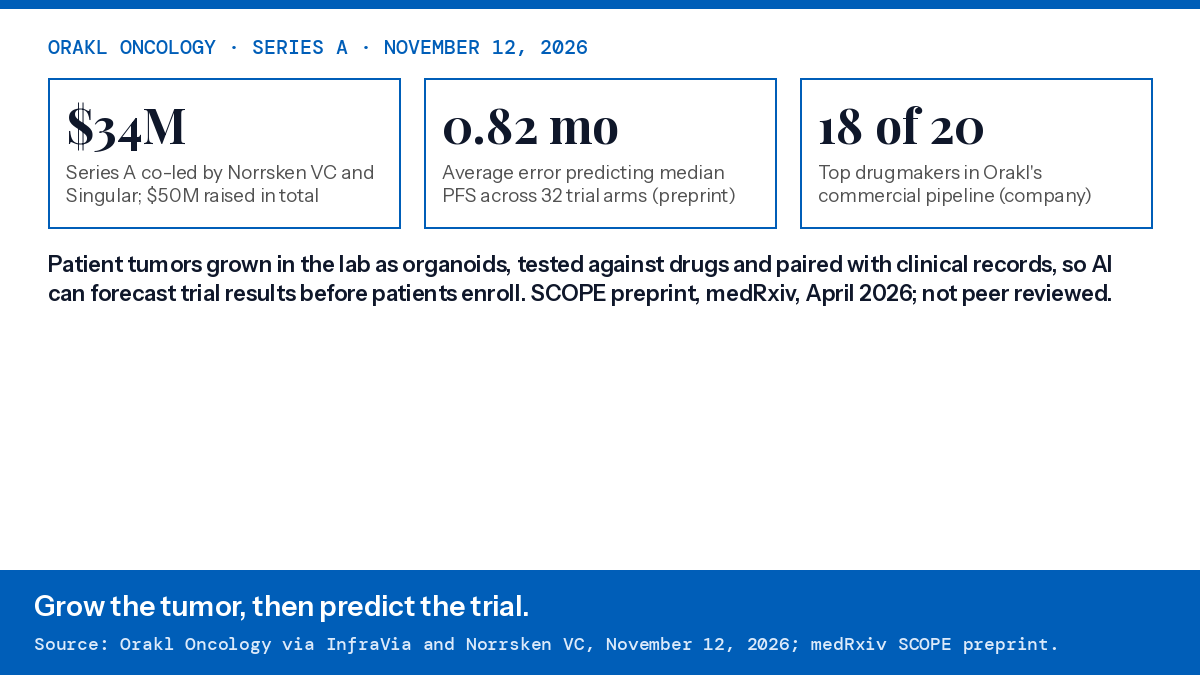
The round: on November 12, 2026, Orakl Oncology announced an oversubscribed $34 million Series A co-led by Norrsken VC and Singular. New investors are InfraVia, Serena, the Patient Autonome Fund managed by Bpifrance, teampact.ventures and Plug and Play; existing investors Verve Ventures, Speedinvest and HCVC returned. Angels include Hugging Face co-founder Thomas Wolf. Total funding is now $50 million. Philip Tagari, insitro's chief scientific officer and a long-time Amgen research leader, joined as an advisor.
-
The platform: Orakl builds what it calls cohorts of virtual cancer patients: real tumors grown in the lab and paired with medical history and deep biological data. Drugs are screened against these organoids, and a model combines the screening signal with a clinical prognosis score to predict outcomes such as median progression-free survival (PFS) and objective response rate (ORR) for a defined trial population.
-
The published evidence: the SCOPE preprint on medRxiv (version 2, April 2026, not peer reviewed) trained on a cohort of patients with matched clinical data and organoid drug screens, then generated synthetic patient profiles from published eligibility criteria and matched them to a biobank of 81 organoid lines. Against 32 arms from 23 published trials in metastatic colorectal and pancreatic cancer, predicted median PFS agreed with reported results with R squared 0.85, a mean absolute error of 0.82 months and Pearson r of 0.92. ORR predictions reached R squared 0.71 with a 7.3 percentage point error. The model picked the better arm in 7 of 8 head-to-head comparisons.
-
A forward-looking call: the preprint says SCOPE, applied before Phase 3 data were available, predicted that daraxonrasib (RMC-6236), a pan-RAS inhibitor, would outperform standard chemotherapy in KRAS-mutant metastatic pancreatic cancer, consistent with emerging trial data. Orakl's announcement describes its engine as 90% accurate in predicting cancer trial outcomes, including predictions that anticipated recent pancreatic cancer results.
-
Commercial traction: just over a year after commercial launch, Orakl says 18 of the world's top 20 pharmaceutical companies are in its pipeline, first engagements are converting into multiyear collaborations across more than 10 drug programs, and more than 15 additional cancer centers in Europe, North America and Asia are negotiating to join its network. In July 2026 it secured exclusive rights to evaluate four undisclosed Sanofi oncology assets; targets and terms were not disclosed.
-
The plan: increase experimental data generation fivefold, add non-small cell lung and gastric cancer to colorectal and pancreatic, build U.S. and UK deployment teams, grow the AI research team in Paris, and extend the platform into identifying and validating new drug targets and combination co-targets.
-
People: Orakl was spun out of Gustave Roussy in 2023 by Fanny Jaulin, PhD (CEO), a cancer biologist whose research career spans Weill Cornell and Memorial Sloan Kettering and who led patient-derived tumor model work at Gustave Roussy; Gustave Ronteix, PhD (CTO), who leads AI and quantitative biology; and Diane-Laure Pagès, PhD (COO), who runs hospital partnerships and operations. The team is more than 40 people, 30% with PhDs.
Certainty: (A) round, investors, plans and traction claims are from the November 12 announcement and investor posts; (A) SCOPE metrics are from the preprint and have not been peer reviewed; the 90% figure and the pipeline counts are company statements we could not independently verify.
The obvious read versus the deeper signal
The obvious read: A well-connected French TechBio raised a solid Series A in a tough biotech funding market, on the back of AI and organoids, two themes investors like.
The deeper signal: The interesting part is the unit of prediction. Orakl is not predicting whether a molecule binds a target or whether one patient responds; it is predicting the summary statistic that decides a trial, such as median PFS for an arm. That makes it a decision tool for capital allocation inside pharma, closer to a forecasting service for portfolio committees than to a discovery platform. The data behind it has to be grown from fresh tissue under hospital agreements, which is slow to copy and gets more valuable with every experiment.
Certainty: (A) arm-level outputs are described in the preprint; (B) the framing as a capital allocation tool is our interpretation.
Historical playbook
Organoids are not new. The modern method traces to 2009, when Hans Clevers' group showed that single intestinal stem cells could grow into self-organizing mini-guts in a dish. Within a decade, academic groups had built living biobanks of patient-derived tumor organoids, and a 2018 study in Science from the Institute of Cancer Research in London reported that organoids from patients with metastatic gastrointestinal cancers mirrored how those patients responded to treatment. The science of patient avatars has been credible for years. What did not exist was a business that turned avatar results into decisions pharma would pay for.
The closer precedent is the patient-derived xenograft era. In the 2010s, contract research organizations sold large panels of human tumors grown in mice as better predictors than cell lines, and many drugmakers adopted them. They improved translational science but did not visibly change Phase 2 success rates, partly because mice lack a human immune system and partly because the models were used to support decisions already made. The lesson for Orakl is that a better model is not enough; the forecast has to be trusted early enough, and by senior enough people, to change which trials get run.