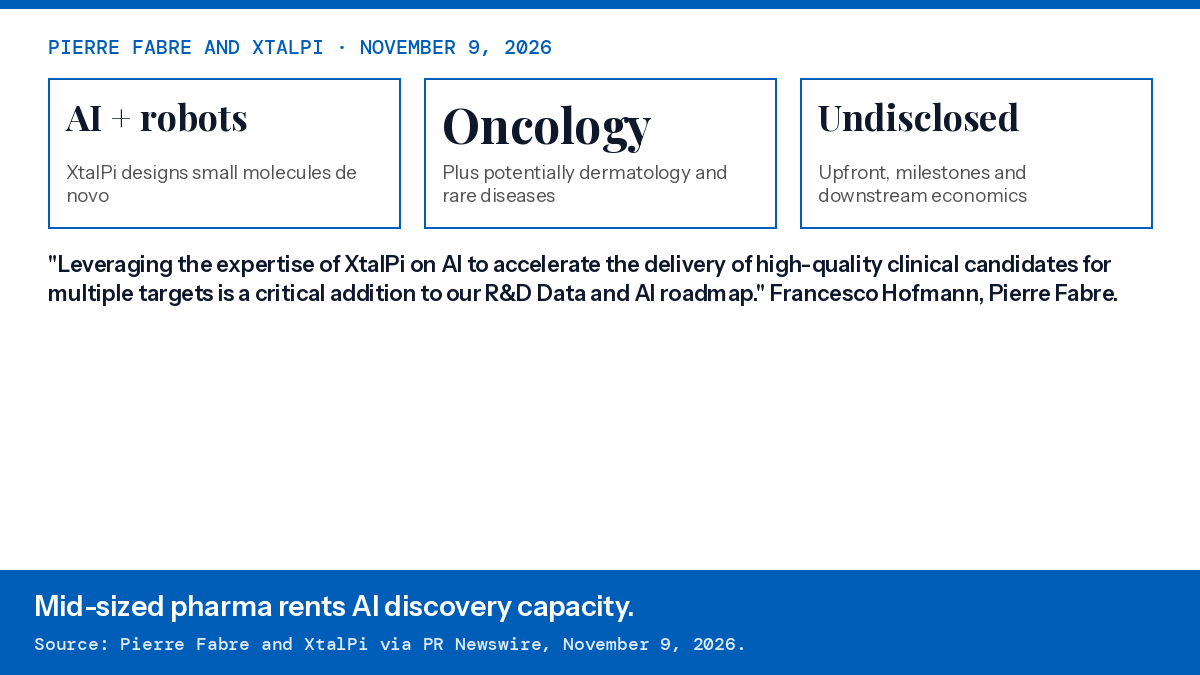
Most AI drug discovery headlines involve the largest pharma companies, a frontier model and a milestone figure in the billions. The November 9 announcement from Castres and Shenzhen is different. Laboratoires Pierre Fabre, a French group whose 2025 revenue was about €3.2 billion and whose pharmaceutical arm brought in about €1.4 billion, signed XtalPi to design new small molecules against targets it did not name, and neither side published a number.
That makes it a useful case study. Mid-sized drugmakers cannot build a proprietary AI discovery stack the way the biggest companies can, and they cannot afford many failed programs. We look at what Pierre Fabre bought, what XtalPi offers that internal chemistry teams do not, what the evidence says about AI-designed molecules so far, and what this deal pattern means for investors in AI-native discovery.
Pierre Fabre is not buying an AI model. It is renting a design-make-test engine for the slowest part of discovery, while keeping the biology, the clinic and the commercial rights.
In This Deep Dive
- Why this matters now
- What actually happened
- The obvious read versus the deeper signal
- Category map and taxonomy
- Evidence Ladder
- Regulation: what changes when AI designs the molecule
- Capital flows and bottom-up economics
- The HealthTech Investor's Signal
- Evidence boundaries
- Forward Intelligence
- The Bottom Line for Pharma R&D Leaders and AI Discovery Investors
Why this matters now
Pierre Fabre's strategy is visible in its numbers. Between 2018 and 2025, oncology rose from 19% to 41% of the pharmaceutical business's revenue, driven by targeted therapies for cancers with rare B-RAF mutations in Europe and, from June 2025, a Chinese marketing authorization in B-RAF-mutated colorectal cancer. Pharmaceutical R&D spending rose 14% in 2025 and represented 13.6% of that business's revenue, with 89% focused on precision oncology.
Pipeline depth is the constraint. The company reported 5 molecules in clinical development and 6 preclinical research programs. For a drugmaker of that size, each new clinical candidate is a significant bet, and the cost and time of getting from target to candidate decide how many bets it can place.
The release frames the work around hard-to-drug targets. If AI and automated chemistry can shorten the path to a candidate on those targets, a mid-sized company can run more programs with the same budget. If they cannot, the collaboration becomes one more external discovery contract.
There is also a portfolio logic. Pierre Fabre's growth has come from targeted therapies for a narrow genetic subgroup, B-RAF-mutated cancers, which is exactly the type of precision oncology where well-defined targets meet difficult chemistry. A company that has already built clinical and commercial capability around biomarker-defined patients can extract more value from each new candidate than a company starting from scratch, which makes faster access to candidates worth more to it.
Certainty: (A) financial and pipeline figures from Pierre Fabre's 2025 results; (B) our interpretation that pipeline depth is the binding constraint for a company of this size.
What actually happened
- Announcement: November 9, 2026, 04:30 ET via PR Newswire, datelined Castres, France and Shenzhen.
- Parties: Laboratoires Pierre Fabre and XtalPi Holdings Limited (2228.HK).
- Scope: Discovery of novel clinical candidates across a number of research programs in oncology, potentially dermatology, and rare diseases, focused on challenging and historically hard-to-drug targets.
- XtalPi's role: Use its integrated AI capabilities and robotics platform to de novo design and deliver novel small molecule therapeutics against undisclosed targets.
- Pierre Fabre's role: Contribute disease biology, discovery, translational research and clinical development expertise to select and advance compounds; responsible for subsequent clinical and commercial development.
- Terms: Upfront payment, multiple milestone payments and downstream economic participation; specific financial terms not disclosed.
- People: Francesco Hofmann, Head of Pharma Research and Development at Laboratoires Pierre Fabre, called it "a critical addition to our R&D Data and AI roadmap and to our discovery engine." Raymond Zheng, Head of Integrated Drug Discovery at XtalPi, said the aim is to "advance promising preclinical candidates to benefit patients with unmet medical needs."
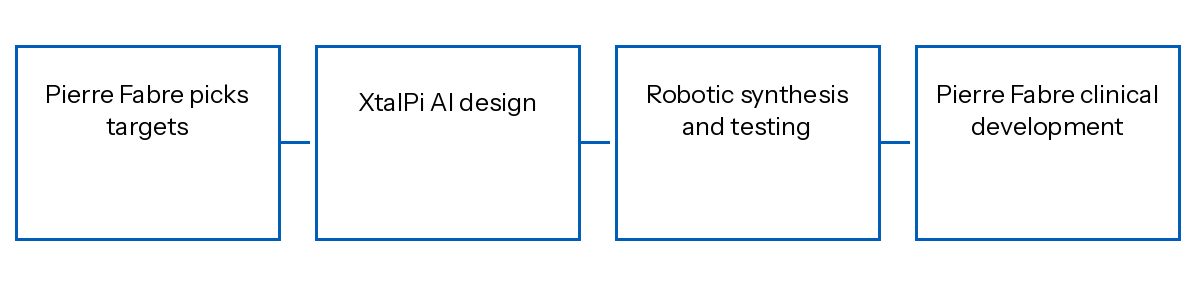
Certainty: (A) all deal facts from the joint release; (B) the four-step flow is our summary of the stated division of roles.
The obvious read versus the deeper signal
The obvious read: another pharma company signed another AI drug discovery partnership.
The deeper signal: the division of labor is the story. Pierre Fabre keeps target selection, translational work, clinical development and commercialization, where its oncology franchise and regulatory experience already earn money. It outsources the iterative design-make-test cycle, which is labor intensive, expensive to build in-house and where XtalPi combines computational design with automated synthesis. Downstream economic participation means XtalPi shares in success rather than being paid only for service. That is a structure aimed at buying throughput without giving away the franchise.
Certainty: (A) division of roles from the release; (B) our reading of why Pierre Fabre chose this structure; (C) actual economics, which are undisclosed.
Historical playbook
XtalPi was founded in 2015 by three MIT physicists and listed on the Hong Kong Stock Exchange in June 2024, the first listing under HKEX's Chapter 18C regime for specialist technology companies. Its best-known deal is with DoveTree, the company founded by Harvard chemist Gregory Verdine. XtalPi says DoveTree paid $51 million upfront in a collaboration valued at up to $5.99 billion, with DoveTree holding global development and commercialization rights to resulting candidates.
Big pharma set the reference terms earlier. In January 2024 Isomorphic Labs announced collaborations with Eli Lilly ($45 million upfront, up to $1.7 billion in milestones) and Novartis ($37.5 million upfront, up to $1.2 billion). Those deals told the market that large companies would pay for AI-led design on chosen targets, with most value contingent on milestones.
Clinical evidence is still early. Insilico Medicine's rentosertib, a TNIK inhibitor discovered with generative AI, reported in Nature Medicine in 2025 a mean forced vital capacity gain of 98.4 mL at 60 mg once daily over 12 weeks in a small phase 2a trial in idiopathic pulmonary fibrosis. Larger trials are needed. Separately, 3billion's primary announcement dated November 10, 2026 describes its DeepLife co-development collaboration combining genomic evidence and virtual cell models.