An oncologist is looking at a patient with hormone receptor-positive metastatic breast cancer whose disease has progressed on first-line therapy. The blood test came back without an ESR1 mutation, which is the marker that most clearly points toward a selective estrogen receptor degrader. So the choice between staying with endocrine therapy and moving to chemotherapy rests on clinical judgment and not much else. That gap, where no actionable mutation exists, is where a large share of real treatment decisions sit.
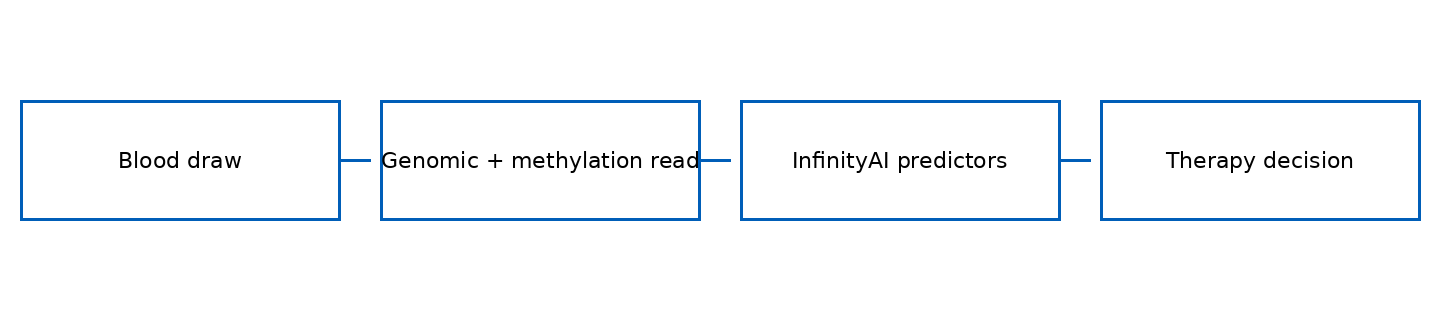
Guardant's November 11 announcement is aimed squarely at that gap. It added five epigenomic applications to Guardant360 Liquid, using methylation patterns in circulating tumor DNA to estimate how a tumor is likely to behave, not just which mutations it carries. The evidence is promising and early, and the business logic is sharper than the headline suggests. Below we cover why this matters now, what actually happened, the obvious read versus the deeper signal, and then, for Signal Plus subscribers, the category map, the Evidence Ladder, regulation and reimbursement, the economics and the evidence boundaries.
A mutation test answers whether there is a target. A methylation read starts to answer what state the tumor is in. That second question is where most treatment decisions without a target actually live.
In This Deep Dive
- Why this matters now
- What actually happened
- The obvious read versus the deeper signal
- Category map and taxonomy
- Evidence Ladder
- Regulation, reimbursement and international divergence: new answers from an existing test
- Capital flows and bottom-up economics
- The HealthTech Investor's Signal
- Evidence boundaries
- Forward Intelligence
- The Bottom Line for Oncology Leaders, Diagnostics Strategists and Life Sciences Investors
Why this matters now
Precision oncology has been built on genomic biomarkers: a mutation, fusion or amplification that matches a drug. That model works well when the marker exists. When it does not, oncologists fall back on tissue tests, clinical features and trial and error. Guardant's release frames the new applications as addressing treatment questions that genomic biomarkers alone may leave unanswered.
Methylation offers a second layer of information from the same sample. Patterns of DNA methylation reflect gene regulation, tissue of origin and, in the case of tumor and immune cells, aspects of the tumor and its microenvironment. Guardant says it is the only platform with genome-wide methylation coverage, a company claim, and it has been building methylation into its screening and therapy selection tests for years.
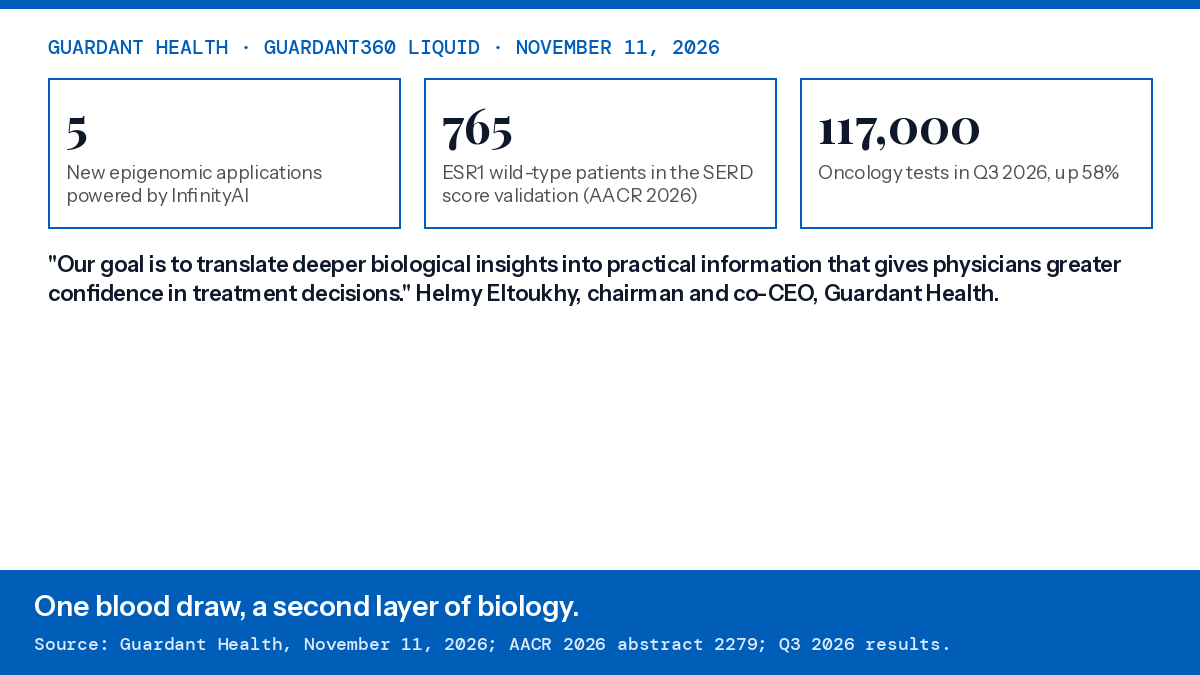
Timing matters for a commercial reason too. Guardant's oncology volume grew 58% in the third quarter to 117,000 tests, and the company raised its 2026 revenue guidance. Adding applications to a test with that much volume is a way to increase the value of each draw without asking oncologists to change how they order.
Certainty: (A) application descriptions, the genome-wide methylation claim (attributed) and Q3 figures are from Guardant releases; (B) the general description of methylation biology is standard background; (B) the commercial interpretation is ours.
What actually happened
- The announcement: on November 11, 2026, Guardant Health announced new applications for Guardant360 Liquid, powered by InfinityAI, which it describes as the smart platform behind its next-generation cancer tests.
- SERD prediction in breast cancer: helps identify patients with HR+/HER2- breast cancer progressing on first-line therapy whose tumors may benefit from SERD therapy, including those without an ESR1 mutation.
- Immunotherapy prediction in lung cancer: estimates likelihood of benefit from immune checkpoint inhibitor monotherapy versus chemoimmunotherapy in advanced NSCLC by combining epigenomic tumor microenvironment characterization with tumor mutational burden and microsatellite instability.
- Blood-based PD-L1 status: epigenomic identification of NSCLC patients who are PD-L1 negative without requiring a tissue sample, to help identify those who may benefit from chemotherapy in addition to immunotherapy.
- ALK fusions and MTAP deletions: Guardant says epigenomic features identify 20% to 45% of ALK fusions and over 250% more MTAP deletions missed by genomic liquid testing alone, the latter relevant to PRMT5 and MAT2A inhibitors in trials.
- The SERD evidence (AACR 2026 abstract 2279): an mHR activity score built from more than 400 informative methylation regions; validated in a real-world ESR1 wild-type cohort of 765 patients from the GuardantINFORM database. mHR-high patients had longer time on SERD therapy (fulvestrant alone or in combination) than mHR-low patients, median 107 vs 89 days, adjusted HR 0.44 (95% CI 0.21 to 0.89). Among mHR-high patients, SERD beat chemotherapy on time to treatment discontinuation (adjusted HR 0.41).
- The immunotherapy evidence (AACR 2026 abstract 100): a MIRS score combining epigenomic signatures, TMB and MSI, trained and tested in 695 advanced NSCLC patients from GuardantINFORM. In the 212-patient test set, MIRS-high patients had longer real-world time on treatment (median 8.7 vs 5.1 months; adjusted HR 0.61) and better overall survival (adjusted HR 0.33). In the ICI monotherapy subgroup (69 patients), median 11.0 vs 4.9 months. No association with outcomes on chemotherapy alone.
- Who said what: Helmy Eltoukhy, PhD, who co-founded Guardant in 2012 and is chairman and co-CEO, said the goal is to translate deeper biological insights into practical information that gives physicians greater confidence in treatment decisions.
Certainty: (A) application descriptions from the November 11 release; (A) abstract figures from the Cancer Research AACR 2026 supplement. The release does not cite the abstracts directly; we link them because they describe the same two predictors and are by Guardant authors. The release does not state the regulatory status of the new applications.
The obvious read versus the deeper signal
The obvious read: Guardant adds features to its blood test ahead of the San Antonio Breast Cancer Symposium.
The deeper signal: Guardant is changing what one test is worth. A liquid biopsy that only reports mutations is a commodity under price pressure. A liquid biopsy that also reports tumor state, immune context and additional actionable alterations becomes a decision platform, and its real-world database becomes more valuable to pharma partners designing trials around those states. The applications also reduce dependence on tissue for questions like PD-L1 status, which matters for patients where tissue is scarce or slow.
Certainty: (A) the tissue-free PD-L1 claim from the release; (B) the commoditization and platform interpretation is ours.
Historical playbook
The history of companion diagnostics is a history of tests becoming more valuable as drugs attach to them. Guardant360 CDx's role as a companion diagnostic for ESR1 testing alongside elacestrant, approved in 2023 for ESR1-mutated advanced breast cancer, is a recent example: a drug approval turned a biomarker report into a required step in care. Methylation predictors are a different model. They do not attach to one drug; they aim to sort patients between treatment strategies.
Tumor mutational burden is a cautionary precedent. It became a tumor-agnostic biomarker for immunotherapy after a 2020 FDA approval tied to tissue testing, but its performance as a predictor has been debated, and cutoffs vary by tumor type. Guardant's MIRS score explicitly combines TMB and MSI with epigenomic features because each alone has limitations. The lesson is that composite scores can outperform single markers in retrospective data, but adoption depends on prospective validation and clear cutoffs that clinicians trust.