Drug redevelopment brings existing clinical evidence into a new development program. The acquired portfolio includes an enzyme evaluated in a completed Phase 2b trial and two related follow-on approaches.
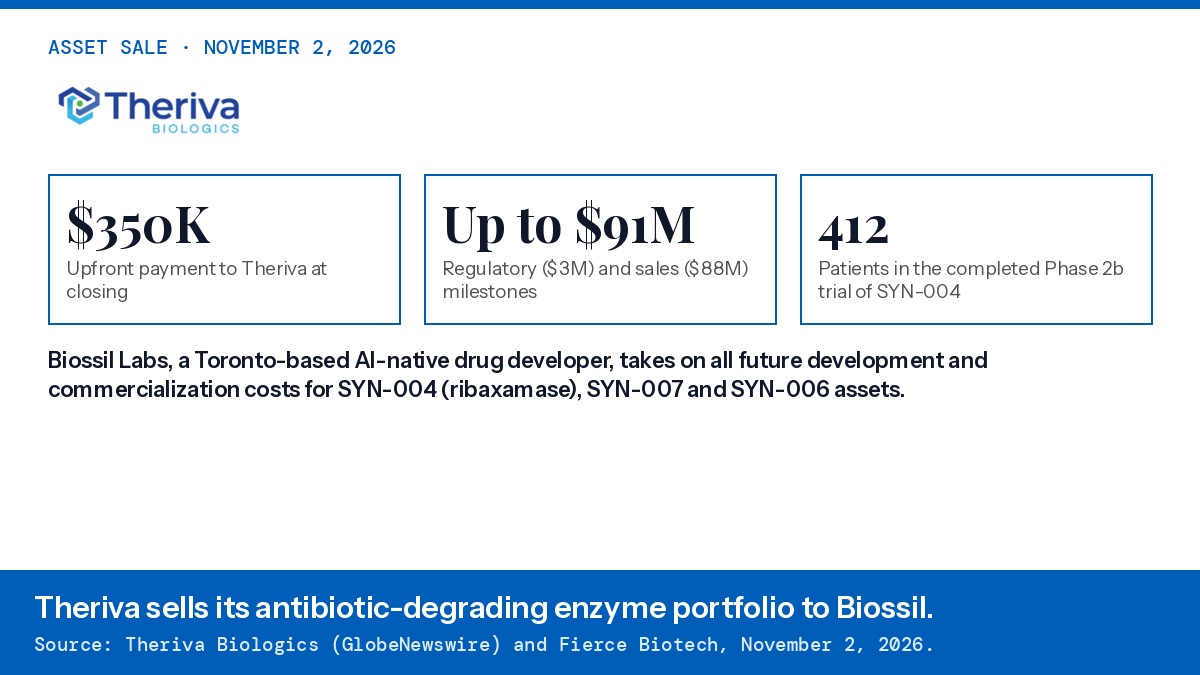
Biossil Labs is pursuing acquired drug candidates. On November 2, Theriva Biologics announced it had sold Biossil its portfolio of antibiotic-degrading enzymes, led by SYN-004 (ribaxamase), for $350,000 upfront and up to $91 million in milestones. Biossil describes its approach as AI-native drug development. Below we look at the asset and the science, the deal and why it is structured the way it is, how Biossil's model compares with other ways of rescuing shelved drugs, and the next clinical and commercial development steps.
A $350,000 upfront payment buys a Phase 2b asset, a registered transplant study and two preclinical follow-ons. Biossil takes responsibility for future development, with Theriva participating in milestones and royalties.
In This Deep Dive
- Why this matters now
- What actually happened
- The obvious read versus the deeper signal
- Category map and taxonomy
- Evidence Ladder
- Regulation, payment and international divergence
- Capital flows and bottom-up economics
- The HealthTech Investor's Signal
- Implementation priorities
- Forward Intelligence
- The Bottom Line
Why this matters now
The transaction allows Theriva to focus on VCN-01 while Biossil takes responsibility for further development of the antibiotic-degrading enzyme portfolio.
Biossil describes its approach as AI-native selection and redevelopment of acquired drug candidates. This description identifies a development strategy, not an independent clinical outcome.
The medical problem is real. Antibiotics save lives, but they also damage the gut microbiome. That damage can open the way to Clostridioides difficile infection and to colonization by resistant organisms such as vancomycin-resistant Enterococcus. Patients receiving intensive antibiotic courses, including those undergoing stem cell transplants, are especially exposed. A drug that protects the gut during antibiotic treatment addresses a gap that existing practice does not close.
Certainty: (A) Theriva's deprioritization and Biossil's history as reported by Fierce Biotech; (B) the clinical framing of antibiotic-associated gut damage is general medical knowledge.
What actually happened
Theriva Biologics, based in Maryland, announced the sale on November 2 via GlobeNewswire. Its filing indicates the transaction closed on October 30.
The assets
- SYN-004 (ribaxamase): an enzyme designed to degrade certain IV beta-lactam antibiotics in the gut, so the antibiotic treats the infection elsewhere in the body without destroying gut bacteria. It completed a Phase 2b trial in 412 patients receiving IV ceftriaxone for lower respiratory tract infection. The trial, published by Kokai-Kun and colleagues in Lancet Infectious Diseases in 2019, evaluated C. difficile infection through four weeks after antibiotic treatment. It reported two cases (1.0%) with ribaxamase and seven (3.4%) with placebo, with a one-sided p value of 0.045. The small event count and confidence interval require careful interpretation. Microbiome preservation was evaluated separately.
- Transplant study: a Phase 1b/2a trial at Washington University School of Medicine (NCT04692181) in allogeneic hematopoietic cell transplant recipients, planned for up to 36 participants. Two of three cohorts were completed before Theriva paused enrollment. Biossil will continue the study; the third cohort involves cefepime.
- SYN-007: an oral reformulation of ribaxamase intended for use with oral beta-lactams, with proof-of-concept in dogs given amoxicillin.
- SYN-006: a carbapenemase designed to degrade carbapenem antibiotics, tested in a pig model with ertapenem.
The terms
- $350,000 upfront.
- Up to $3 million in regulatory milestones.
- Up to $88 million in sales-threshold milestones.
- Low single-digit royalties, capped at $250 million.
- Biossil assumes all future development and commercialization costs.
What they said
Biossil's chief scientific officer, Dr. Alexander I. Mosa, said in the release: "Gut dysbiosis, antibiotic-resistant colonization and opportunistic infections in vulnerable patients represent important unmet needs that recommend we advance this portfolio of antibiotic-degrading enzymes with rigor and equipoise." Theriva, led by CEO Steven A. Shallcross, said the sale lets it focus on VCN-01.
Certainty: (A) assets, trial facts and terms from Theriva's release, its filing summary and Fierce Biotech; (A) the 2019 Phase 2b publication; (B) the closing date relies on a filing summary aggregator.
The obvious read versus the deeper signal
The obvious read: Theriva and Biossil agreed a portfolio transfer. Biossil assumes future development costs, while Theriva retains milestone and royalty participation.
The deeper signal: look at the structure. The upfront payment is tiny relative to the potential milestones and royalties. Nearly all the value Theriva can receive depends on Biossil succeeding. That is a buyer-friendly deal, and it tells us how the market priced this program: as an option, not a near-term product. For Biossil, the logic is a portfolio. Pay little for each asset, take on development costs only where the analysis says the odds are better than the seller thought, and accept that most options will expire.
The transaction gives Biossil responsibility for development and commercialization, while Theriva retains participation through contingent milestones and royalties. Future product-specific trial results and development plans will inform assessment of the portfolio.
The important caveat is that "AI-native" describes the buyer's method, not a proven result. The acquired enzyme portfolio remains investigational. The model's success will be measured in trial outcomes, not in deal count.
Certainty: (A) deal structure; (B) our reading of portfolio logic and Biossil's strategy; (C) whether AI-led selection improves success rates.