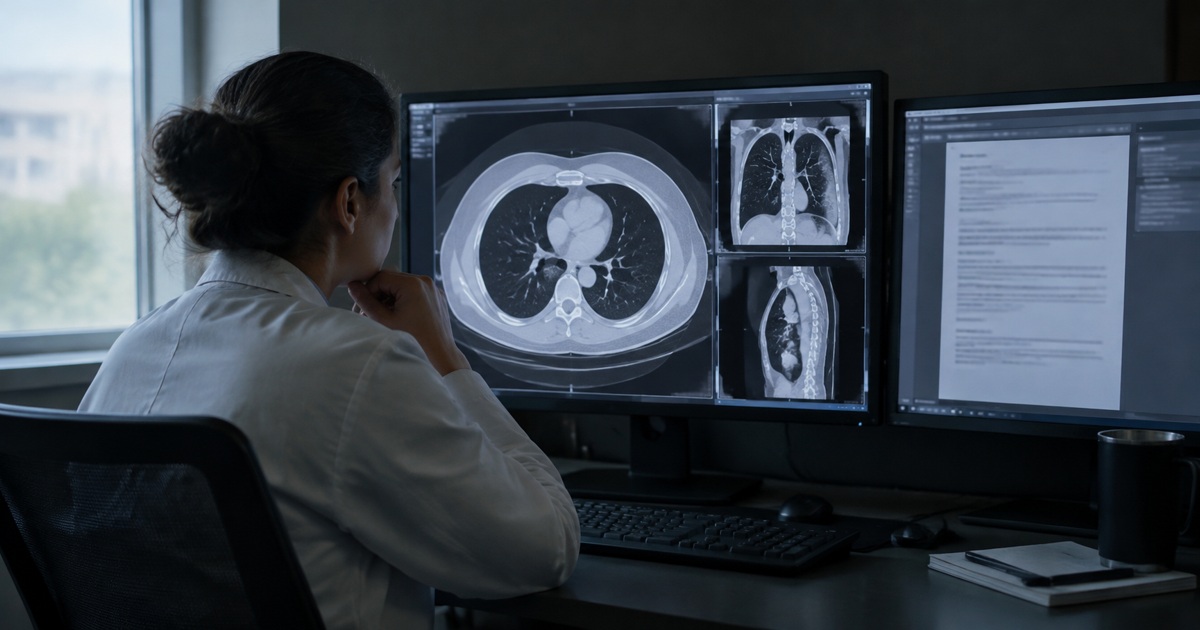
A pathologist grading a breast tumour has to count dividing cells in the most active part of the slide. She scans for the hotspot, counts by eye, and the number feeds the grade that shapes treatment. Ask two experienced pathologists to count the same slide and they can disagree, sometimes widely. It is slow, tiring work, and it matters.
On November 25, Histofy said its MitPro software won CE marking under the EU In Vitro Diagnostic Regulation (IVDR) for exactly this task, across seven tumour types. It is a narrow tool with a broad lesson: in pathology AI, the companies that clear Europe's strictest diagnostic rules with clinical evidence are setting the terms for everyone else.
Mitosis counting is the kind of task AI should own: repetitive, measurable and variable between humans. The hard part is proving it to regulators, not to engineers.
In This Deep Dive
- Why this matters now
- What actually happened
- The obvious read versus the deeper signal
- Historical playbook
- The world forming around certified pathology AI
- Category map and taxonomy
- Evidence Ladder
- Regulation: what IVDR demands
- Capital flows and bottom-up economics
- The HealthTech Investor's Signal
- Counter-thesis
- Forward Intelligence
- The Bottom Line for Pathology Leaders and Investors
Why this matters now
Pathology departments face rising workloads, and digital pathology is spreading as labs replace microscopes with scanners. Once slides are digital, tasks such as mitosis counting become candidates for AI. Histofy says manual counts are time-consuming and known to vary between pathologists, which can strain services and delay treatment planning.
Regulation is the other driver. The IVDR replaced the EU's older diagnostics directive and applies stricter rules on clinical evidence and notified body review. Its transition periods were extended in 2024, but the direction is fixed: pathology AI sold for clinical use in Europe needs IVDR conformity, and many vendors are still working through it.
Tier A (fact) for the CE mark, indications and study as stated by Histofy, and for the regulations cited. Tier B (interpretation) for the competitive implications.
What actually happened
- The clearance: MitPro achieved CE marking under the EU IVDR, allowing clinical use across Europe for seven tumour types, according to Histofy.
- The function: MitPro identifies and counts dividing cells on digital images of tissue and highlights the three areas with the highest counts, so pathologists can focus where it matters.
- The evidence: In a clinical study involving 13 pathologists across three centres, average time for mitosis assessment fell by more than half, from nearly five minutes to just over two, while consistency between pathologists improved significantly, the company says.
- The oversight: Pathologists remain in control and can review, adjust and verify the AI's results before their final assessment.
- The people: Professor Nasir Rajpoot, CEO and chief scientific officer, called the CE mark a major milestone. Professor David Snead, chief medical officer, said pathologists now have a practical solution for mitotic counting across a range of tumours. Dr Simon Graham is chief technology officer.
Digital slide
AI detects and counts mitoses
Top three hotspots highlighted
Pathologist verifies and grades
Tier A (fact) as stated by Histofy. Study results are company-reported; a peer-reviewed publication was not cited.
The obvious read versus the deeper signal
The obvious read: A UK pathology AI start-up won a European regulatory approval for one task.
The deeper signal: Multi-tumour indications under IVDR are hard to win, and they turn one product into a reusable building block. A lab that adopts MitPro for breast grading can use the same tool for six other tumour types, which raises switching costs. Paired with marketplace distribution through PathAI and partnerships in drug development, Histofy is building a portfolio of narrow, certified tools rather than one general model.
Tier B (interpretation).
Historical playbook
Mitotic counting has been part of tumour grading for decades, from breast cancer grading systems to sarcoma and neuroendocrine tumour classifications. It has also long been a known source of variability, which is why it was among the first tasks researchers tried to automate once slides could be digitised.
Digital pathology adoption has followed a familiar arc: early scanners and research tools, then validated primary diagnosis on screens, then AI for specific tasks such as cancer detection, grading support and biomarker scoring. The bottleneck has shifted from technology to regulation, integration and payment.
Histofy's own path reflects that. Before this clearance, it signed a contract with the West Midlands Secure Data Environment in February 2026 to deliver AI-ready histology data, joined the PathAI marketplace for AISight Dx in October, and launched Provantis Compose with Instem on November 17 for AI-assisted nonclinical study reporting.
The world forming around certified pathology AI
Pathology AI now has three layers. Scanner and image-management vendors own the digital slide workflow. Platforms and marketplaces, such as PathAI's AISight Dx, let labs buy third-party algorithms through one integration. Algorithm developers such as Histofy build specific certified tools and rely on those channels to reach labs.
Larger, broader AI companies are also moving in. Harrison.ai, best known for radiology, said its February 2025 Series C of US$112 million would accelerate both radiology and pathology products. As general models improve, narrow certified tools will need to show that certification and clinical evidence are worth paying for.