A medicinal chemist with a hard target used to spend months making and testing compounds before knowing whether a series was worth pursuing. At six of the world's 20 largest drugmakers, some of that work now starts with a request to a model, billed by usage. That is the business Boltz described on November 18 when it announced a $110 million Series A, and it looks very different from the deal MSD signed with Isomorphic Labs the next day.
Both companies sell AI for molecular design to big pharma. One meters access to models that any scientist can call. The other takes on a single target, designs molecules for it and earns milestones and royalties if they succeed. Below we look at what each announced, how the models compare, what regulators have said about AI in drug development, and what buyers and investors should measure before deciding which approach captures more of the value.
The round raises a pricing argument: should AI drug design be paid like software, or like a partner in the molecule?
In This Deep Dive
- Why this matters now
- What actually happened
- The obvious read versus the deeper signal
- Category map and taxonomy
- Evidence Ladder
- Regulation: what FDA and EMA have said about AI in drug development
- Capital flows and bottom-up economics
- The HealthTech Investor's Signal
- Counter-thesis
- Forward Intelligence
- The Bottom Line for Pharma R&D Leaders and Bio-Compute Investors
Why this matters now
The money in AI drug design has grown fast. Isomorphic announced a $5 billion Series C on November 17, which BioSpace reported as the largest single venture round in biotech. Insilico said in its November 13 exchange filing that it signed collaborations worth $7.3 billion in the first half of 2026. Genomics and Vertex extended a target discovery deal on November 18. Boltz's round is smaller, but it is the clearest public example of the metered model, and it arrived the same week.
The question is no longer whether pharma will pay for AI design. It is how. A per-use price rewards the vendor for adoption and leaves the upside of any molecule with the drugmaker. A milestone and royalty structure rewards the designer only if a molecule progresses. Which one wins will shape margins, valuations and which companies get bought.
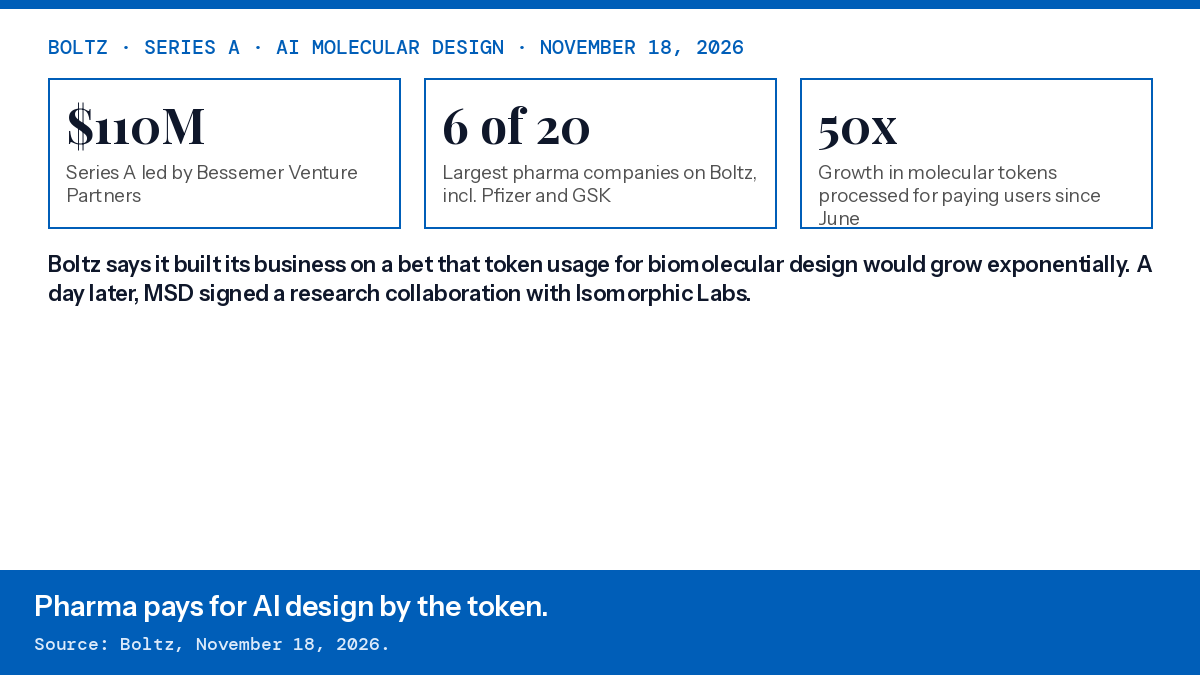
There is also a practical reason now. Boltz says it has partnerships with six of the 20 largest pharma companies and that paid usage has grown 50-fold since June. If that usage keeps growing, pricing power and data access become the competitive questions, not just model accuracy.
What actually happened
- Boltz's round. On November 18, Boltz announced $110 million in Series A funding led by Bessemer Venture Partners. Existing investors Andreessen Horowitz, Amplify Partners, Zetta Venture Partners and Obvious Ventures participated, with Greycroft, F-Prime Capital, Hummingbird and
Benchling joining. Bessemer partners Andrew Hedin and Byron Deeter join the company's journey, Boltz says.
- Boltz's product and traction. Boltz Lab launched in January to give any scientist or AI agent access to its models. BoltzMol-1 (small molecules) and BoltzProt-1 (proteins) were released in June. Boltz says it found small-molecule hits and designed protein binders for a majority of the challenging targets it pursued, and that molecular token volume for paying users grew 50-fold since June. Customers named include
Pfizer,
GSK, Takeda and BMS.
- The team. Bessemer says CEO Gabriele Corso, CTO Jeremy Wohlwend and Head of Research Saro Passaro were among the core developers of the open-source models from Professor Regina Barzilay's lab at MIT, that the open models have more than 5 million downloads, and that they are used by more than 100,000 scientists. Boltz says the team has grown to 40.
- MSD and Isomorphic. On November 19, MSD and
Isomorphic Labs announced a collaboration to discover small molecule candidates against an oncology target. Isomorphic performs in silico predictions with its drug design engine, IsoDDE, using select proprietary MSD data sets; MSD handles preclinical and clinical development, manufacturing and commercialization. Isomorphic receives an upfront payment, milestones and tiered royalties, and an option to co-fund development for elevated royalties.
- The people at MSD and Isomorphic. George Addona, senior vice president and head of discovery, preclinical development and translational medicine at MSD Research Laboratories, said wet-lab and dry-lab coordination is the key. Sarah Skerratt, chief research officer at Isomorphic, announced it for Isomorphic, which is led by CEO Sir Demis Hassabis and President Max Jaderberg.

The obvious read versus the deeper signal
The obvious read: Another big AI drug discovery round, and another pharma partnership. The sector is hot.
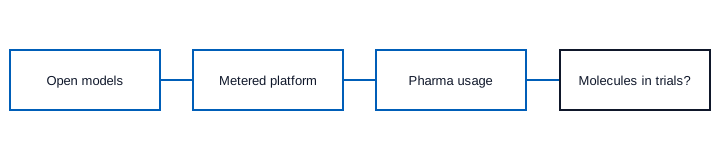
The deeper signal: The deeper signal is that two pricing models are being validated at once. Boltz is betting that molecular design becomes a utility, like cloud computing, where value accrues to the platform with the most usage and the best models. Isomorphic is betting that design is scarce enough to command a share of each molecule's future value. Pharma is paying for both, which suggests buyers want broad, cheap access for routine design and bespoke partners for their hardest targets. If that split holds, the metered vendors face price pressure as models improve and open alternatives spread, while the royalty partners face the slower, binary test of clinical success.
Historical playbook
Software has seen this argument before. In bioinformatics and computational chemistry, tools that started as academic open-source code often became commercial platforms by adding hosted access, support and proprietary versions, while the open versions kept pricing honest. Boltz's path, from open models to a hosted, metered platform with proprietary models, follows that pattern. The lesson is that open distribution builds trust and usage quickly, but the paid layer has to stay meaningfully better.
The partnership model has its own record. Isomorphic announced deals with Eli Lilly and Novartis in January 2024, and
XtalPi, Insilico and Genomics have all signed milestone-heavy collaborations in which most of the headline value depends on future progress. Headline values in these deals are mostly contingent; the upfront payments, where disclosed, are much smaller. Buyers and investors have learned to read the upfront and the royalty rate, not the biobucks.